107. Starting a Sport in Midlife as a Beginner, with Cortnee White
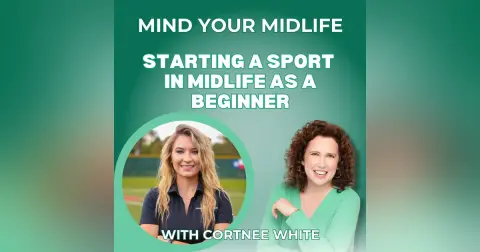


Quick Summary: Cheryl talks with Cortnee White, a sports therapist, mental performance coach, and owner of The Athlete Mind, about the mindset side of starting a sport in midlife. You’ll learn why being a beginner feels so vulnerable, how to get better without making your hobby feel like work, and how to choose a “mind stance” that helps you enjoy the game whether you win or lose.
Intro:
Maybe it’s pickleball, golf, tennis, or a running club. Starting a sport as a hobby in midlife is good for us. But it can bring up a lot between our ears: comparing ourselves to other people, getting frustrated with ourselves, and feeling like a beginner when we’re good at so many other things.
In this episode, I welcome Cortnee White, a sports therapist, mental performance coach, and the owner of The Athlete Mind. Cortnee has been an athlete her whole life, from youth sports to NCAA to fitness competitions and even women’s arena tackle football. Today she helps athletes from kids to pros understand how their mind, body, and behavior work together under pressure. We talk about why competition feels so uncomfortable for some of us, her “no zero” approach to practice, a simple way to handle frustration, and the three mind stances she teaches her athletes.
What You’ll Learn:
✔ The Beginner Challenge: Why trying something new in midlife feels so vulnerable, and why you get to decide what this sport means to you
✔ The “No Zero” Approach: How small, focused practice (even five minutes) builds momentum without turning your hobby into a chore
✔ Catch It, Disrupt It, Redirect It: A simple method for handling frustration on the course or court, plus Cortnee’s three mind stances: the Challenger, the Anchor, and the Appreciator
Links & Resources:
- Cortnee’s website: theathletemind.com
- The Athlete Mind on Instagram: @theathlete_mind
- This episode’s sponsor, Barre3 Arlington. Your first class is free, and listeners get $10 off a class package with code ARLMINDYOURMIDLIFE. Located in Ballston, Arlington, Virginia.
- Connect with Cheryl: @cherylpfischer on Instagram, LinkedIn, and Facebook
- Enjoying the show? Leave a five-star rating and review on Apple Podcasts
Frequently Asked Questions:
Why is it so hard to be a beginner at a sport in midlife?
Cortnee says that by midlife we’ve become competent in many areas, like work and raising children. Starting something new asks us to not be good at something, which feels vulnerable and leads to comparison.
What if I don’t like competition?
Cortnee says competition asks you to take risks and step into uncertainty, so it can feel uncomfortable. Sometimes there’s a story behind that feeling. Other times competition is just unfamiliar, and anything unfamiliar feels uncomfortable.
How can I get better at golf or pickleball without practicing all the time?
Cortnee says there’s plenty of room between practicing seriously and not improving at all. She uses a “no zero” approach. On a busy day, five focused minutes on one thing, like your putting setup, still counts and keeps your momentum going.
How do I handle frustration when I’m playing a sport?
Cortnee teaches “catch it, disrupt it, redirect it.” First, notice and name what’s happening (“I’m starting to rush”). Next, do something physical to release the energy, like gripping and releasing your hands. Then ask yourself what one thing you can control next.
What is a mind stance in sports?
A mind stance is a mental stance you choose before you play and come back to, the same way you return to your physical stance. Cortnee teaches three: the Challenger takes on the challenge, the Anchor stays steady through the storm, and the Appreciator focuses on joy and meaning.
Do I have to be good at a sport for it to be worth doing?
No. Cortnee’s main takeaway is that you don’t have to be good at something for it to be good for you. Trying, being courageous, and tolerating the vulnerability of being a beginner are what’s worth focusing on.
Episode Chapters:
00:00:00 - Midlife Sports And Mindset Setup
00:04:19 - Why Starting Feels Hard
00:08:31 - Competition And Identity Stories
00:15:20 - Practice Without All Or Nothing
00:21:12 - Frustration Reset Toolkit
00:26:42 - Three Mind Stances For Athletes
00:35:54 - Key Takeaway And Listener Actions
Music: Cartwheels by Good News Tunes, licensed by Premium Beats. YouTube ID: NOYTHM5TOK62B7JY
Why This Episode Matters:
When you let go of having to be good at something, you free yourself to enjoy the game, move your body, and grow in confidence. In Cheryl’s words: do the thing to enjoy the thing.
Take a little bit better care of yourself in midlife.
Barre3 is a guided fitness practice, offering classes that combine strength, cardio, and mindfulness
Disclaimer: This post contains affiliate links. If you make a purchase, I may receive a commission at no extra cost to you.
🌸 Liked this episode? Share it with fellow Gen X women navigating hormone balance, an empty nest, and/or self-confidence!
🫶 Love this show? Leave a review to help more women over 50 find us.
💡Want menopause advice, mindset shifts, or support with midlife transformation?
- Find out more about the Midlife Recharge at cherylpfischer.com/recharge
Let’s talk health after 50, self-talk, and redefining aging for women — without the “midlife crisis” narrative. Every week I'm adding new success strategies for midlife women.
Connect with Cheryl: Instagram | LinkedIn | Website
---------------
💡If you are a brand, author, or business wanting to reach an audience of women in their 40s and 50s who are focused on health, success, and taking care of themselves and others well in this stage of life, consider sponsoring Mind Your Midlife podcast. More information here.
Midlife Sports And Mindset Setup
Cheryl FischerIf you are anything like me, you either have started or you've considered, you've thought about it. Starting a sport as a hobby. Probably not high level of competition, but as a hobby. And the biggest ones are probably pickleball and golf, but I bet tennis is in there. Maybe it's some sort of running club, maybe it's biking. There's a million things, right? Starting it as a hobby at this stage of life has some mindset challenges. And I wanted to talk about that. So here we go. If midlife was only about hot flashes, 3 a.m. wake up, silly injuries, and worrying about everyone from aged parents to adult kids, we'd all be unhappy and isolated. And that's just not true. Whether you're frustrated at work, stressed about retirement, or just looking for the phone that's already in your hand, you're in the right place. Let's change the story around midlife and start loving this chapter. This is the Mind Your Midlife podcast. Big thank you to this episode's sponsor, Barre3 Arlington. Created for women by women, Barre3 is a full-body, low-impact workout that combines barre, Pilates, and strength training to build strength, improve flexibility, and increase energy. It's unique for its focus on mind-body connection, love that, and real-time modifications that help you personalize every movement. So expect movements that support your everyday life, helping you feel balanced and strong from the inside out. It's fitness on your own terms, allowing people of every fitness level to create sustainable change from the inside out. So experience Barre3 Arlington's community and classes at the corner of Wilson and North Quincy Street in Ballston in Arlington, Virginia. Your first class is always free, and listeners can get $10 off a class package using the discount code ARLMINDYOURMIDLIFE. Go down to the show notes and grab those details. Now back to the show. There may be some of you listening who are thinking, what is all this mindset stuff? If I want to play pickleball or golf, I'm just gonna grab a racket or a club and I'm gonna go hit things and it's gonna be fun and I don't care about the rest. And I'm happy for you if that's you. However, for a lot of us, and I'm sure some of you listening are thinking this too. There's a lot going on inside here between our ears that we are comparing ourselves to other people. We're berating ourselves, we're really nervous about starting something new. We feel like we're more out of shape than we used to be. Like a million things, right? I don't want to list all the negatives. I can still get in my golf cart and walk around the course a bit and hit some golf balls and be outside. I love the idea of still being able to be active in that way. I feel like I can do it for 30 or 40 years. So that means I want to feel good about it. And the thing with golf is you hit a shot and then you got some time to think about what you just did in between getting to wherever your ball is and going to the next shot. And I struggle with that, especially if I'm having an off day. One of the things that has helped me is to watch professional golfers and realize that they sometimes hit the ball in the water or the trees too. I do it more. Fair. But not nobody's perfect. And so it holding myself to this standard of perfection is creating a mindset problem. But all that being said, sports and this physical activity realm is where I struggle with my own mindset the most. And maybe that's true for you. So I have a guest who is going to help us, and I am so excited that that is the case.
Why Starting Feels Hard
Cheryl FischerSo today, Cortnee White is joining us. She is a sports therapist and a mental performance coach and the owner of The Athlete Mind. She herself is a lifelong athlete. She's competed from youth sports to NCAA to fitness competitions, even women's arena tackle football, which is amazing. And now she works with athletes anywhere from kids who are playing sports all the way through professional athletes in all sorts of various sports and everything in between to help them understand how their mind, body, and behavior work together and under pressure and get aligned on that so that they can really enjoy and perform well. And all of that amazing. I'm so excited for us to be able to learn from her. Welcome, Cortnee. Thanks for joining me. Of course. Thank you for having me. I do spend a lot of time recommending to women. And if you're listening, you're probably in your 40s, 50s, maybe early 60s. But I spend a lot of time and my guests spend a lot of time recommending you gotta move, you gotta get out there and move, you gotta find something fun to do. Because if it's not fun, you're not gonna do it. And what that leads to is we try a sport. We try golf or pickleball or tennis or maybe even surfing. I had a guest on who started surfing in her 50s. And with that comes challenges, because maybe we never played a sport ever, which is me, or maybe it's been a long time, right? So tell me about the women that you see in their 40s and 50s that are picking up a sport. And maybe we need to talk about them in two groups like that. I don't know. You can tell me, but what do you see coming up for them?
Cortnee WhiteYes. So there are two separate groups. There are the women who used to be very high level, whether that was high in high school, collegiately, maybe they played something professionally who now have retired, took a lot of time away from the sport, and are coming back to it. And so they get confronted with their own challenges. And then there are the women who were never in any competitive things, or maybe they did something competitive like dance, or just something that was different from what they're dabbling in now, and are like, hey, I've never done this before like this. And I've never experienced the things I'm experiencing. And so, so there are there's kind of two different sets of women who are coming back to a sport or coming into a sport, and some of the things intertwine, some of the things they're facing, but there's also their own unique um variables that are coming into play.
Cheryl FischerYeah, that absolutely makes sense. So, so then let's start with the sort of beginner sport people, because again, this episode is for me. So I I know that in midlife we don't like to be a beginner. And I'm assuming that comes up for a lot of people. Is that one of the things you see a lot?
Cortnee WhiteYeah, being a beginner can be very vulnerable. If again, for both groups, if we're talking about both both sets of groups, it's asking us to not be good at something. And and especially when we age, we become competent in a lot of things in our life. Job, we've raised children, we've done a lot of things that we feel I've figured a lot of things out. And then we step into something that either we've never done before, or again, we're being a beginner again, and it's uncomfortable. It's asking us to then start comparing and and and other things come in where we're like, this doesn't feel very great, or am I gonna get good at this at this age?
Cheryl FischerYeah. So it's the not wanting to not be good at something, because yes, I agree with you. It we're we're good. I mean, it's it's feels weird to say it, but we're good at a lot of things in our lives at this point, as you say.
Competition And Identity Stories
Cheryl FischerWhat about how people feel about competition? What do you hear? And what do people struggle with?
Cortnee WhiteYeah, so again, there's two groups. There are the people who would label them more competitive, even if they didn't necessarily play competitive sports. There are people who feel competitive. They, whether it's board games or trivia or something that or work, um, they have a competitive nature that has been with them. And then there are people who go, I have never in my life ever been competitive, wanted to be competitive, thought about that being a thing. And so again, there are two confrontations of I'm so competitive and I hate not being good at something because I want to win. I want to compete, and I can't because I'm not there yet. And then there are the people who like, man, people around me are competitive. They're taking this really seriously, and I'm not matching up to the peers around me. And that is also its own like, am I disappointing? Do they want me here? There's again a social piece that comes into play. Um, or just people are like, I don't know if I like it, or I even want, I don't want to be in that that realm of competitiveness.
Cheryl FischerPotentially both, though, the way you're describing it, are going to cause us to pull back or cause us to stop because there's a bad feeling there. And in fact, a woman in my family, I won't name who she is, but were said to me a couple weeks ago, I am never going to do anything competitive in my life ever again. And I was like, whoa, like I don't love competition either, but that tells me there was a story there. She didn't really want to talk about it, but that tells me something happened. So talk a little bit more about what's going on in our heads when we are like, I don't want to compete. I don't like this.
Cortnee WhiteYeah, you're you're spot on. I think, you know, for me, competition, when we think about sports and we think about being competitive, it is a very confrontational place because competition asks you to take risks, it asks you to step into uncertainty where you may be the winner, you may not be. People may count on you, you may have expectations, and so it's a very vulnerable and and sometimes risky place. And so when I am confronted with people who either are competitive or not, um, who aren't feeling very good about competition, I would want to understand why. What is competition uh bringing out inside of you? What what place, what uncomfortability, insecurity, fear is being in that moment or a moment that's asking something of you. What is it pulling out? Is it pulling out disappointment? Is it is it pulling about out comparison, social connection, meaning? So that's always for me is you know, yeah, why don't you like it? There there is a story sometimes, and again, some people are just not competitive and it's unfamiliar. It's not that you don't like it, it's just very unfamiliar to you. And unfamiliarity is uncomfortable. So sometimes there is a story, and sometimes it is I just haven't been confronted with this space, and I don't know what to do with it. So either way, we can we can work those ways, but usually it's unfamiliar and uncomfortable.
Cheryl FischerUnfamiliar and uncomfortable, the last thing we want. Exactly. So I'm thinking about myself as you're saying that. I would say that I am someone who does not like competitive things. And I'm thinking to myself, why? What is it? I think probably for me, it comes from feeling like I probably won't be good at it because I wasn't, at least in my opinion, good at sports, you know, good at sports as a title. I wasn't that as a kid. So maybe it's sort of that self-definition coming back.
Cortnee WhiteRight. Absolutely. And I think that's where sports in general are such a unique place to study and be a part of, is because again, it is, it's like our focus is winning is the point. Success is the point. And it doesn't have to be, and it's not. But yet that is such a hard thing, even for me who sits in it every day, who is a competitor who uh I still want to win and I still don't like to lose. So there is a piece that it is really hard to get away from and not just be like, hey, just have fun. Um, so so it is, it's a hard place to navigate.
Cheryl FischerYeah, and I guess you need all the people you're participating with to agree on that. Because I'm thinking about this is not a sports uh activity, but I'm thinking about Mahjong, which is like crazy popular everywhere. And I play it a lot, and we like there's one winner, and then everybody just keeps going, like whatever, you know, the winner is like, yeah, I won. And then we just keep going. It's just fun. It doesn't matter. I don't want to ever play in a tournament or any of that. So maybe that's also how we need to look at it. Why can't four people go and play pickleball and then just kind of say, hey, we won this time and keep going? It's interesting how it sort of almost like automatically becomes something else. But to your point, I guess it doesn't have to.
Cortnee WhiteYeah. And I think that's the great thing, too, that I also notice with my my older athletes, the seasoned ones or the ones coming back to it, is more now than ever in your life, you get to choose what this competitive nature, sport, thing you're getting involved with means to you. When we are younger, we feel less like this is just mine and what it means to me. My parents spend money on this, we're involved in very structured teams and organizations that there is external pressures and variables that we do carry. And as we get older, and you are entering something by choice completely apart from what you want to do, it doesn't have to mean winning and being great. It can mean what you want it to mean. And I think that's the beautiful piece that I try to get my older athletes or returners to tap into is you truly now get to choose this meaning.
Cheryl FischerGood point. Good point. It doesn't have to be about anything we don't want it to be about. Yeah, good point.
Practice Without All Or Nothing
Cheryl FischerOkay, so so that leads me into sort of my next question because I when we chatted before this, I remember you saying that because I am working on golf, that I've chosen one of the toughest sports with regard to mindset, right? Because you said there was so much time to think. So here we are. I've chosen a tough one. But my husband and I look at how we're going to learn and improve at golf very differently. He's the type of person that wants to know all the things and he wants to practice regularly and he wants to go the driving range and work on it, work on it, work on it. That sounds to me horrible. I don't want to work on anything that I want to do for fun. The point is to do it for fun and exercise, but I get stuck in, well, how am I going to get better so that I have more fun when I feel like the practice part and the learning part is work and I don't want to do it? Does that make sense? Like I get stuck in this sort of mind game.
Cortnee WhiteYeah. And we assume that there are only two choices. We either practice seriously or we don't improve. And there is a lot of room in between those two things. Good point. And that's the mind game. Right. And I think we do this in a lot of areas, especially working out. I find myself this all or nothing. I ate bad and I didn't go to the gym two days in a row. You know what? I will I'm gonna start over. I'll probably just start over because I've ruined it. And that's not true. But we we do that same thing where it's like, well, I'm not doing it the way other people are or it should be, and so I'm stuck in maybe I'm I guess I'm just not gonna improve. That's not true at all.
Cheryl FischerWow. Okay, yes, you caught me in that. I was doing an all or nothing. You're absolutely right. It's maybe it's a human nature kind of a thing that we do that to ourselves a lot. So, what could it, just for an example, what could it look like for someone who doesn't want to like work, work, work hard, but wants to get better?
Cortnee WhiteI think find especially as you you are rolling into it too, it can be overwhelming. Golf is very overwhelming. There's tons of clubs, there are uh different holes. It's not just give me a basketball and we're gonna shoot here in here. It is this putt and this drive and this hole and this yardage. There are so many variables that that will stop you in your tracks before you've even tried it. So, again, as a beginner, is is being as simple as possible and and starting somewhere. I do this thing that with myself, because of I'm a competitor and because I have a history um with being on the extreme side of like I'm gonna work hard and every day and all day. Um, as an adult, I've transitioned to I can't and won't do that now. I don't have to. So I do something for myself that's just no zero. So all that means to me is I want to work out, I want to be healthy, I want to play sports, uh, but I don't have time or the bandwidth, or again, I'm not competing. My body doesn't work like it used to. So I will go out there and find a small way to do something. And so for me, it's not zero. If it's hey, I didn't oh I only have 15 minutes today. I'm gonna do you know, 15 push-ups and 15 squats, and that'll make me take me five minutes. But you know what? I got in there even when I was tired, even when I didn't want to, and I did something for me, and there's still improvement to be had. So I think the same way applies if you're working on your putting game. Hey, I have five minutes, I don't want to do the whole thing. But you know what? I think I can go just work on this setup and and and do this for five minutes because it's not a waste. And mentally, it keeps the momentum in you away from doing that extremist well not improving, not doing anything, I'll just do it start over.
Cheryl FischerYeah, no zero. I like that because it feels like it still feels a bit like okay, I can do whatever I want, but I can see how the little things could add up, because of course that's true. Yeah.
Cortnee WhiteYeah, and it's not ever like you can't take a break. Um, it's it's those times where you catch yourself like I'm just not doing it because it's hard and time consuming. So if it is truly a rest day or a day that I'm not it's not meant to be, then I take it off. But days where I'm like, you know, I could do something, I just want to make sure that I don't completely derail myself because I know I will. I'll do like everybody else and and go to the extreme. And so, you know what? Today I feel really good that I really focused for five minutes on just that that backswing. I'm really proud that I took those five minutes to concentrate on that. So I think that is just as important, especially when we think about practicing. It's not quantity, it's quality. You can go spend an hour, but if you weren't paying attention, you didn't really want to be there. You were just like, I'm here doing the thing I'm supposed to do. That didn't do you any good. But that five minutes maybe did you more good.
Cheryl FischerSo it's all about mindset, isn't everything? Yep. Yes, okay, I like that. That makes a lot of sense to me. Small things, and maybe they become bigger things because maybe as we get better we enjoy it more or something like that. I know things like that tend to happen. You're nodding, yeah.
Cortnee WhiteMomentum, you're building momentum.
Cheryl FischerExactly.
Frustration Reset Toolkit
Cheryl FischerNow, what happens if we sort of get stuck in frustration? We're trying to learn something, or we're trying to maybe like move up in a difficulty level or something like that. What do you recommend when we just get really frustrated?
Cortnee WhiteYeah, frustration, it will always be there in our sport realm. It often shows up because there's just a gap between what we expect, we expect of ourselves, what we expect of the outcome, and what actually happened. Right. And so I often tell my athletes that frustration is A to be don't be surprised by it, be ready for it. It again, the the better you get to, the more frustration you will also experience because now your expectation becomes higher. And the little things, the simpler things that you don't do right become even more a frustrating point. It's not the hard things anymore. It's the simple things. And so I I it's always like people are like, how do I get rid of this? Or how do I not become frustrated? And I and I the goal is not to ever be frustrated, it's to lose it's to have less time with it. Get frustrated, have it, and then we must either settle it or move with it. And so there's a few ways to approach handling frustration. And one of our most basic ways, you're probably familiar with it, is the catch it, disrupt it, and redirect it method. And and I think that's at the base of just A for me, it's it's let's not be surprised by it. So when it happens, yeah, yeah, you're frustrated. You missed the shot. You could have done something different. Right. And so it is that ability to then get better at catching it and just verbalizing, oof, I'm really frustrated. I'm getting frustrated. And or naming that behavior of I'm starting to rush, I'm starting to clench, I'm starting to lose my mechanics and really verbalize what's happening to you, as you know, that that allows us space from the emotion, allows us to be more prefrontal, allows us to do something with it versus just like, and here it goes. I've been taken over. Um disruption's huge for me, but there's always a pattern to our emotions that has probably been run running through your life. Maybe it developed in sports, maybe we see a pattern of how we react under certain emotions that comes up in a lot of different ways. And so disruption is more body focused, right? Frustration is an action-oriented emotion, so it usually comes with more fuel. I'm a little more tight, I'm a little more clenched, I'm a little more having it more of an arousal state. So disruption is going, hey, I usually rush, I usually start clenching, and I understand that's a pattern of my frustration. So having a body release, utilize some of that energy. We do a grip and release method where it's like, yep. I learned to kind of expel that or have athletes who need to go take a sprint. Okay, before you say anything, because you want to hit, yell, cuss, hit a sprint, walk it back. Allow your body to disrupt a normal pattern and then redirect it. Right? Then going, hey, yes, emotional, express it, and then go, what's one next thing that I can control in this moment? I think. Yeah. Hey, catching it. Catching it's always the first and most important piece to then follow the next two.
Cheryl FischerI like that because I can see I'm trying to picture somebody on the golf course, on the pickleball court, whatever. You're you're kind of maybe saying it or even muttering it to yourself, depending on the, you know, I'm starting to this, I'm getting frustrated. And that gives it some logic, and then some sort of physical change. And maybe the pickleball player is not taking a sprint across the court, right? But I could even see kind of like jumping up and down or like shaking your hands out, or yeah, I think that would help, absolutely. Yeah. Yeah.
Cortnee WhiteYeah. I think it is. It's we're interrupting a cycle that our our body and brain has learned to deal with frustration because it's the feeling itself is what it is. We've attached meaning to it, we've attached a response to it, an expression to it. So once we understand our expression of that emotion, um, we start to learn to go, oh, here it is. I'm feeling starting. Here's what I do instead. Can I start learning to feel the way I feel and still focus on my next job? Then we have so much control over that moment. And then frustration is like, oh, we've moved on. I can move on too.
Cheryl FischerAnd maybe we get better and better at going through that cycle faster to be able to kind of reset faster without sitting in it. I can see that feeling good for sure. Absolutely. So, one of the things that you also talk about is mind stances that you recommend for
Three Mind Stances For Athletes
Cheryl Fischerathletes. So tell tell us a little bit more about what that means.
Cortnee WhiteYeah. So I came up, and mind stance is out there in the world. I didn't come up with that term by any means. Um, but I was looking for ways to introduce mindset, especially to my younger athletes. And when I talked about mindsets to them, I felt like they got it, but they didn't. Or they were hearing versions of mindsets from coaches and parents and peers, and it was something they just started to go, yeah, be positive. They they yeah, oh, have a good mindset. It just became this hoora thing that they didn't really understand, and they just thought, it's be positive or think good thoughts, have a good attitude. And while that can be a part of it, I they just started, I could see their eyes glazing over and going, Oh, another lady talking about a mindset to me. And so I was like, hmm, I wonder if there's a different way to make this make sense or to come across differently to them. So mind stance really resonated with me as a way to go, hey, how do you want to stand in the moment that you're in, the moment of competition? What's your stance on competition? What are you walking in with? What are you pre-deciding? When the moment hits and knocks at your door, how do you stand? And then there was also when we think about sports, we think about our physical stances. Every sport, we learn stances golf, right? There is a stance, we approach the ball, how we stand and swing, baseball stance, defensive stance, right? Pickleball has a stance. Um, and we learn that from the very beginning, and we return to it every single time, no matter how we feel, we must stand and come back to that stance. So I thought, you know, maybe that will relay better, and that's a better understanding of going, hey, you have a physical stance, you don't ever think twice about that. You always know how to return to it. I want you to have a mental stance that you too resonate with, approach the game with, and can return to. So I teach essentially three mind stances. Now, I also allow flexibility. If people don't respond well to the three I give them, they can have their own. Um, but the three kind of encompass different personality types and approaches to the game. So I have a challenger mind stance. So the challenger mind stance is for those who maybe in moments of hard and scary and big, they run, they hide, they go, This is too big for me. And so a challenger says, I will take this on, I will step in, I choose to accept the challenge in front of me, no matter what could happen, I will engage versus disengage. So they they're my more competitive ones who really relate to the challenger. They're like, okay, yeah, okay, tap into that version of me. Um then I have the anchor mind stance. The anchor, I tend to first give them the picture of an actual anchor. I have them think about themselves on a boat and a storm is approaching. And I say, you know what, sometimes when storms approach, what would you do? They'd be like, oh, turn around and run. Right? Because maybe we can outrun the storm. And then there's another version of where maybe we should drop anchor because storms will pass. Right? If we drop the anchor, you be present, you man your ship, you give direction, and you go, This storm will pass as long as I don't panic and I can stay here, follow my process, be a little more on the quieter side, more present side. Maybe people see me as someone who's a little bit more calm in the storm. So they're more present athletes, more athletes who say, I can stand inside this storm and let it come and pass. And then lastly, I have the appreciator. The appreciator mind stance are for those who tend to see themselves or know themselves to operate best in joy, process of meaning, purpose. Yeah, they they know that's the thing. It's gonna be me, but keep talking. Yeah, yeah, they know they know that man, when I'm at my best and I'm having the best time, it's because I walked in going, man, this is a beautiful day, and I love this game. And win or lose, there's purpose in this. There's a bigger picture. If I lose today, man, I came here to be active and have friends, and the game teaches me something. And so the appreciators, I usually in the face of adversity, I go, hey, tap into meaning, tap into the joy of the game, the gratitude you feel, stadium full of people, and you go, Wow, man, this is the crazy thing I get to do, and I love that people are here to support me. That's their first stance. So so I present kind of different, these three different versions of a competitor, I guess you could say, that have different ways of approaching the game, but all are elite levels of performance.
Cheryl FischerAnd I can absolutely see like this helps people. And if you're listening right now, maybe you saw yourself right away in one of them. I saw myself right away in the third one because yeah, the reason I would even do a sport is because I know it's healthy for me and I get to be outside and it's a beautiful day, and exactly what you described. I want to appreciate the whole thing. And goodness, if we're in midlife, we're kind of appreciating even being able to move our bodies in that way. So nothing wrong with that. That's a hundred percent me. So say the three of them again, if you don't mind.
Cortnee WhiteYeah, the challenger, the anchor, and the appreciator.
Cheryl FischerPerfect. And I'm sure there are some people listening who are more competitive and the challenger made a lot of sense to them. I like that a lot. And the anchor is very interesting because just kind of hanging in there and going through it is probably something that I could see would help people. And and just thinking, you know, I'm here for a reason and I'll just keep going and it'll be okay. Yeah, absolutely.
Cortnee WhiteYeah, so and some people, you know, they especially my older athletes will go, what if I resonate with all three or two? And and that is very common as well. And so um I I personally utilize two. I have a main one and a supporting one. And and so I think that that always comes into play too. It's like I could see here in this moment, in this moment. And so I try to say, hey, have one strong one that leads you. That, you know, when you think about what gets in your way, what is your instinct? And right for me, sometimes I my my head is challenger because sometimes right, my anxiety wants me to pull away and go, that moment's too big. You'd be safer. So for me, I I start with challenger. I'm willing to take this on, I'm willing to engage no matter what happens. And then appreciator is my supporter. When I get into the moment after I've chosen challenge, then I appreciate that moment. So there are different cool ways that I found to utilize the different styles.
Cheryl FischerYeah, and I could see appreciator 100% would be my number one. But maybe when I'm in a moment where I'm frustrated or something feels hard, or you know, I don't know if I want to be there, then I think anchor would be my second one to say, like, just hang in there. That resonates with me a lot, just keep going and it's all gonna work out. Yeah, absolutely. Very interesting. I like it. And I agree with you. I mean, here I am on a mindset podcast. I agree with you that the word mindset is becoming uh almost meaningless in some cases because we talk about having a mindset about everything all the time, and it just it's people think of the like posters with the cat in the tree hanging there, you know? Yeah, yeah. So this is making a big difference for me in terms of the activities that I choose to do. I appreciate that. And and if you're listening, I would say we could extend this to you said board games, in fact, to board games, to you know, anything that has an aspect of doing it with other people or learning something new, right? Absolutely, yeah. Awesome.
Key Takeaway And Listener Actions
Cheryl FischerOkay, so before I forget to do it, tell us how people can find you, connect with you online, learn more about what you do.
Cortnee WhiteAbsolutely. So I am on most social medias and I'm under The Athlete Mind, and my website's theathlete mind.com, but I have everything from Instagram, TikToks, and YouTube. So I have most things that you can find me there. But yes, The Athlete Mind. And I also, if you're a parent of young kiddos, I also have The Athlete Mind Junior. Uh that caters to a little bit more of the the younger kiddos as well.
Cheryl FischerOkay, perfect. There'll be there'll be a young end of the listening group, maybe that has some kids who are doing school sports and stuff for sure. Okay, so I always say that people listen to podcasts doing the dishes, doing the laundry, driving the car. They can't remember everything. What is the one thing that you really want somebody listening to take away from this today?
Cortnee WhiteI think that you don't have to be good at something for it to be good for you, especially as we get older and on on both sides of the spectrum of whether you are returning as a competitor or you're a new competitor. That again, at this stage in our life, we don't have to be, we don't have to master it for it to be good for us in any sense of the word.
Cheryl FischerI love that. That's powerful because if we say we're gonna go out there and do this new sport as a hobby, but then we drive ourselves nuts not being the perfect competitor, then we're not really doing what we said we were gonna do. So very good reminder. Yeah.
Cortnee WhiteYeah. We believe enjoyment has to be earned through competence and success. And that's not true.
Cheryl FischerSo do it for the fun of it, maybe is the message.
Cortnee WhiteFrom social uh again, you're testing yourself. And again, that's why I try to get athletes to come back to is these values of you trying, you being courageous, you expanding your ability to tolerate vulnerability, possibly being judged, possibly not being good enough. And man, that is worth it. If you can tolerate that, you're willing to try. Yeah, that is what we should be focusing on. Not did I win or am I good at it?
Cheryl FischerLove it. Oh my gosh, love it. That goes into everything in life. Absolutely. Love it. Well, Cortnee, thank you so much. This has been fascinating for me, and I know that will be true of everybody listening as well.
Cortnee WhiteWonderful.
Cheryl FischerWell, thank you so much for having me. I had so much fun. Okay, I don't know about you, but Cortnee's one thing is so freeing to me. Do the thing to enjoy the thing. We don't have to be the best. We don't have to be better than the other person. We can be how we want to be. Do the thing to enjoy the thing. I mean, gosh, I think that's probably how we need to go through our midlife completely to do the thing to enjoy the thing, right? Hang on to that. I know I've learned quite a bit, and I hope you have as well. Find me on social media, @cherylpfischer, Instagram, LinkedIn, Facebook, and tell me what you think. Tell me if this made a difference for you. I love to hear from you about what you've learned on the podcast or what came up for you. And make sure that if you are listening on Apple Podcasts, that you go to that Mind Your Midlife page, scroll down a few episodes, tap the five stars, and then write a little quick review. It makes such a difference in telling the app that there are probably more women out there who want to hear this. And I think there probably are more women out there who want to hear this. So thank you in advance for doing that. And in the meantime, keep remembering, midlife is your time to take a little bit better care of yourself. A little bit better on the inside, and that's the mind we've been talking about today, and on the outside, which is the physical take care of your body, which we've also been talking about today. A little bit more care.


