102. Changemakers: Back To Work In Midlife After a Career Pause, with Dr. Ann Marie Peters
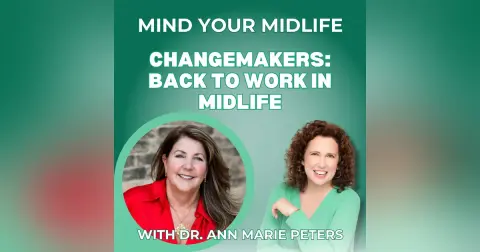


Returning to the workforce after a career pause is somewhat common in midlife but we tend to doubt ourselves. We often carry insecurities around our employment gaps and falsely believe our past experiences and accomplishments no longer matter.
In this episode, I welcome Dr. Ann Marie Peters, an executive coach, leadership strategist, and organizational psychologist. Ann Marie is the author of the brand new book We'll Be Right Back, which focuses on helping women re-enter the workforce after taking a pause. We dive deep into why smart, capable midlife women discount their abilities, the realities of the "part-time myth," and how to translate the hidden skill sets of motherhood and volunteering into a powerful career comeback.
What You’ll Learn:
- The Part-Time Myth: Why squeezing a full-time workload into part-time hours often leads to burnout and how it impacts your career advancement.
- The Hidden Skill Sets of a Pause: How managing households, resolving conflict, and leading community events translate into highly valuable skills for employers.
- The Kaleidoscope Career Model: Why women in midlife naturally shift their professional focus away from just "challenge" and prioritize authenticity and balance.
Links & Resources:
- Ann Marie's Book: We'll Be Right Back
- Ann Marie's Website: annmariepeters.com and the FREE Reflections Workbook: annmariepeters.com/reflection-workbook
- Ann Marie's Instagram @backwithAMP and LinkedIn annmariepeters
- Cheryl's Midlife Recharge: cherylpfischer.com/recharge
Episode Chapters:
00:00:00 - Midlife As A Change Window
00:01:06 - Thriving Mindset And Coaching Offer
00:01:53 - Why Returning Feels So Hard
00:03:15 - Anne Marie’s Career Pause Story
00:11:05 - The Part-Time Myth At Work
00:14:48 - Re-Entry Through Entrepreneurship
00:18:18 - Gaps, Penalties, And Ageism
00:21:10 - Reclaiming Experience And Hidden Skills
00:26:35 - Midlife Priorities Shift To Meaning
00:31:45 - Where To Find The Book
00:32:55 - The One Takeaway To Remember
00:36:00 - Host Wrap And Listener Requests
Why This Episode Matters
By acknowledging the incredible skills you've built during your career pause and embracing your desire for balance, you can reclaim your professional identity and step confidently into your next chapter.
Take a little bit better care of yourself in midlife.
🌸 Liked this episode? Share it with fellow Gen X women navigating hormone balance, an empty nest, and/or self-confidence!
🫶 Love this show? Leave a review to help more women over 50 find us.
💡Want menopause advice, mindset shifts, or support with midlife transformation?
- Find out more about the Midlife Recharge at cherylpfischer.com/recharge
Let’s talk health after 50, self-talk, and redefining aging for women — without the “midlife crisis” narrative. Every week I'm adding new success strategies for midlife women.
Connect with Cheryl: Instagram | LinkedIn | Website
---------------
💡If you are a brand, author, or business wanting to reach an audience of women in their 40s and 50s who are focused on health, success, and taking care of themselves and others well in this stage of life, consider sponsoring Mind Your Midlife podcast. More information here.
00:00 - Midlife As A Change Window
01:06 - Thriving Mindset And Coaching Offer
01:53 - Why Returning Feels So Hard
03:15 - Anne Marie’s Career Pause Story
11:05 - The Part-Time Myth At Work
14:48 - Re-Entry Through Entrepreneurship
18:18 - Gaps, Penalties, And Ageism
21:10 - Reclaiming Experience And Hidden Skills
26:35 - Midlife Priorities Shift To Meaning
31:45 - Where To Find The Book
32:55 - The One Takeaway To Remember
36:00 - Host Wrap And Listener Requests
Midlife As A Change Window
Cheryl FischerYou've heard me say that midlife is a time of tremendous change. And quite frankly, whether you've heard me say that or not, you know it's true. We're all here in this together. And that means that there are potentially quite a few of us who are making some kind of career change, career re-entry, business start. And that takes a really empowered mindset, and it takes thinking about our life experiences in a way that helps us instead of hurting us. So let's talk about it. If midlife was only about hot flashes, 3 a.m. wakeups, silly injuries, and worrying about everyone from aging parents to adult kids, we'd all be unhappy and isolated. And that's just not true. Whether you're frustrated at work, stressed about retirement, or just looking for the phone that's already in your hand, you're in the right place. Let's change the story around midlife and start loving this
Thriving Mindset And Coaching Offer
Cheryl Fischerchapter. This is the Mind Your Midlife podcast. It's time to stop just surviving midlife and start thriving. My Midlife Recharge pairs powerful one-on-one coaching with the being profile to reveal the unconscious habits keeping you drained. Once we identify those underlying patterns, we rewrite them so you can wake up feeling excited about your life again. Reclaim your energy and purpose today at CherylPFischer.com slash recharge. Now back to the show.
Why Returning Feels So Hard
Cheryl FischerAnd had I had that option, I believe I probably would have taken it for a short period of time. And then I probably would have wanted to figure out how I could come back into the workforce. And you may have heard me say that I have worked in corporate America and I have worked in education. And both of those at this point were quite long careers because overall it's been quite a long career. So I've seen a lot of different sides to the story. And because I've moved in and out of those, I've had to sell my experiences, which let me tell you, the education sector doesn't necessarily always believe that corporate experience is valuable, and the corporate sector doesn't necessarily believe that education experience is value, although I would beg to differ anyway. Let me not get too sidetracked with that. I know there are many of us who struggle with this idea of major change or re-entry into the workforce after not having worked for a period of time, whether you were raising kids or maybe you were taking care of aging relatives, whatever it was that pulled you out of the workforce. Now you want to come back in. Oh my goodness, what a mind-bender sometimes that is. So my guest today is going
Anne Marie’s Career Pause Story
Cheryl Fischerto help us out. Dr. Ann Marie Peters is an executive coach, a leadership strategist, an organizational psychologist, and most exciting for our discussion, an author with a brand new book that just came out this week. She has more than 30 years of experience across corporate, nonprofit, and academic sectors. She founded her own consulting firm. And she has written a fantastic new book called Will Be Right Back that is focused on we women coming back into the workforce after a pause. And it is practical, telling us exactly what to think about, what to focus on, what to do as we get ourselves ready to do that. And this came from her doctoral research in getting her industrial and organizational psychology PhD. That was a mouthful, isn't it? And so I am really excited for her to be able to share some of her experiences with you as a change maker. She changed her career multiple times. So that is how we're going to phrase this discussion today and how she can help you to be a change maker as well. So welcome, Ann Marie.
Ann Marie PetersThank you so much for having me here today, Cheryl.
Cheryl FischerI'm excited to talk to you. And your new book is launching this week, right now, as this episode airs. So yay for that, first of all. Thank you. Yes, yay. I'm so excited. Absolutely. I know. I can only imagine. It's kind of sending your baby out into the world. And the book is very much related to your story. So tell me and tell our listeners how you ended up leaving and coming back to the workforce and then ended up putting that into a book.
Ann Marie PetersAbsolutely. So, you know, I started my career in corporate America in a Fortune 500 company. And I was very fortunate to have a lot of great opportunities within within that organization. And including, you know, when my husband had his first opportunity that that uh caused us to move, um, my company said, come on, we got a job for you in California too. So so that worked out really well. And in 1995, I had uh our first daughter. And my intention was to stay home full time. Because as you may remember, at that time, you know, the choice was pretty much work full-time or stay home. There was not uh much in the way of flexible hours, et cetera, et cetera. And uh I was fortunate that at the time uh the woman that I was working for said, Well, what will it what what what do we need to do to get you to stay? And I said, Well, if I could work from home part-time, I I would do, I would stay. She said, we're gonna make that happen. So I feel like I was a pioneer in uh the flexible work schedule opportunity. I was also a pioneer in the um part-time myth too, which I talk about in the book, but um, but really, I mean, what a great opportunity to be able to balance um my family life and two more children came along with my career, which I had, you know, worked already for eight years building. Um, so that was a really great opportunity. I took that responsibility very seriously because I knew at the time it was very unique. And I wanted that, I wanted to do a good job with it so that it was more available to other women in the future. And so um that's that kind of kicked off that part of my career. So I was still in a Fortune 500 company, a big international bank, and um, we moved several times, and I was, you know, told pack up your computer and just take it wherever you're going. So I was able to perpetuate that for about 12 years. And the part-time myth I'm I make reference to is I always had a full-time job, but I I felt privileged to be able to smash it into prep part-time hours and then have the bulk of my time to spend with my children. But uh, you know, about the time when uh our oldest daughter was about 12 and and then we had eight and four, and I was traveling, my husband's traveling, we're in Chicago, we don't have any family around who can, you know, pop over and stay overnight, etc. It it was just chaos. It was just chaos with with the schedules and with both of us trying to work even with the part-time schedule. And so at that point, I finally made the decision to stay home full-time. So at this point, you know, I was like 18 years in my career. And so um decided to stay home full-time, did that for about four years, came back into a workplace as an entrepreneur with two other women in Chicago. We started uh interview savvy, which was a terrific experience and a great business that um we ran together for about 10 years, and then um a move to Idaho, which I thought would really kill my career. Obviously, knowing no one in Idaho. Sorry, I don't know. No, I hope wait, it gets better. Hold on, it gets better. Only because I didn't know anybody. And and I was running Interview Savvy in Chicago. It was very much a Chicago-based company. And um I was fortunate enough because of Interview Savvy being a higher ed focused company to be introduced to the new president of a brand new community college that was starting in eastern Idaho, College of Eastern Idaho. And so I always used to joke with the president that I had to move from Chicago to Idaho to have my most favorite and rewarding job that I ever had in my career. And um just loved our time in Idaho and really had an opportunity to contribute in not only higher ed, but a nonprofit and um to do some fantastic development work, which actually last month we cut the ribbon on a big building that I had imagined and now stands. So it's uh it was really just an incredible opportunity to help in education, which is certainly a passion of mine. And then uh actually, all of that time that I was in Idaho, I had already established my consulting business. So I've had AMP consulting since 2017 and uh was on retainer in that role. And then since then, um my practice is strategic management consulting with organizations and also with individuals as a as a coach, whether it's on a management change, a strategy focus, or whether it's actually one-on-one coaching for um someone who is looking for advancement. So that's that's basically my my career story, but mixed in there when uh I was uh in Idaho, I started my PhD program. So finished my foot PhD while I was working full-time. And uh that's also launched some very interesting um opportunities, including uh We'll be right back, which is the book that you referred to earlier.
Cheryl FischerYeah, it what an interesting story. I I love how we can change careers and we can move around and we can find things that are surprising that happen. It's really, really interesting.
The Part-Time Myth At Work
Cheryl FischerAnd that's kind of been my story as well. So tell me some of the challenges you faced along the way because I did hear you say the part-time myth, and I think that probably has to go on the list early on. And I'll say that one of the reasons I left the corporate world many years ago and became a teacher was because I was trying to talk them into some type of flexible schedule, part-time or part from home or something. And this was this was in the very beginning of the 2000s, so a little bit later, but similar situation. And they wouldn't, and so I said, All right, I'm gonna go look and see what else I can do. So I understand the challenge of trying to figure that out when you really want part-time, and then when you have it and you still have to do all the work. And so is that one of your key challenges, or are there others along the way? I'm sure there probably were.
Ann Marie PetersWell, certainly um you've you've hit on the biggest challenge is that you're, you know, if if you want to keep leaning in and and remaining challenged and you are performing, uh, you know, I was I felt fortunate that I was still getting opportunities, but definitely full-time jobs. I mean, at one point I was national sales director for a um, you know, for a credit card division of this big bank. It was not a small job, and I was had three different locations that I had to to manage, etc. So, you know, the beauty of that, which I I wanna I want to emphasize the positive, because at the end of the day, this was a positive experience. The positive is that you are doing enriching work, you're you're doing things that you feel like you're making contributions. Um, you know, frankly, I even though I was half time, I still had benefits. I was still getting a bonus, which was fantastic. I mean, that was that was great too, of course. So I felt like it was a win-win, you know, uh in the sense that I had so much freedom with my children and could spend so much time with them. On the other hand, you know, it was a challenge with trying to squeeze that into part-time. And I think the part-time myth part of it that I would focus on is, you know, I had a home office and and so the part-time part of it is when you're saying things like, I'll, I'll be, I'll be back in 10 minutes. I just, I'm just gonna go send a quick email on it, and then, you know, it cascades into something else, et cetera. And it's also, I used to joke, you know, this was not a a job where like, you know, you sell the last widget and you lock the door for the day. Like my my brain was was was working at 24-7, right? So, so I think those are the things that come up in the with a part-time myth. Now, there's also, I think for some women, um, you know, what what I've learned through interviews and focus groups is that women are part-time, but they're they do lose their benefits, they do, they do lose their bonus, they they lose opportunities to be able to to be a manager or to um be promoted within the organization. And sometimes, you know, they're making even less. Even it's not 50% of what they made. It's it's a different, it's a different number. And so um I that's those are the things that that I think contribute to that part-time myth.
Cheryl FischerYeah, I I fully agree with you.
Re-Entry Through Entrepreneurship
Cheryl FischerAbsolutely. And I could tell a bunch of stories about things that happened to me as a teacher too, when I was part-time and back to full-time. But I don't want to focus on that too much because even more interesting potentially, and if you're listening, I will see whether you agree with me or not, is the movement back in to the workforce. So maybe part-time worked well, maybe it didn't, maybe it was available, maybe it wasn't. But at some point, a lot of us choose to step back. And then maybe, particularly at the point where our kids are getting older, but who knows, a lot of other life changes could happen. We want to go back in. Now you have an interesting story because you started a business with some friends. And to me, that feels like a really smooth re-entry. I don't know if you agree with me or not. It feels like maybe that's, dare I say, easier in air quotes. What do you think about that?
Ann Marie PetersWell, I think starting a business is never an easy thing, you know, in the sense that if you take on a new role at at any kind of organization, typically you're going in, you're doing your job, and you're getting paid for it. You know, starting an entrepreneurial venture from zero is, you know, is is you're not gonna make money until you start to get clients and actually make it into a business. So it's got a a ramp up time. Now, there I loved that opportunity. And and you know, if you're if if we have more time at some point, I'll tell you the whole story about how it happened because it's a great, great story about how the three of us connected and started this business. But um it was scary because I hadn't been in the workplace for four or five years. You know, I felt like, gosh, I mean, my PowerPoint skills, my Excel skills, like I I need to even, even like like professional email, like I needed to to kind of brush up those skills a little bit, even though I had been doing some of that, but just not at that level. And so it was really um wonderful to be able to get back in there and do that. And then what I would say too is that we built it from the ground up. So, you know, I'm a little bit of a startup junkie. I did it actually in the in corporate America. They they tapped me for a lot of startups, and then we had this startup, and then I was with the college that was a startup, anyways. But it was fun because we got to do everything marketing. We we built our own website, you know, we we had to go out and find clients from zero and we had to learn to tell our story, you know, all of those things and working with friends. It was it was a really incredible experience. And honestly, if COVID hadn't come along, we might still be running it.
Cheryl FischerInteresting. There's a twist I did not see coming. Interesting. And I guess when I said easier, which I said let's put it in air quotes because I knew I was making a sweeping generalization, I was thinking maybe you weren't having to convince some large corporation to bring you back in. But good point, there's always going to be some challenges, it's just different challenges.
Ann Marie PetersRight. But you are absolutely right in the sense that there is a large percentage of women who um have taken a pause from the workplace who are coming back as
Gaps, Penalties, And Ageism
Ann Marie Petersentrepreneurs. And, you know, part of it is it's something that they've become passionate about. Maybe it's a business that they've dabbled in part-time during their pause and they want to make more of it. But sometimes it is because they're they're meeting with roadblocks, coming back into their former career sector or returning into um, you know, going back through and getting their resume looked at and you know, that gap that we hear about. And and really honestly, um, you know, the motherhood penalty. Yeah you know, to be honest. And in some cases, ageism is entering into it too. So it's not always one factor, just as, you know, when when women leave the workplace, most people think of women returners, and I'm using your quotes here, as somebody who, you know, had their first baby and just felt like they had to hold that baby 24-7, and so they left the workplace, and and that's their story. That's very rarely the whole story. Yeah, there are there are in and as you alluded to, um, women opt out of the workplace at many different junctures. It's not always with that first child. And in my own research, what I found was there are typically a lot of factors. It could be that, yes, you've been in this role, but maybe you see a glass ceiling. Maybe you're not getting paid at the rate that you you think you should be. Maybe you're not being challenged. Maybe you you, you know, there could be a whole lot of contribution, maybe you're experiencing harassment. I mean, unfortunately, that's still um happening at a high level or a high percentage level in in the workplace. So there are a lot of um contributing reasons to why people opt out. And then lots of contributing reasons as to the paths when women opt back in.
Cheryl FischerYes, it's it's interesting. And I can't speak personally to coming back into the workforce after staying home. I switched careers to something that would be would work better with my family schedule. And then I switched back into corporate after that. So not exactly the same thing, but I will say this was in my late 40s that I came back to work at a corporation. I was doing a training function, which to me was very similar to teaching, but they didn't necessarily see that. And I had to talk my way in about how training adults really wasn't that different than the teaching I had been doing. And I was in my late 40s, so I had to just mindset it like I'm plenty young to be doing this. And obviously that wasn't discussed, but yeah, it was it was not exactly as easy as I thought it would be. So yeah, there's challenges for sure.
Reclaiming Experience And Hidden Skills
Cheryl FischerYes. Now, one of the things you talk about early on in your book that really resonated with me is when we're getting ready to say, okay, we want to come back into the workforce, we often need to actually actively think back to the experience that we have had over our career, even if it's been a while ago, and kind of appreciate that, I would say, remember it, appreciate it about ourselves. Have you found that a lot of women are really just discounting that past experience?
Ann Marie PetersYes. I I one of the reasons I included that in my book was because in my research and in interviews and focus groups, I heard over and over again because one of my first questions was So tell me about your profession. Before you um paused your career. And I had so many women say, nobody has asked me that in years. My kids don't even know what I did. You know, those kinds of reactions. Followed by it was so empowering to look back on my career and to remember kind of the badass that I was in my in my career. And, you know, that identity loss is so common. You know, all of a sudden that's sort of in the rearview mirror, and that experience gets smaller and smaller and smaller because we're focused in a in a different direction during our pause. And, you know, it's it's so important to remember and to actually, you know, with with the reflection exercises, I think it's helpful to write it down. Certainly I'm not giving people homework, but there's a few questions at the end of each chapter to help people to identify those those um attributes in the case of your former career and all of the things that you're proud of.
Cheryl FischerYeah. And it's I the I really felt this when I read this because I was managing a group of people at maybe 28 or so. And I did that for six years, maybe, and then I almost forgot that I even had those skills. And now I don't manage people by choice. I am doing something very different, but it's almost as if, oh, that was a long time ago, so it doesn't count, which it doesn't that doesn't make sense, right? Right.
Ann Marie PetersYes. And the other thing that is a common uh challenge is that I'm sure you've heard people say this. Oh, I'm just a stay-at-home mom. Yeah. I hate when I hear people say that. You do so much. If somebody followed you around just one day, they would be amazed at all of the things that you do. And and again, helping women to get to that realization of wait a minute, you are managing conflict, you are managing people, you are uh probably a master time manager and schedule manager. In a lot of cases, if someone's on a pause, they start doing work in the community. Often that means, you know, organizing volunteers and organizing events. And I mean, this is full of skills, and I call them the hidden skill sets of motherhood, full of skills that would be valuable to an employer. So it's it's naming those things that you've done and thinking, just basically shining a little bit of a different light on it. Yes, and then having the words to articulate it to what you want to do next, whether that is on a resume and going back to an employer or whether it's it's starting your own business, just to remember, oh, wait, I'm not starting from nothing here. I have lots of stuff I did before and a lot of things I've done in my paws as well.
Cheryl FischerYeah, and you're right. If someone is very interested in the the feelings of success, the feelings of uh being in charge of something or doing something meaningful, they're gonna find that even in some type of volunteer role, or they're gonna be leading groups of kids to do something, or they're gonna be doing something because yeah, that's the personality, right? Absolutely. Yes, absolutely.
Ann Marie PetersYes, and so often uh the women that I encountered and just encounter every day, they were overachievers in their professional career before they paused. Then they were overachievers in their pause in every way, in their family, in their community. And and then when they do come back into the workplace, whether it's as an entrepreneur or in an organization, they're overachievers again. So what a great group to draw from if you're an employer.
Cheryl FischerAbsolutely. And I'm just gonna put a mindset plug in here as well, just for a second. Can we stop describing ourselves with the word just ever? Yes. In any way.
Ann Marie PetersI agree. Oh my.
Cheryl FischerI'm working on it, Cheryl.
Ann Marie PetersI mean, same.
Cheryl FischerI myself, yeah. Yeah. We can say it, we can't always do it, but we can try. And we're not just anything ever. Right. So maybe somebody can come up with an exception to that, but I don't think we are.
Midlife Priorities Shift To Meaning
Cheryl FischerOkay, so let's focus on midlife for a minute because we are here on Mind Your Midlife. And there's a lot going on in terms of simply physical health, family changes, relationships during this sort of 40s, 50s, early 60s period of time that we call midlife. And there's gonna that's gonna create mindset shifts, emotional shifts. There's so much. We talk about this all the time. There's a lot. So what are some of the things that you're seeing in people, in women who are at this point deciding to go back? And what are some of the things that they maybe need to remember or that they're struggling with?
Ann Marie PetersWell, one of the things that's a very interesting, I'm gonna say, research-based model that speaks exactly to that uh as it relates to your career is the kaleidoscope career model. And so, you know, is the basis of my dissertation. Um, but but essentially that model, it's for men and women, and it it measures authenticity, balance, and challenge at early career, mid-career, and late career. And what that uh the research using that model has determined is that at midlife, which is also commonly when women are returning to the workplace after a long pause, um, women are more focused on authenticity and balance versus challenge. So we start out the same at the beginning of our careers with men, we're aligned with challenge. But as we get to that mid-career, there's more of that focus. And so what you're finding is um, you know, when one of the questions that I was asking was, you know, my my um participants were all women who had been in a for profit organization and returned to work into a nonprofit organization. So keeping that career model in mind, my question was, well, were they coming back into a nonprofit because they couldn't get back into their former career sector, which is not uncommon, you know, the gaps and the you know, the challenges that we we face with employers, um, or was it a philosophical change and that focus on authenticity and balance? And what I found again and again was that yes, women were were preferring to focus on authenticity and balance. And in some cases, you know, uh they were fairly certain they could not get back into their their former career sector. Perhaps it had been eliminated, or perhaps it was because of um, you know, some other entry barrier. But in most cases, it was a choice not to go back. I I a lot of women were saying, I don't want to work 60 hours a week. I don't want to work 80 hours a week anymore. I don't want to work for um an organization that I don't feel good about. I want my if my work to matter. I want it my my personal philosophies and the mission of the organization to be aligned. Now that's not necessarily just, you know, you don't have to zero in only on nonprofits to make that happen. There are a lot of for-profit organizations, but that was um that focus, authenticity and balance.
Cheryl FischerYeah, it's really interesting. And I think, and I don't know if this has really been a big part of your research, but if we just extend that out a little bit more, I think it's gotta become even stronger as we get almost to retirement, because my husband and I are just right now enjoying the heck out of talking about when we're gonna retire because we're looking forward to it and it's not that far away anymore. And so if my business went in a direction that I really didn't like, or my company went and did something that I really didn't like, then I might not want to be there anymore because I see a very short timeline. And so I could see how authenticity would become even more important and balance even more important because you know we almost hit the end of the race here in terms of in terms of work only, people, in terms of work only. Right. Right, exactly.
Ann Marie PetersJust work, and we'll be around having fun for a long time after.
Cheryl FischerYeah, I just want to say that because I want to catch anybody who's listening who's going, well, geez, it makes she makes it sound like it's the end of my life. No, that's not what I'm saying. You got a lot of life to enjoy still. Yeah, yeah, it's the beginning of your life for a lot of people, retirement. Exactly. Exactly. So this idea that we're focused on balance and authenticity, though, really rings true for sure. For sure. Okay, well, before I forget to do it, how can people find you? Tell us again your
Where To Find The Book
Cheryl Fischerbook, and just generally, where can they find you and connect with you?
Ann Marie PetersThanks for the opportunity to talk about that. The book is called We'll Be Right Back, and it is available on, you know, your it through your normal channels, Amazon, et cetera. And um, I appreciate the link that you, I believe, have included in the show notes. Um, you can also find me at annmariepeters.com. And that is my consulting website, but it's also my book website, so you can get more information there and also um sign up for emails so that you can keep up with uh what's happening there. On Instagram, I'm "back with AMP." Thank you for that.
Cheryl FischerAnd let's let's go to my sort of favorite question to ask. We listen to podcasts while we're doing something else, while we're driving, we're doing the laundry, we're doing the dishes, whatever. And as we're listening, we're thinking, oh my goodness, yeah, exactly. Exactly. I need to remember that. Oh, yeah, good idea. But we don't remember any of it because we're doing something else. So, what is the one thing that you really want someone listening to
The One Takeaway To Remember
Cheryl Fischertake away from this episode if there is one thing that she can hold on to?
Ann Marie PetersI think particularly directed at women who have had a pause, whether you're currently there, you're thinking about it, or whether it's something that you've already um you know turned a corner on and started doing something else. It your your passion and your accomplishments matter. It matters. And and just because it's two years ago, 10 years ago, it's still really important. So empower yourself. Empower yourself to to be able to see the amazing woman that you are. And I like to think that that's what we'll be right back does. It it walks women through that process of reflection to remember who you were in a in a former career life, um, reflection to think about the positives of that you've gotten out of the pause that you've been on. And hey, let's talk about the negatives too, some of which you mentioned, you know, physical challenges, um, isolation, grief, etc. Let's talk about those and let's name those two because that's all part of your story. And then, and this is something you do very well, Cheryl. Um, you give actionable advice. So taking all of that and being able to help women to think about it in a way that is actionable. So giving women the language around those hidden skill sets to be able to utilize it in a way to take that step back into the workplace if that's what they want to do. And if I can do it, you can do it. I promise. And I want to hold your hand along the way. So I see you, I guess, is the one sentence I would use. I see you. I see you.
Cheryl FischerI love it. And we as a species, as a gender, I don't know, a gender, I guess, do tend, I said this before, to downplay our own accomplishments, our own abilities, our own achievements. And so I love the concept of empowering ourselves too. And I totally agree with you. And I had a friend once who said to me as I was changing careers and I was in my late 40s, she said, Well, why wouldn't people listen to you and trust your knowledge and your skill? You've lived for almost 50 years. Of course, you know lots of things about lots of things. You would. You've had all this life experience. And it was a simple statement, but it was just quite profound to me to think like we don't make it through 40 or 50 years of life without having learned a lot of stuff. And that stuff is valuable. Yeah. Exactly. Thank you so much for joining me today, Ann-Marie. I really enjoyed it.
Ann Marie PetersThank you so much, Shirley. I um appreciated
Host Wrap And Listener Requests
Ann Marie Petersthe opportunity and I love your shows.
Cheryl FischerOkay, if you've been listening to this podcast for any amount of time, you know I love it when the one thing is related to us believing in ourselves, knowing that we matter, and feeling empowered. Yes. And keep in mind that I have to say this to myself as well. My husband and I talk about this all the time. I can say all sorts of things as a coach and on this podcast. And that doesn't always mean that I follow them perfectly either. You probably give advice to people in your life and you don't necessarily follow your own advice either. That is exactly where the saying, do as I say and not as I do, came from. None of us are perfect. However, we can try every day, maybe it's even every hour, maybe it's even every few minutes. We can make an adjustment and we can try. And by try, I mean believe that you have had some really valuable experiences, that you have valuable skills, that you can do what it is that you really want to do with your life. I believe Dr. Peter's book, we'll be right back, will help you head to the show notes, find out more about that. And if you are listening to this podcast on Apple or on Spotify, if you would scroll down and tap to rate and give that five stars, that would be amazing. And if you're on Apple, if you would write a quick review, it really tells the app to share this podcast with more people. I bet you know someone who might enjoy it or might benefit from it. So thank you in advance for doing that. And keep remembering midlife is your time to take just a little bit better care of yourself. And that's on the inside and on the outside. Just a little bit better care makes a big difference.


