105. Why Men Withdraw in Midlife and How to Help, with James Davis
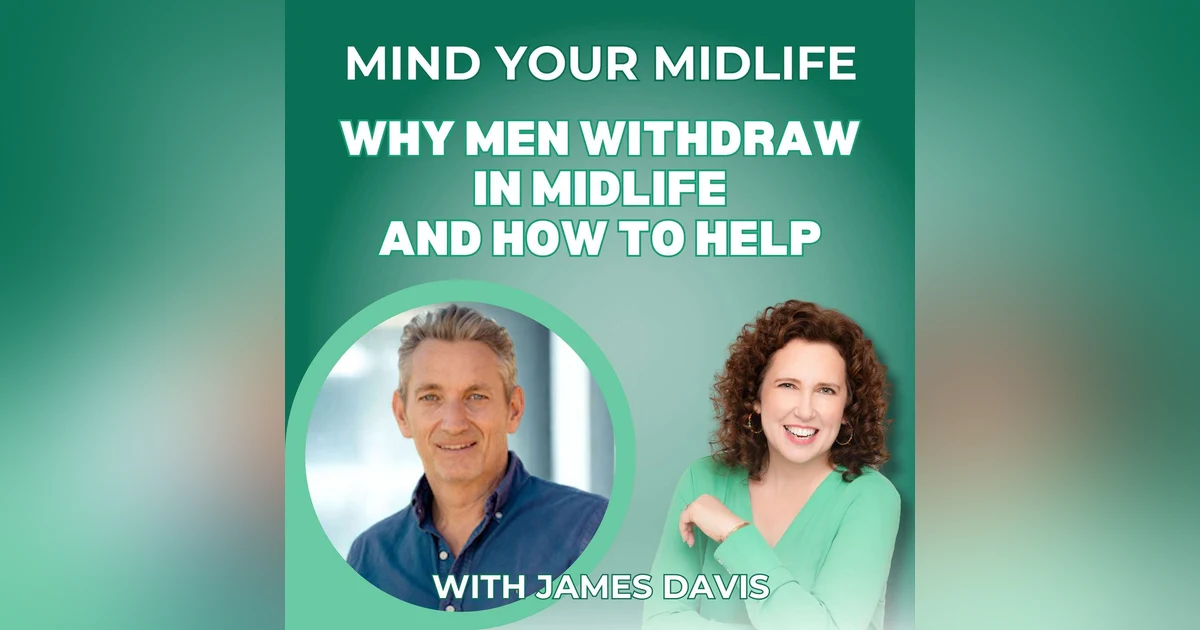


Quick Summary: In part one of a two-part mini-series on the men in our lives, Cheryl talks with James Davis, a coaching psychologist, men's health advocate, and author of The Midlife Male Handbook, about what men go through in midlife. You'll learn what andropause is, why many men withdraw instead of talking, and how to gently start a conversation that brings you closer.
Intro:
We talk a lot on this show about what we're going through in midlife: hormones, adult kids, aging parents, career changes. But what about the men in our lives? Beyond the red-sports-car "midlife crisis" stereotype, there are real changes happening for our husbands, partners, brothers, and friends, and many of them don't have the words to explain it.
In this episode, I welcome James Davis, an award-winning coach, coaching psychologist, and men's health advocate with over a decade of experience. James and his wife, Claire, are the Midlife Mentors, hosts of a popular UK podcast focused on midlife health and well-being. James is also the author of The Midlife Male Handbook: A Man's Guide to Thriving Through Andropause. We talk about testosterone decline, why men pull back when they're struggling, and simple ways to reconnect, and maybe even have more fun together.
What You'll Learn:
✔ What Andropause Really Is: Why it's not "male menopause," and how a gradual drop in testosterone can affect energy, confidence, motivation, and mood
✔ Why Men Withdraw: How career identity, breadwinner pressure, and a lack of emotional vocabulary can lead men to go quiet instead of opening up
✔ How to Start the Conversation: A gentle, low-pressure way to check in with your partner, plus one simple repair sentence for heated moments
Links & Resources:
- James and Claire's podcast and website, Midlife Mentors: themidlifementors.com
- James's website: jamespdavis.com
- James's book: The Midlife Male Handbook: A Man's Guide to Thriving Through Andropause
- This episode's sponsor, Barre3 Arlington: first class free, plus $10 off a class package with code ARLMindYourMidlife
- Sponsor Mind Your Midlife: cherylpfischer.com/mymsponsorinfo
Frequently Asked Questions:
Do men go through menopause?
James says no, and calls it a myth worth dispelling. Men experience andropause, an age-related decline in testosterone that happens gradually, so it's often written off as stress, tiredness, or just getting older.
Why does my husband seem withdrawn or less confident in midlife?
James explains that hormone changes, questions like "Have I achieved what I wanted?", and a lack of emotional vocabulary often hit at the same time. Many men pull back and go quiet until they can figure it out themselves, which can create distance in a relationship.
How do I talk to my partner about this without making it a big deal?
James suggests picking a calm moment and mentioning what you've noticed, like seeing friends less, without making it about the relationship. Let him know you'd like to work on it together, even if he can't put it into words yet.
Should men in midlife get their testosterone tested?
James recommends a simple blood test through your doctor, ideally two or three tests since levels fluctuate. If levels are low, he says to start with lifestyle changes: exercise (especially strength training), less sugar and processed food, enough protein, and good sleep.
What should men know before starting testosterone replacement therapy (TRT)?
James notes that TRT isn't right for some health conditions and can affect fertility. Over time it can shut down the body's own testosterone production, so he says to think of it as a lifelong commitment.
How can couples handle perimenopause and andropause at the same time?
James says it comes down to compassion: breathe, pause, and don't take things personally. He suggests asking, "What do you need from me right now?" as a simple way to repair a tense moment.
Episode Chapters:
00:00:00 - Midlife, Now Including The Men
00:03:59 - What Andropause Looks Like
00:09:14 - Breadwinner Pressure And Fewer Friends
00:16:24 - Starting The Talk Without Pressure
00:18:27 - When Both Partners Are Shifting
00:20:55 - Retirement, Loneliness, And Purpose
00:24:19 - Testosterone Tests And TRT Tradeoffs
00:29:11 - Shared Goals, More Fun, Key Takeaway
Why This Episode Matters:
When we understand that the men in our lives are going through something real, and may not have the words for it, we can respond with curiosity instead of blame, and build stronger, more connected relationships in this chapter.
This episode is for educational purposes only and is not medical advice.
Take a little bit better care of yourself in midlife.
Barre3 is a guided fitness practice, offering classes that combine strength, cardio, and mindfulness
Disclaimer: This post contains affiliate links. If you make a purchase, I may receive a commission at no extra cost to you.
🌸 Liked this episode? Share it with fellow Gen X women navigating hormone balance, an empty nest, and/or self-confidence!
🫶 Love this show? Leave a review to help more women over 50 find us.
💡Want menopause advice, mindset shifts, or support with midlife transformation?
- Find out more about the Midlife Recharge at cherylpfischer.com/recharge
Let’s talk health after 50, self-talk, and redefining aging for women — without the “midlife crisis” narrative. Every week I'm adding new success strategies for midlife women.
Connect with Cheryl: Instagram | LinkedIn | Website
---------------
💡If you are a brand, author, or business wanting to reach an audience of women in their 40s and 50s who are focused on health, success, and taking care of themselves and others well in this stage of life, consider sponsoring Mind Your Midlife podcast. More information here.
00:00 - Midlife, Now Including The Men
03:59 - What Andropause Looks Like
09:14 - Breadwinner Pressure And Fewer Friends
16:24 - Starting The Talk Without Pressure
18:27 - When Both Partners Are Shifting
20:55 - Retirement, Loneliness, And Purpose
24:19 - Testosterone Tests And TRT Tradeoffs
29:11 - Shared Goals, More Fun, Key Takeaway
Midlife, Now Including The Men
Cheryl FischerIf you've been listening to this podcast for any amount of time, you know that we've talked about so many challenges that we're going through in this 40, 50, early 60 something period called midlife, like kids who are now becoming adults, empty nest and getting used to that, aging parents and becoming more involved in care, losing people that we love, changing careers because we realize we're unhappy, looking ahead to retirement, and the body changing, the hormones changing, feeling differently, and all that comes with that. Whew. However, up until now, we haven't really talked about the men in our lives. So let's do that now. If midlife was only about hot flashes, 3 a.m. wake up, silly injuries, and worrying about everyone from aging parents to adult kids, we'd all be unhappy and isolated. And that's just not true. Whether you're frustrated at work, stressed about retirement, or just looking for the phone that's already in your hand, you're in the right place. Let's change the story around midlife and start loving this chapter. This is the Mind Your Midlife podcast. Big thank you to this episode's sponsor, Barre3 Arlington. Created for women by women, Barre3 is a full-body, low-impact workout that combines barre, Pilates, and strength training to build strength, improve flexibility, and increase energy. It's unique for its focus on mind-body connection, love that, and real-time modifications that help you personalize every movement. So expect movements that support your everyday life, helping you feel balanced and strong from the inside out. It's fitness on your own terms, allowing people of every fitness level to create sustainable change from the inside out. So experience Barre 3 Arlington's community in classes at the corner of Wilson and North Quincy Street in Ballston in Arlington, Virginia. Your first class is always free, and listeners can get $10 off a class package using the discount code ARL MindYourMidlife. Go down to the show notes and grab those details. Now back to the show. If you have a husband or a partner in your life, or quite frankly, a brother, a father who's sort of on the young end of the age one of our fathers would be, a close friend who's a guy, you'll want to hear what we're talking about today. Because even though it's now quite well known that we as women go through hormonal changes during this menopausal period that really not only affect our body and our physical abilities, but potentially our moods with anxiety, potentially even depression. We know that and we're learning more about that all the time. Men are going through something as well. And you maybe have heard historically people would talk about the midlife crisis. And when I say midlife crisis, and I think men, I imagine the stereotypical TV show or movie guy who goes out and gets a red Ferrari sports car and goes to find a younger girlfriend, right? Like that's how it's stereotypically been portrayed, this midlife crisis. I'm doing air quotes that men go through. However, there are real things going on for men during this 40, 50, early 60-something period of life. And so we're gonna do two weeks, a little mini-series on how we can help the men in our life and how can we understand the men in our life better.
What Andropause Looks Like
Cheryl FischerAnd I'm so excited to have James Davis join me today. He is an award-winning coach, a coaching psychologist, and a men's health advocate with over a decade of experience guiding individuals and organizations toward transformation. He and his wife, Claire, specialize in midlife health and well-being related to nutrition, hormone health, stress management, and all the stuff we talk about that's going on in midlife. And as a pair, they are the Midlife Mentors, a very successful podcast coming out of the UK. You will want to check it out. Link in the show notes. And James is also the author of the book, The Midlife Male Handbook, A Man's Guide to Thriving Through Andropause. And I'll make sure there's a link for that as well. Welcome, James. Thanks for joining me.
James DavisHi, great to be here, Cheryl. Thanks for having me on.
Cheryl FischerI appreciate you being willing to share all the secret information that we don't know. Okay. So let's start because we're talking about men in midlife to an audience of mostly women.
James DavisYeah.
Cheryl FischerLet's start just by understanding what is it that men are experiencing in this sort of midlife 40s and 50s phase.
James DavisWell, actually, I'm going to start by by kind of throwing that open to your listeners and just, you know, have you ever noticed this kind of change in a man in your life? Maybe your husband, your partner could be your brother, father. But they hit midlife and they just seem to be getting a bit more withdrawn and less confident, but they're not really able to vocalize what's going on. It's so interesting. It's normally um the partners that will spot what's happening. So essentially what's happening for men at midlife is for women, we've thankfully got so much education around the menopause now, and we know that's largely driven by fluctuating levels of estrogen and progesterone, they fluctuate and die away. For men, our primary sex hormone is testosterone. Now, that will peak in our 20s and declines at a steady rate, one to two percent per year, which doesn't sound a lot, but compound that it means by the time we hit midlife, we get to really start to notice the effects. But whereas for women, you know, that that drop-off is happening in quite like a relatively narrow period to your life cycle. So the symptoms, the effects can be quite noticeable. This is a little more insidious, it's happening gradually, so it gets chalked up to being, I'm just stressed, I'm overwhelmed at the moment, I'm just getting old, I'm tired. But of course, those things are happening, but testosterone plays a role. We think of it as this, as this from you know, from the sports world, as like it's all about, oh yeah, muscle and things. Yeah, it does do that, but it's also about our confidence, um, how we how our metabolism works, how we process energy. It's about our motivation levels. It affects things like our libido. Then layered onto that, you know, I think a lot of men of of my generation who are in midlife now probably weren't raised with the the vocabulary and the framework to emotionally express themselves and be vulnerable. You know, we we heard things like, you know, keep the problems to yourself, big boys don't cry, suck it up, soldier on, you know, and there's a place for that, of course. It's called it's called resilience. But what can happen is we're loading too much internally and building up that psychological pressure. So imagine you've got a couple of things, more than a couple of things, happening in tandem. You know, maybe we're we're not starting to recognise our physical selves because, you know, we've suddenly got less energy, we're putting on more weight around the midsection, you know. Maybe yeah, again, the libido thing. But at the same time, you know, midlife is like we're questioning, like, well, have I achieved what I wanted to achieve? Who am I now? And then, you know, compounding that this testosterone is like undermining your confidence, making you more anxious. And then we don't have on top of it the vocabulary, the framework, we don't feel safe to express it or even know how to express it. So then the psychological load becomes immense, and then what men tend to do is like, I can't label this myself, you know, we're solution-focused creatures. So until I figure it out, I'm just gonna pull back and be quiet. It's safer for me to withdraw than actually risk putting myself out there. And then, of course, this creates massive emotional distance in relationships because women are uh are kind of looking for that emotional connection. The man's not actually saying what's wrong, they're just kind of like, wow, he's he's really pulling away from me. I don't really understand why. And of course, you know, it's human nature, our mind starts trying to find the reasons why, and we can jump to the wrong conclusions, and it can all get very complicated. But essentially, I think we need to recognise that that it's not a menopause for men. Let's just dispel that myth straight out of the box. It's a very different, very separate process. But, you know, there are hormonally driven changes for men, there's psychological pressures on men that may make them behave differently in midlife, be more withdrawn, be less confident. And then these things, of course, play out in how they see their place in the world and how they interact with everyone else and and in their relationships as well.
Breadwinner Pressure And Fewer Friends
Cheryl FischerWhat you're describing is very interesting because I would say women are going through the same thing in terms of the aspect of okay, is this what I meant to achieve? Can I still achieve something? Like maybe I should make a change right now, because I have 10 years left in my career or whatever. So we're going through that at the same time. However, we're going through it, it sounds like very differently. And I wonder if we should add one more thing that in our generation, often the men think of themselves as kind of the main breadwinner. And so that adds pressure to the, well, I can't change my career right now and just go dabble in something for 10 years, right? Because I gotta stick in this thing that now I feel stuck in. I'm wondering, is that true too?
James DavisAbsolutely. I mean, I think we are, we have seen, yeah, thankfully, greater gender equality in terms of pay and career and stuff. There's still work to be done there. But yeah, men, men who are at midlife now, you know, when they were being raised, as children be like, you know, I am the breadwinner, that is my role, it's my responsibility. And even if, you know, the the woman in the relationship has historically earned more, there's still that pressure, I think, to be like, I need to be providing in some way, I need to have a purpose. And what we see as well is that I think this is the research that supports this actually. So women are much better than men at at building and maintaining their social, social networks. In fact, men's social networks decrease as they age, we isolate more and more. Also, men tend to define themselves in terms of their career role, that's a big part of their identity. Women will happily be members of like lots of different social groups, community groups, and have different identities that they're they're happy to move between, but a man is always like, oh yeah, I'm I'm I'm a lumberjack, uh, this is what I do, I'm a lawyer, this is what I do. And of course, reach midlife, and it's like, oh, I can see that the the end of that is perhaps coming. I'm not sure what is next. What does that mean for my identity? And then just relating to that thing about the social networks, and not only do men not have the social networks to support them, but again, the research says, you know, they don't open up to their friends in the same way. So women will happily get into a group and talk about, you know, I'm experiencing this, experiencing that. Oh, have you tried this thing, that thing? And it'd be very, very open. Well, men don't want to do that so much. Uh, and that's something we have to change, it's narrative we have to change. But it just means again, we've got this like internal pressure building up.
Cheryl FischerYeah, interesting. I think you're right. Well, you are right. You're a man, right? You're talking about things that you and people you know have gone through. But I know my husband always says to me, Well, I like to do activities with people. So if we're gonna get together with people, we need to do an activity. I don't want to just like sit around and talk. So that's exactly what you're describing. I can see friend groups of guys wanting to go play golf or to go, you know, watch the game or whatever. And so it's different. Yeah, you wouldn't have the same communication.
James DavisYeah. No, and men speak in metaphors, right? So there might be something really bothering them, but they'll go watch the game and talk about, oh man, what do you think of the game? And it's like a metaphor of what they're feeling expressed through whatever they're participating in, but they don't actually make the real thing vocal.
Cheryl FischerOh, interesting. Interesting. So it sounds to me like there is a midlife phase that is challenging for men, just like there is for women. But maybe the hormone change isn't so dramatic, so we haven't gotten very good at talking about it in the right way that helps men. Is that fair to say?
James DavisI think that's really fair to say. I mean, if you the technical word for it is andropause, which basically means age-related testosterone decline, but most men aren't even aware of that phrase or of the fact that testosterone declines with age, and then that could be having a knock-on effect on all these facets of their life. So I think it'll be the next thing we start talking about. I know certainly here in the UK, we we kind of had in the last six, seven years a real explosion of awareness around menopause. You know, um, everyone's sort of talking about it. We've had books, we've had TV shows, you know, we have like menopause programs in organizations, education. It's it's fantastic. I know I do a lot of that work, but increasingly I, you know, I'm I'm being approached by organizations and going, well, you know, we've we've we've got all this in place, but what's going on for men? And so I think the conversation is coming. And the other thing I throw in there is like we see increasing divorce rates at midlife as well. And it's really interesting, largely initiated by the female. And that has to do, I believe, with of course, a socioeconomic shift, and that, you know, if we go back even 50 years, you know, um, for a woman to leave a relation uh you know, a marriage, it was kind of like, well, financially, what does that what does that mean for me? But now women are a lot more financially independent, so it's kind of like, oh, I'm not really getting my emotional needs met at the moment from this guy, plus I can go it alone, so I am gonna go it alone. Um so it's just I think that's just interesting from a from a cultural context.
Cheryl FischerGood point. And I have not really talked about that on the podcast before because it hasn't been my experience, but you're a hundred percent right that there are a lot of divorces during this phase of life. And I've always kind of said, I I've watched people I know go through this. There's kind of a run of divorces when the kids go to school, there's a run of divorces when the kids leave the nest, there's a run of divorces later. It's people kind of reevaluate their lives, I think, and say, maybe this isn't what I want. But good point to add in there that maybe the men aren't communicating. And I will say, from a women's percep perspective, if the men are pulling back, like you're saying, and not communicating, women are going to blame themselves and get upset about that and then want out. Because when you were saying, you know, the women are wondering what's wrong, the women are going to start blaming themselves and then they're gonna get upset. So that's just kind of how we operate.
James DavisExactly. And the man will probably pick up on that as well. Most of them will be aware, like, oh, you know, I know this isn't a happy situation. I can see and feel something's wrong, but I actually just don't know what to do about it because I don't have that emotional training to kind of try and reach out and bridge the gap and go, hey, I know I've been off recently. Um, I'm feeling, you know, just a bit like I'm lacking direction and motivation. I don't know what's going on. So I just want to let you know that's why I'm being this way. And can you bear with me? You know, something as simple as that is just, you know, it's taking away that question mark, like you know, you're saying. If you're wondering, like, why, why has the communication gone? Why, why is this person pulling away from me? If you can just find the courage for those first few words to kind of like, look, I don't know what's happening, but this is how I'm feeling. Please bear with me. That can go a really long way because you're you're quelling those those those doubts, those thoughts that come into our head.
Cheryl FischerYeah, really fascinating.
Starting The Talk Without Pressure
Cheryl FischerOkay, so then women are listening to this, and what is there something that a woman in this relationship in that scenario could do to sort of start that conversation without making it be a big thing and feel very pressuring?
James DavisIt's a really good question. I I think every situation is different, and you'll kind of have to have to gauge, you know, kind of w where your where your husband, where your boyfriend is at, uh, and what's a good way to approach them. But I think definitely less pressure is better. You don't definitely don't want to pile on in there. So it might be just like, you know, pick your moment, go, oh, you know, is it is it okay if we just have a chat and just say, look, I've just noticed recently that you seem a bit more withdrawn. I I noticed maybe don't make it about the relationship. I notice you're not seeing your friends as much. You just don't seem to have the same like zest. Is everything okay? Is there anything like going on? I understand maybe you can't even vocalise it yourself, but just you know, it'd be good to know so that we can work on it together. Something like that, I think a soft, soft, gentle approach. So you're you're giving the man permission to kind of go, Oh, yeah, you know, yeah, actually there is something going on for me. Um I'm so glad you brought that up, you know. Oh what a ri what a relief. Um what we don't want to do is go, hey you what is wrong with that? You have your ideas, or I'm out of here.
Cheryl FischerIt's a really good perspective though, because I I not that we can solve every divorce that happens, right? There's there's many, many issues at play, and and obviously people are taking that very seriously. But I I'm learning as you're speaking. And so hopefully those who are listening are learning too that there's a whole different perspective that we maybe didn't realize or we didn't take into account. Yeah.
James DavisYeah.
When Both Partners Are Shifting
Cheryl FischerNow let's let's flip it a tiny bit because if men at this age are in a relationship, whatever it may be with a woman, the woman probably is going through perimenopause, menopause, all the stuff surrounding that that we talk about on here all the time. So how does that affect men in a relationship?
James DavisYeah, well, of of of course, when you've got these two processes happening in parallel, the potential, potential there for for let's call it a flash point, of course, is huge. If if the man's kind of like, I don't know what's going on for me, like I just yeah, I like how am I gonna get the energy to get through the day? And then you know, the woman's kind of like, Oh, I'm at the mercy of my hormones, I'm getting hot flashes, you know, I know my mood swings. So I think in both cases, it's compassion. And this can be really hard, right? Because when you're in that moment, when emotions are raised, it'll be really hard. But so breathe, pause. Uh because like so many things get said in the heat of the moment that we later regret. So I I think for men, it's like understand, educate yourselves around the perimenopause and the menopause, educate yourself on what some of the symptoms are for the for the women in your life, then you'll have more understanding and compassion. And don't take things personally, right? This is a big one for me. It's like men, men are kind of hardwired to always find solutions and be right. But I'm like, it's not about not having boundaries, guys, but like, do you want to be right or do you want to be happy? Like, some sometimes your wife, your girlfriend, is it's gonna seem nonsensical that she goes off at you about something, right? But you can just go in your head, do not say it out loud. That's the hormones, I think. Um I'm just gonna go, okay, okay, listen. What do you this is what you're thinking? People want to be seen and heard. What do you need from me right now to make you feel better? That's such a simple repair sentence. What do you what do you need right now from me to make the situation better?
Cheryl FischerYeah. Great, great, great point. And yes, don't say it out loud. Very good advice. It's kind of like earlier in life, don't say the PMS thing out loud either. No, out loud is not good. Okay, so you touched on this earlier.
Retirement, Loneliness, And Purpose
Cheryl FischerI have read a couple of interesting articles where they've done studies on men who retire. And and there's some really significant percentage, unfortunately, of men who don't live that much longer. And the studies have been saying maybe it's because this was their self-definition. This you know, their job was their life, which you have kind of mentioned. Yeah. So is that have you seen that with men you've worked with as well?
James DavisYeah, absolutely. I mean, I think fortunately it's becoming less of a stereotype than it was. But you know, again, if if we go back only a few decades, it was literally like the man retires and then he'll pass like in two or three years after that, which is which is crazy when you think about it. Yeah. Um, and I do think it's that there's a lot of research now that says um loneliness has the same negative health impact as smoking like around 17 cigarettes a day. It is a massive killer. And what can tend to happen for men is you know, we had. Identify very much with the role our friends in inverted commas are the people we work with. But of course, as soon as you're removed from that environment, you're not at work, you haven't got your friends, and you realise that they weren't really friends. And then you know, how often have we seen that maybe in our parents' generation of couples, you know, where the man's only not working anymore, but everything social is driven by the woman in the relationship. He l he literally has nothing going on himself. Guys, this is not a good way to be. It's not healthy for you, it's not healthy for your wife, it's not healthy for your relationship. So I'd say to men, you know, start cultivating those relationships, you know, with with other men. Men men need like guy time. So start cultivating those. Do get hobbies and activities that will get you out meeting other people. Yeah. Do stuff, of course, do stuff with your partner as well, but don't be reliant. You know, if it's like, oh, my partner's arranged this, my partner's arranged this, and that is it, that's kind of a warning sign that you need to need to start doing some stuff yourself.
Cheryl FischerOkay. Okay, very good. So, women who are listening, you can also watch for that warning sign. If your husband or partner is only doing the things you're making him do or scheduling for him to do, warning sign. Yeah, good point. Loneliness is a big deal, and that's something we definitely talk about for women as well. And we talk about creating community and new hobbies. But if men are in situations where it's easy to socialize by doing things, then do things. And in fact, my husband, uh, he and I are both in our mid-50s, has just started learning how to play ice hockey in his mid-50s. And so that's amazing. He loves it and he's meeting people. So exactly that. Brilliant. Yeah.
James DavisAnd that's often often the best way. I mean, I think we've got this paradox now that we live in this hyper-connected world, right? And it's easy to deceive yourself that you have social contact, but you know, through a device and a screen is it's just not the same as being with people in real life.
Cheryl FischerYeah, and I'm sure COVID made that sort of get all mixed up for us too, even though it's been seven or six years now. Yeah.
James DavisYeah. Yeah. For sure.
Cheryl FischerOkay.
Testosterone Tests And TRT Tradeoffs
Cheryl FischerSo let's circle back to testosterone before I forget to do this because I have I have a comment and then I have a question. So testosterone in the US is getting this weird. I don't know. People are thinking about it in a weird way right now because of what the military is doing, where they're saying, I mean, it's ridiculous. We're gonna test everybody for testosterone. We need these tough warriors. Well, I mean, it's just silly. So that's not helping in this situation. But are you saying that men in midlife maybe should be getting tested to see where their testosterone is? Is it something that is easily treatable if it's low?
James DavisYeah, so I I say like we're seeing I'm seeing a similar thing over here. I mean, the the thing in the states with the armed forces is yeah, quite quite incredible. But you know, oh over here, we're lucky that we have like, you know, a state health system. HRT is freely given out to to women here, but try try to get TRT for men, it's it's nearly impossible. So we're starting to see a lot of private providers, but of course, what that means is like there are some who are uncomfortable with the space because, of course, they're profit-driven organizations, so there's an incentive for you to say that you need this. So I'll break it down. Interestingly, testosterone levels are falling in the Western world, like quite quite significantly. So a 20-year-old man today, an average 20-year-old man, would have much lower testosterone than a 50-year-old man from the 1980s. So think about that. And this is why we also have falling fertility rates, obviously. You know, it's on the male and female side, but testosterone is dropping, and there's lots of reasons for for that, mainly to do with you know poorer food quality, less physical movement, all that kind of stuff. But you can get your levels tested with a really simple blood test. So you go to your doctor, you say, Can you take some blood, test it for testosterone? They're gonna come back and say, This is the level in your blood. Now, just a word of warning, just like for women, if they're getting their hormone levels tested, they can fluctuate over time. So in an ideal world, you'd you'd want to get like two or three tests just to go, you know, was that a fluke result? Is that you get your baseline? Now, if you're high, yeah, fine. If you're in the normal range, fine. If you're like low, below like the then then there's a few things you can do. I'd say always start with the lifestyle stuff first, right? So we know what what works for raising testosterone, resistance training. So like lifting weights. But listen, actually, in reality, any exercise will do. We tend to live very sedentary lives now. So get up, exercise, clean up your diet. You know, sugar is massively inflammatory for the gut, the brain, and our hormone pathways. So try and reduce your sugar intake, reduce all those processed foods, try and go back to a diet that's as natural as possible with like a good amount of protein in it as well. Make sure you're getting enough sleep. Sleep is so important for your hormone recovery. So, you know, a good solid eight hours a night. And if you do these things, you know, you can over time raise your testosterone levels back up. And the reason I say try the lifestyle adjustments first is yeah, just like there's HRT for women, you can get TRT for men, testosterone replacement therapy, which as it suggests, is you would put testosterone into your body to raise your levels. The thing is that is contraindicated for certain health conditions for men. Um, it can affect your fertility. So if you're planning on having you know more kids, it's probably not. But the key one is you would actually shut down your body's own testosterone production after a you know a period of time. So then it becomes a lifelong commitment. So that's what I tell men to always think about. It's not like, oh, I'll go on this for three months and then I'll come off it. You're kind of making the commitment that you're gonna stay on it for the rest of your life. So, you know, are your symptoms unmanageable? Are there other ways you could look at them? Have you tried all the lifestyle factors you could address first? Yeah. But the the first point of call is yeah, go go get a simple blood test, uh, and then you'll know whether your testosterone is, you know, normal, low, high, and you can go from there.
Cheryl FischerYeah, great, great, great points. And I don't think it's the case with women that when we do HRT, it shuts down our body's production over time of hormones, right? That's very interesting. Good to know. And women obviously have testosterone too.
James DavisWomen have testosterone too. This their ratio is a lot lower. And that there's a big argument now for it, including, you know, low low doses of testosterone in HRT. So we're increasingly see that happen because the effects it has then for women on um lowering anxiety, increasing focus, increasing libido. So, yeah.
Cheryl FischerYeah, interesting. So I'm learning along with you if you're listening.
Shared Goals, More Fun, Key Takeaway
Cheryl FischerAnd that's why we're doing this. Okay, let's kind of circle around and say you gave us a great idea about how to talk to our partners and ask them in a calm way, in a good moment, what was going on, or did they need help with anything? Do you have any other tips or advice for women who are listening?
James DavisYeah, well, a big one. And again, you have to be careful how you approach this. But if there's a man listening, it's like if you are experiencing this, the temptation is to bury your head in the sand, right? It's like, okay, I c I don't really understand what's happening here, but if I just ignore it for long enough, it will go away. It probably won't, guys. So so just ask yourself this question: if if nothing changes in this, in a year from now, two years from now, am I going to be happy or not? And if the answer to that question is no, then you need to do something about it, you need to take responsibility and do something about it. So say it's say for women, it's kind of a conversation going, you know, once you've maybe had that gentle opener going, look, you know, are are you happy with where you are at the moment, like in your in yourself? If we go forward one, two years and you're still and you're like this, well, are you gonna be happy or not? And if the answer is no, it's like, well, okay, let's explore what we can do together to change the situation. Recently, maybe like you want to say, Hey, shall we start going to the gym together and doing a little workout together? Think about like, oh, you know, wouldn't it be fun if we just tried to eat a bit differently and oh yeah, let's make some meals together. Just small things like that you you could do. And I say the other thing is that we we kind of underplay, I think, in Western society, is we're we're very good at focusing on what I call the external factors, which is like, okay, let's let's work out in a certain way or let's eat in a certain way. But for for men and women at midlife, those hormone changes, they were actually affecting our psychology and our emotional state.
Cheryl FischerYeah.
James DavisUh, and knowing that, and unfortunately, it is in a more negative way, we become you know more risk-averse, we become more fearful, become more anxious. So, knowing that, what are the psychological tools you're going to use to actually optimize your psychology? Be more optimistic, take little risks that make you feel good when you succeed at them, all those kind of things and what work on a plan together. I say make on a work on goals together that kind of stretch you, go, oh, should we do this thing together? And it doesn't have to be like, hey, let's sell the house and go backpacking around the world. It could be like, oh, shall we, shall we maybe like learn to salsa dance together? Do you want to learn a language? You know, should we take a little trip like next summer for a for a couple of weeks? Right. Just find something.
Cheryl FischerGreat advice. Great advice. And in fact, I was talking to my husband recently, and he's got his new hobbies, I have my new hobbies, and we were saying, maybe we need like something that we do together as well. So we're working on that. We're thinking, what can we do together also? Because yeah, you don't want to always be having new hobbies that take you in two different directions.
James DavisYeah. Exactly. And it's good fun to do stuff together and you can learn together as well.
Cheryl FischerYeah, absolutely. Absolutely. And maybe fun is a key in that sentence because sometimes I think we get very serious about all of this and worried about all of this. And isn't it interesting that having just some fun would maybe help the situation? Yeah.
James DavisWell, I listen, I'm a big believer in this because we get old, we get older and we get serious, of course. We're we're loaded with more responsibilities, we're more aware of everything going on, you know, in in the world. But what happened to your childlike wonder of doing stuff just for the sake of having fun? We kind of get to adults. We're like, oh, you know, that's just frivolous. I shouldn't do it. Oh no, go. If it just makes you laugh and makes you happy, go do it. Yes.
Cheryl FischerYes. Agree 100%. Absolutely. Okay. Let me make sure I give you the chance to, if people are wanting to know more about what you and Claire do to find you and connect with you, how can they do that?
James DavisSo we are the Midlife Mentors together. We have a podcast, Midlife Mentors. Our website is themidlifementors.com. If you want to learn more about the andropause work I do, um, then that's James P. Davis, D A V I S dot com, James Pdavis.com.
Cheryl FischerPerfect. And I'll make sure the links are in the show notes too. Perfect. Fantastic.
James DavisThank you.
Cheryl FischerSo the way I like to kind of wrap up these conversations, because I think everyone listens to podcasts sort of while doing other things and sort of half pays attention. What's the one thing that you really want them to take away from this episode?
James DavisI would say recognize that there is something going on for men at midlife and just be curious about it. Investigate it. Don't just think it's an inevitable path you've got to go down. Be like, okay, that's interesting. Something's happening here. Get curious, investigate it, and find the solutions that work for you.
Cheryl FischerPerfect. Yeah. And curious feels so much less threatening than accusatory or digging in too hard. Yeah.
James DavisExactly. Exactly.
Cheryl FischerI love that. Recognizing that men are going through something as well is really important.
James DavisYeah, absolutely. Absolutely.
Cheryl FischerAwesome. Well, James, thank you so much for joining me.
James DavisThanks for having me on, Cheryl. It's been great speaking to you.
Cheryl FischerOkay, so you heard that one thing. Men are going through something at this time too. And I'll add to that to review something that James said a couple times, and they don't necessarily know how to talk about it. And it is possible that some do. Of course, we're speaking in generalizations the entire episode today. But in our generation, Gen X, were men really taught as they were growing up to talk about feelings? I'm me, I'm a woman, and I have a sister. So it's hard for me to answer that from my childhood, but I'm not sure that they often were. I think that is changing. So in future generations, there will be different issues and different things that that people need help with. For us, understanding that men are going through something that is real at this point in life, and that they don't necessarily have the vocabulary, have the ability to talk about it, I think it's gonna take us a long way in improving that communication, which is gonna improve relationships, maybe even help us have more fun, as you heard us talk about. Powerful stuff. And I will be back with you next week with some personalized stories and tips about the men in our lives coming directly from you, in fact. So hit the follow button, make sure you stay with us. And in the meantime, if you're a business or a brand looking for ways to reach savvy midlife women, I do have a couple of sponsorship slots available in the upcoming months on Mind Your Midlife. Go to CherylpFischer.com/mymsponsorinfo and take a look. The link will be in the show notes. And in the meantime, keep remembering midlife is your time to take just a little bit better care of yourself. On the outside, meaning being active, doing the things, having the community, and on the inside, how we feed ourselves and all the stuff going on in our heads. Just a little bit more care makes a huge difference.