65. Money, Self-Worth, and Deserving More in Midlife, with Denise Duffield-Thomas
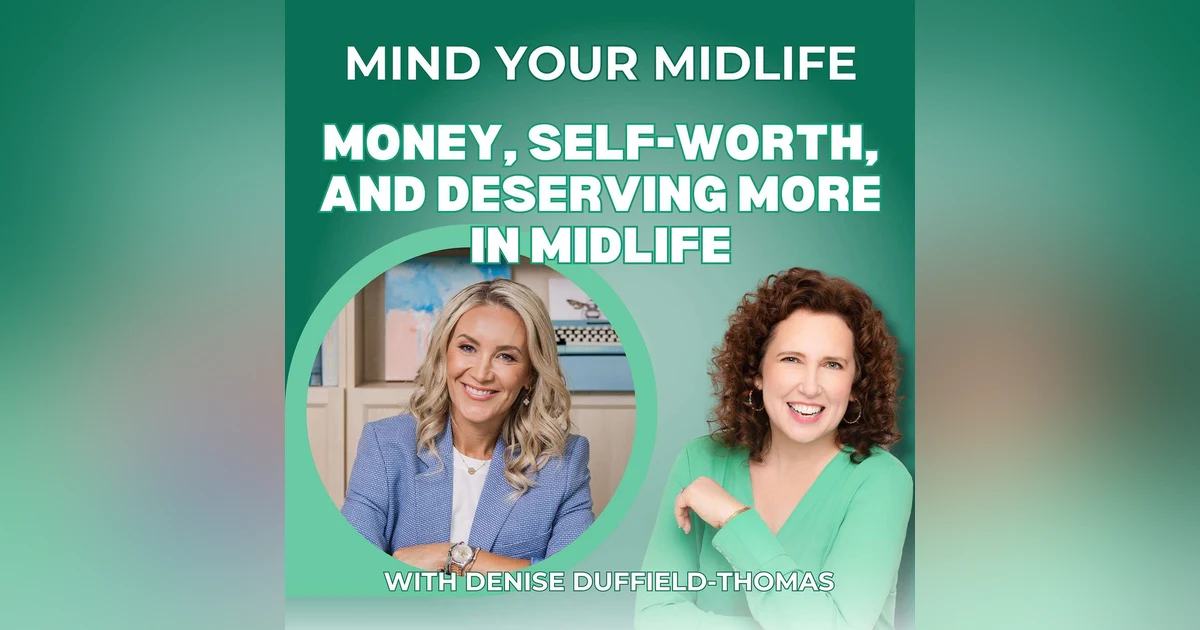


Are you a woman in midlife who knows she wants more ease, freedom, or financial security — but still feels uncomfortable receiving, charging, asking, or even wanting more? You’re not broken, and you’re definitely not alone.
In this episode of Mind Your Midlife, I’m joined by money mentor and bestselling author Denise Duffield-Thomas for an honest, compassionate conversation about money mindset, hidden money blocks, gratitude, the upper limit problem, and why so many women feel unsafe with success, ease, or abundance — even when they’ve worked incredibly hard for it.
We talk about the subconscious beliefs that quietly run the show, how midlife changes our capacity, and why learning to receive is just as important as learning to give.
If money brings up guilt, discomfort, fear, or a sense that “this isn’t for me” — this episode is for you.
What You’ll Learn:
✔ Why gratitude does not mean you can’t want more
✔ What the “upper limit problem” is — and how it shows up in midlife
✔ Why success, comfort, and ease can feel unsafe in your body
✔ Why midlife (and perimenopause) often forces a reevaluation of hustle, capacity, and ambition
✔ Simple ways to begin choosing what you want — without guilt
🎯 OMG Moment:
You don’t just serve — you deserve. Receiving money, care, ease, and comfort doesn’t make you selfish or greedy. It makes you human.
Take Action Today:
- Get curious (not judgmental) about your money stories and family rules around money
- Practice choosing what you want in a low-stakes moment — a meal, clothing, rest, or time off
- Explore Denise’s work, including her books Get Rich, Lucky Bitch and Chill and Prosper, and her podcast Chill and Prosper
- Connect with Denise on Instagram @denisedt
Why This Episode Matters
Midlife is often when we notice how much energy we've spent proving, pleasing, pushing, and holding it all together. It’s also when the old rules about money, worth, and success stop working.
This episode is an invitation to loosen the grip of those rules — to build a life that feels safe, spacious, and aligned now, not
Anniversary Giveaway! See cherylpfischer.com/anniversary for terms and conditions.
**Find bonus episodes by subscribing where you find Mind Your Midlife on Apple podcasts - or go to cherylpfischer.com/bonusepisodes.
🌸 Liked this episode? Share it with fellow Gen X women navigating hormone balance, an empty nest, and/or self-confidence!
🫶 Love this show? Leave a review to help more women over 50 find us.
💡Want menopause support, mindset shifts, or support with midlife transitions?
- Build a mindset for success with the private bonus episodes!
- Book a free Mindset Coaching / Intro Call: cherylpfischer.com/coaching
Let’s talk midlife body positivity, self-talk, and redefining aging for women — without the “midlife crisis” narrative. Every week I'm adding new success strategies for midlife women.
Connect with Cheryl, Midlife Coach: Instagram | LinkedIn | Website
00:00 - Welcome & Why Mindset Matters
03:20 - Introducing Denise & Her Mission
05:32 - Gratitude As An Anchor For Abundance
13:20 - Good Person vs Rich Person Binaries
22:04 - Origin Stories, Consequences, Patterns
31:51 - The Upper Limit Problem Demystified
40:10 - Capacity, Comfort, And Being Liked
48:02 - Hustle Traps, Perimenopause, And Pace
0:00 There are so many points in our lives where we are maybe making a decision that holds us back, or not taking advantage of something that would have actually been a helpful thing to do, or just not even being comfortable receiving money or care or gifts from someone. There's a lot of hidden stuff in our heads that can hold us back. And today we're talking about the money stuff. So here we go. Welcome to Mind Your Midlife, your go-to resource for confidence and success, one thought at a time.
0:43 Unlike most advice out there, we believe that simply telling you to believe in yourself or change your habits isn't enough to wake up excited about life or feel truly confident in your body. Each week, you'll gain actionable strategies and, oh my goodness, powerful insights to stop feeling stuck and start loving your midlife. This is the Mind Your Midlife podcast. You may have heard me say before that in the past, this is many years ago now, but in the past I really poo-pooed personal development. I thought that all the mindset stuff was silly and that what we really needed to do was just work hard and learn what we needed to know and just do the thing.
1:31 And then I started my own business. And when I started my own business, initially I did all the things and it grew quite quickly, but then I got to a point where I was trying to promote it to that next level and I couldn't quite get it. And I kind of fell back. And then I tried again and I almost got it and I fell back three times. I almost got to this next level of business that I was trying to get to, and I kept falling back and not making it. And I was realizing how powerful the head trash that we all have hidden in there, or even to put it more simply, just those subconscious beliefs that we have in our heads.
2:15 Some of them may be productive beliefs. It's beliefs about how the world works and the how the consequences of our actions will come about. And money, it's in there. And I started to realize that held the power for me. And I was at times doing things that messed me up or held me back. And here I am helping others to get through that. Now, today I have an exciting guest for you. Denise Duffield Thomas is the money mentor for the new wave of online entrepreneurs wanting to make money and wanting to change the world.
2:56 And she helps women get past this head trash about money and about success. She has written three books. Her latest is called Chill and Prosper, and I will link to those in the show notes to make sure that you can grab them if you want to. And her Money Bootcamp has helped over 10,000 students from all around the world. You'll also hear us talk about her podcast, Chill and Prosper, and she lives on the east coast of Australia. So I am super excited to welcome you today. Hi Denise. Thank you so much for having me, Cheryl. I'm glad we finally hit record because I think I feel like we could have talked in the pre-show for hours.
3:41 Yeah, that was a little dangerous. We might have forgotten what we were here for. Story of my life. Well, that's a good thing. It's a good thing. We're friendly, we're getting along. It's a good thing. Okay, so let's dive in. I want to start with this trap that we fall into sometimes, I think, as women, where either we don't want to be grateful because that means we shouldn't want more, or when we're grateful we think we shouldn't have more, or I don't know, something weird in there. And so tell us how that becomes a money block or a way that we hold ourselves back, and then maybe we can talk about what we could do. I would say there's one time that I have a couple of times a week, and because I do ballet, and at the end of the ballet class, it's called the Reverence.
4:28 And it's basically you curtsy and you say thank you to your teacher. And I always take that moment to be very present and to say, I'm so grateful. I'm so grateful to be here. I'm so grateful for dance. And I think those moments become little anchors and little pins in our life to say, I am here. I am here, I am present, I am experiencing this moment. And you know, I've been in this personal development space for quite a long time, and I've heard this idea about gratitude being such a great tool for abundance, and I remember Oprah talking about this too, and she said that for all of the tools she's learned in all of her life, gratitude is the one that she does regularly, and she does it every single night.
5:17 She writes down five things she's grateful for. And again, I I rarely think about that way, except for those ballet classes, right? And I think the tricky thing is when we uh desire things and we want things and we have this um idea of how our life would be, and sometimes we spend a lot of time thinking about that and creating dream boards and visualizations and thinking about that. Gratitude, I think, is the thing that keeps us feeling good in the lag time between where we are and where we want to be. And that is so important because if we're constantly living in the future, most of us have this very idealized idea of what that would look like.
6:05 Especially the version of ourselves with more money. And we think, well, the the wealthy, you know, the millionaire Cheryl version of me, she would be perfect. She would never yell at her kids, she would never be mean to someone, she would never think anything bad about herself or others. And it's almost like we've got this this like non-saint-like version of ourselves. And the more we idealize that version, the more we're just we're never going to be able to live up to that. And so the idea of us having more money always just seems like a pipe dream.
6:47 And I think my um one of my roles, I think, in this world is normalizing talking about money, normalizing also imperfection around success and money. Because when we realize that we are we are on our journey, we are going to be the same person with or without money, and largely would be the same person in any time, you know, in history, if we were born in any country, would probably be the same. And then you can start to give yourself permission, I think, to be imperfect in the now around every part of your life. And then I think the more we can collapse those two time frames together, one having gratitude for what we have, but also um love and compassion for ourselves, then we can actually take the actions towards that idealized self because you realize, oh, I'm not waiting for things to be perfect.
7:44 Um, I'm not waiting for the absence of fear. I am that person already. And I think, yeah, gratitude just helps us feel better, I think, in that lag time and more present because that's when you know we get that lottery. Sorry, that that lottery mentality where we make money and then we don't know how to hold it because it's so foreign to us. Well, we're gonna talk about that because I think that's related to the upper limit for sure. Yes. Before before we go to that, you said something that kind of piqued my interest around this idea of we would become this perfect person when we had the money. I think sometimes also we think we're gonna become a bad person if we have a lot of money, or you know, money causes us to be greedy or selfish or something.
8:34 Sometimes I think that's hidden in there too. It really is, but it is again this separate self, isn't it? And we can't even fathom what it would look like for us on a daily basis. And I'm not even necessarily talking about money here, because for some people it's like when I'm thinner or when I'm magically organized. I hear that a lot, right? It's like I'll do this, I just need to get organized. And I go, you're probably never going to, right? So why don't we just embrace it now? And it is that feeling of like there's something outside of me, and it's very binary sometimes.
9:15 True. Uh what I love digging into though is finding out what people's binary rules are, because we there's some universal ones for sure, but I feel like everyone's got their own little thing. So it's like I can be, I can be rich or I can be a good mum, but I can't be both. I can be rich, I can be a good person, I can be rich or ethical, I can be rich and have love. And sometimes those um those binaries come from our experiences from childhood where we, you know, maybe you grew up watching those uh hallmark movies, the Christmas Hallmark movies, where it's like, you know, the successful career woman, she goes to the small town and then she finds love, but she has to give up the career for it.
10:01 And I love that we're coming to that season, right, where all of those movies come out, and it is the same story again and again. But that's uh though that could be one little thing. Like I grew up watching, um, like I'm 46. I grew up in the 80s where there were a lot of reruns of 60s shows like I Dream of Janie and um uh what was the other one? Bewitched. Yeah, and they were on after school every day. And the message from that is you could be this magical, amazing, powerful woman, but you had to hide it. You weren't allowed to use your power, and even the husbands were always really annoyed when they used their powers to do housework, like the most mundane thing.
10:48 And it was like you can be magical, but you should do it the hard way because people will judge you, or somehow your big secret will come out that you're this powerful, amazing woman, and so don't use it. And they weren't even using to do anything fun, it was like to do the housework. No, no, no, you should do that yourself. And I as a kid, I really, really wanted this executive life watching uh She Devil. I don't know if you watched She Devil, um but it was like oh it was um amazing. But it was like Merrill Street was this big fancy writer and this this downtrodded housewife played by um Roseanne Barr wanted to have her life, you know, and she started her own temping agency, and it was like my god, this this idea of this glamorous office life was just like, oh my goodness.
11:47 But um, I think again, it was just the message constantly in those movies was you're a bitch. Like if you want leadership and power and money, you have to be a bitch, and then you get criticized for being a bad mum or being a bad friend or whatever, and you have to give up. And I think that's what so many of us are afraid of is that I will have to give something up. And when we really dig into people's reasons about why they're blocked around money, I often hear people say, But who will I be friends with? Oh, interesting, right? Because I won't have any friends. I won't have any friends, I'll be lonely, people will want something from me, they'll be jealous, and it's it feels like a real burden when you start to really dig into why are you scared of having more money?
12:36 And from the surface, especially in America, it's very much like of course you want money money. Oh, yeah, for sure. Of course we want to win, yes, and like I'm married to a Brit, I'm Australian, I see the cultural differences a lot, but I think for like there is that feeling of like, am I a bad person for kind of wanting this? But in America, sometimes it's what's wrong with me? Of course I want money, but it's like, but do you? Let's look at why you might be holding yourself back on this and why it's not safe for you to want more money. And that's the that's the big one. It has to feel safe in our bodies, and for some of us it really doesn't.
13:20 And a lot of that still probably comes from what we're talking about, either messages we've gotten from things we've seen or read, or our situation growing up. Maybe we always saw people with money as a certain way, or yeah. Um, but that's interesting that you say maybe we don't want money like we think we do. Interesting. And what I get people to do is uh and with my work, right, is very much about curiosity, curiosity and compassion. Um, I'm not a psychologist, I'm not a financial advisor, but I am um I'm curious and I teach people how to be curious about their own lives.
14:01 So what we do, we do this process I call OCP, where we look for origin stories. What are some things that are um that stand out to you? And what what often we do? We go we go very general at the start. So we just go, what are your money memories? What do you remember about money? But when a pain point comes up for people, we look for very specific stories. So if someone says to me, um, you know, I can't send out invoices, what's going on? Right. So that's actually the C part of OCP. It's the consequence. Here's a consequence and a cost that is coming up for you. I cannot send invoices, which obviously costs you money, right? I've had Yeah, I've had people say I've quit my business because I could not receive the money.
14:44 I had a personal trainer say she would she would just go, I can't, oh, give it to me next week. And then of course people would never give her money. She had to stop doing her business, right? So then we look for what are some specific origin stories around this particular problem? And if sometimes people can think of one thing, they go, Oh, yes, you know, someone stole my pocket money when I was a kid, and I've obviously made a decision, it's not safe for me to handle money, something like that could be a very specific thing. But sometimes it's a very general thing, and it will be like, what are the unwritten rules of your family? And one of them could be it's very impolite to talk about money, which is not an uncommon thing, right, for people to hear.
15:27 And you might have been told that explicitly, you might have been told it implicitly, it could have been very hidden, it could have been very secret, but this idea that talking about money is tacky or it's very rude, and so you can then draw a very clear line, right, to the consequence consequence of this. I can't set my prices, I can't say my prices, I can't put my prices anywhere. If someone asks to work with me, I cannot say how much it costs, I cannot send an invoice, I cannot chase up an invoice, I cannot um correct someone if they pay something incorrectly, I cannot send out my bank details, whatever it is, you can see there is a massive cost and consequence.
16:11 Wow, of course, of course, of course, right? And so then the P is the pattern interrupter. And this can come in so many different ways, short-term, long-term, whatever, behavior change stuff. But even a pattern interrupter is awareness. Absolutely, right. That and that moment you're going, of course. When you hear other people's stories, and you go, of course, why wouldn't you? You can see it directly, right? You go, oh, yep, yep, I can connect the dots on that. The more people's stories you hear, the more you dig into your own with curiosity and compassion, you just go, anyone would feel that way, right?
16:54 So that's that's such a huge part of it, just the awareness. But also, this is why I curate groups around this. I have my money boot camp. Because when you start to see other people just talk normally and honestly about money, you know, when you educate yourself around this, when you maybe get some coaching or some accountability, or you read a book about it, then you see that there is a different way of being, and also, oh wow, that person didn't die when they talked about money. And it's actually okay to talk about money. You can do therapy, you can do somatic work, you can do things like emotional freedom technique, EFT. Yes, tap all of these things. Yeah, tapping, all of these things are great pattern interrupters, but I think so much of it is that awareness of going, I didn't even realize that that was a thing.
17:37 Oh, no wonder I feel that way. And that's the fun part of my work, right? It's just like, oh, tell me your stories. Oh, oh, let's connect to the dots on that. And that's one example, and there's so, so, so, so many. Yeah, it's uh I'm in my mid-50s now, so we're not that far apart in age, but a little bit. And about 10 years ago, I had a very interesting experience with my dad. He was moving into his retirement neighborhood, and it's a very nice neighborhood. He has a nice home, nothing huge or anything, but very nice. And he said to me, I think I live in the rich neighborhood now. And he was like scandalized, like, oh no, I live in the rich neighborhood now.
18:22 And I was like, well, first of all, no, but second of all, good for you. You know, why is that bad? But I really, really thought about that a lot. Like, why is he saying that's bad? I've probably absorbed something from that. Maybe if that was always his attitude. It's very interesting. Well, I think too, depending on where we grew up and and how we grew up, some some societies are more class divided, right? And you know what your class is and you know who you are. And I think we we kind of live in this amazing place at the moment, I think, where the boundaries aren't so cut and dried. Yeah. But I totally, I think we all kind of know what that feels like to be like, oh, this is this is not quite my thing.
19:08 And some of us we are cycle breakers or some of us we're you know, class breakers or whatever, and we know what that we're like, oh, I'm gonna stretch into doing doing that, and we have more awareness of what what things are. But I I totally uh resonate with your dad because a couple of years ago, um, like I built this amazing house by the beach, and I was so the closer and closer we got to move-in date, that's exactly how I felt. I went, I'm moving to this rich neighborhood, who what are people gonna think of me? And I was incredibly uncomfortable with it, and even to the point where we had some really, you know, cool things in this new house. One of them was under floor heating in the bathroom, and I didn't use it for six months because I kept I kept on thinking, but what if I get used to this life and I can never tolerate.
19:59 Get cold feet again, you know. Like, who am I gonna become? And it was, I didn't use my office for a couple of months either because I was just like, Who am I? Because it just was shaking the walls of my identity a little bit, yeah, and I didn't know how to handle it. Yeah, such a good point. I think we probably all do this to ourselves sometimes in little ways, sometimes in big ways for sure. And that really is what we're talking about with the upper limit problem concept, right? There we we sort of have this thermostat setting and we don't feel comfortable going higher than that.
20:39 And so, what do you hear is a pattern for a lot of women, especially like in the 40s and 50s, where they sort of are hitting their upper limit and struggling with that?
21:36 Yes. So um so the person who coined that term is Gay Hendricks with his book Um The Big Leap. And I think that's such a great book because it really does talk about this idea of this upper limit problem where we get very blocked or triggered. And I it's actually I like to really nut it down into actual categories. And this is what I get people to do when they come and join my money boot camp, actually. We've got this questionnaire, and I get people to rank things in their life, whether they are economy, premium economy, business class, or first class. Because I think breaking it down like that, we kind of have a general sense of what that feels like in our life, right?
22:19 Yeah, and when you're on a plane, there's very particular signifiers that show. And I have flown in all of those categories and they are very deliberate things. It's like, oh, the toilet paper's a little bit nicer, you know, you get three olives instead of two olives. You get, you know, the the silverware gets a bit nicer. All of those things. And it is very, very, very deliberate. In our own life, though, sometimes it's quite difficult to figure out what those categories are because of some of our conditioning. You know, it's like, well, what is what is the minimum standard in my family? And that can be very different. And what I find most of all, it's contrast.
23:01 What do you have compared to what other people have? How did you feel about that contrast? And that's why I think when I very first started this work, I was like, well, I grew up poor, so of course I've got money blocks. But I thought, but if you grew up wealthy, you wouldn't have money blocks. Which is not really true in the end, right? It's not true at all. Because we all have these, like we has when I talk about the contrast, so I'll say to people, how did you grow up? And they go, Well, I thought we were middle class, but actually my family were very poor. But I didn't realize it because of the way they talked about money.
23:44 You know, my family were very optimistic, we were very grateful, you know, we um we took care of what we had, and you know, I felt like I never wanted for anything, which is really interesting, right? And then someone else might say, you know what? I actually found out later on that we were very wealthy, but the way my family talked about money was that we always felt like we're one week away from being homeless on the street. Oh gosh. Yeah. Or someone would say, you know what, sometimes we were wealthy, sometimes we weren't. We had this very roller coaster life. And when I say about the contrast, I've heard people say, you know what, we were middle class, but I I went to this really fancy school, so I was the poor kid.
24:28 Right, right. I've heard other people say the opposite to say, actually, we were kind of poor, but my family had slightly more than other people, and so I was the snobby rich kid. Even though their life was the you know, yeah, premium economy, but for other people in their life, they were like, no, you're super fancy. So when I get people to do this questionnaire, it's really interesting just to see what the flavor of your life is, but also what what's your meaning around it? And the upper limit stuff's coming, I promise, but it might be you start to go, oh, I look at all these things I'm putting up with. You know, I've got a squeaky chair and I've got ripped clothes, and it's again, it's usually how you feel about those things.
25:15 So um, you know, growing up, we had to shop in thrift stores, and so for me, I would have thought, okay, that's economy. Now I'm very wealthy. I love shopping in thrift stores for the the hunt of it. Yeah, it's a thing. Yeah, that's my version of a first-class life now. But I think when we first start this work and you go, wow, look at all these things I'm putting up with. And then we get people to start to improve their life a little bit. You know, like think of a DJ board, and you're just like, I'm gonna try, what does that feel like? Oh, I'm gonna put take the volume down on this. And at the start, we think we think our millionaire life is gonna be every button's pushed to the top.
25:55 I'm gonna have the fanciest clothes, I'm gonna have the fanciest house, I'm gonna have the fanciest car, I'm gonna have everything the best. And life's not like that. You know, you start to go, I'm allowed to choose according to my values, not according just to cost. Oh, okay. And I started to overcompensate in some areas. I was like, well, if the more money I make, I get I guess the fancier I have to look. So I'm gonna now uh I'm gonna if I'm gonna upgrade my shoes, well, I'm gonna push it all the way to the top and have high heels. And then I was like, I actually don't like wearing high heels. Why doesn't it feel good to me? Right. And so then you start to have to develop discernment. Yeah, what feels good for me.
26:36 And so this is where this upper limit stuff comes from, is that you'll start to go, there'll be things that don't feel right for me. There'll be things that feel like that there's too much, but also there's learning, and this is what he talks about in the book as well, is that some of us don't know how to deal with good feelings. True. Some of us don't know how to deal with like, am I allowed to have time off? Am I allowed to um have comfort? That's when the icky stuff starts, and it becomes it's not then a class problem, it is our capacity problem. And I think we have to learn that. And some for some women, it is the unlearning because where we might be used to saying, but what am I allowed to have?
27:22 What is appropriate for me to have? What is the uh perfect amount of comfort that is also gonna um no one's gonna disagree with me, yeah, you know, where I'll still be liked, where I'll still be a good person, where I'll still be a good mum. Right. And it's a very complex kind of thing. Absolutely, absolutely. It's it's making me think of the should problem. Where should I shop? What should I look like? What should I have? And as soon as should comes into it, then that's a whole nother thing. Oh, absolutely. Because what do other people think of me? What am I allowed to have? What it and we don't want a lot of contrast sometimes.
28:03 We don't want to stand out. And so so many of us, we're still making decisions from that place of being a little kid, being, you know, a teenager, thinking about what our friends would think, thinking about what our long-dead grandmother would think. And uh then people go, but I don't know what I want. And so it's easier sometimes to think of this idealized version because there's no like complexity, right? It's like I'll just be this perfect version of myself. And it's like, yeah, but you'll still have to like live life, you'll still have to be a human, but it's easier to think, oh, well, that's not for me, instead of going, okay, what do I truly desire here? And that is adjustment.
28:46 That is adjustment, and I think we're we're very scared of the consequences of that. Um, and I think so many of us, it is I will not be liked. Um, people will not like me. Yeah, and I can see very, very painful. Yeah, yeah, yeah. At the base level of all sorts of things you've named, I can see that somebody's not gonna like me, somebody's gonna judge me, I'm gonna stick out, I'm gonna be different, whatever. Yeah, it doesn't feel safe. No, it doesn't. And it's we've all experienced that, and it's not fun to experience it. And there will be times that that things like not life is not gonna be perfect.
29:26 But I think when I hear people especially starting a new business, what they're really asking me sometimes for advice is how can I how can I build a critic-proof business? How can I um find the critic-proof price to price my services with? How can I build this critic-proof life? And because I don't want anyone to unsubscribe, I don't want anyone to ever ask for a refund. I don't want anyone to you know say something mean about me on the internet. And we we get very consumed with trying to build that, that we actually then for so many people, they don't even do anything, they get stuck and paralyzed, and we can see why, we can feel that. Um, but also uh there's a that procrastination comes into play.
30:08 I see people quit businesses at the the first hurdle because they cannot handle that someone doesn't like them, and I get it, I really get it. I would I build my life like that too often. Um, but that's that's where it comes into. We have to build a life, our version of a first class life. And that could look so different to what your family expected from you, what other people expect from you. And some things will be better than you thought, some things you'll go, oh, okay, I don't want that. And you'll overcorrect, you'll overcompensate. And I've definitely gone through that, I've gone through my new money phase, and I'm sure I still will, where I was like, Oh, I thought that's what would be really good.
30:50 I actually sold my beach house because I didn't like living near the beach. I realized I was like, it's too bright, it's too busy. I was like, I don't like, I never went to the beach, and um, and I had to I had to right-size that, and you know what, the same feeling came up. I was like, oh, people are so invested in my dream of living by the beach. I have to, I've made my bed, I have to live in it now. And and it's but it's this, I know that sounds like rich person problems, but it's the same, it's the exact same emotion that we feel of like, I can't start a business because what if someone's mean to me, you know, on the internet because we just we want to please. And that's I think so much more for women than it is for men, is that we I think we really overthink the consequences of all of everything that we do, you know, and what that means for us as uh as a person.
31:43 Yeah, I I I couldn't agree with you more, and I I'm thinking this whole on the internet thing is such a a whole thing that we could go fall down into a rabbit hole and we probably shouldn't. But that being said, I remember I'm trying to think who it was. Somebody once told me in a training that nobody is paying attention to you in the way that you think they are, and even if they make some comment or they see something and they're going right past it the next day, it's gone. Like nobody cares about what you think, you know, you changed your mind, you close this, you change that, you redo this. It's okay. Nobody's gonna say, Hey, weren't you three months ago offering this other thing?
32:26 Did that not work? Why did that not work? They don't remember. It's okay. They know everyone's in their own little bubble. And and I have to say though, spoiler alert, if you do anything in life, there will be people who will not like it. And especially if you are doing things on the internet, if you're doing something different, but that is often, you know, your selling point. You know, if you're thinking, oh well, no one wants to see, you know, a 50-year-old woman do blah blah. I'm like, yeah, but maybe teenagers don't want to, but other people will love it, and who cares? And you will get people who'll make comments. You know what the best, the best, best thing I've ever heard?
33:08 Someone said, You look like the crazy girl who goes out first on The Bachelor. And I remember I I wrote back and I said, I know you're trying to be mean, but that is actually the funniest thing I've ever heard. And I just thank you so much. Because I and I was genuinely thankful because I was like, this has actually cured my fear a little bit of being criticized on the internet because it's so ridiculous. And also, when people make comments like that, I just go, Who raised you? Yes, like who raised you? You are so you were so rude, and I I really don't take it personally, but I think it's so funny because I actually could see that. You know, there's always someone who's a little bit witchy and weird, and I'm like, yes, that would totally be me.
33:54 Um and you just kind of go, Yeah, cool, thanks, and block people. And I think it's cool too to just be like, oh, I didn't, I didn't die. Well, someone criticized me and I didn't die. But that being said, having that compassion for yourself and doing those modalities like tapping and things like that, because the fear is very real. And if you did have experiences of being bullied or ostracized at school, that will absolutely carry on into your life as an entrepreneur, you know, as a human being. And so anything you can do to get that out of your body, and and it could even just be that affirmation: it's safe for me to be visible, it's safe for me to do what I want to do, it's safe for me to have happiness and read books like The Big Leap to help you expand your capacity for more.
34:45 Yeah, absolutely. Now, let me just make a little segue from that then, because in your book, Chill and Prosper, you talk about creating a business or doing what we want to do in life, but without all the hustle, making it more chill, I guess I'll take your word. So I feel like if we we might fall into the trap of saying, okay, I've decided what I want and I'm aware of where I might stop myself and I'm growing, I'm growing. Well, now I better keep doing it, I better work hard all the time, otherwise it's not gonna work. And that's a bit of a trap, too, right? It's a massive trap. I I have done that myself as well.
35:26 And actually, one of the things that I did as my business grew is that I increased my expenses, and so then I was almost trapping myself in that work phase, and so I remember thinking, oh, okay, and this is this kind of came around to the beach house thing where I was like feeling that niggle of going, I don't really like living in the beach, and and I I mean we built this beautiful big glass house, right? And as an introvert, worst nightmare ever, because people could literally see into my house. And then I went, I'm trapped in this. Like I I have to keep on working for this, and so I'm glad, you know, I I recognize that.
36:10 And I think there's times where we do have to pause and say, okay, even on that like first class economy class, I go, okay, am I working the hours that I want? Am I working with the clients that I want? Am I really truly enjoying all of this? And here is the tricky thing: giving yourself permission to change your mind. Yes. Because what worked for you in one phase of your life may not work for you in the next. And I think women feel an enormous amount of guilt around this. I see people who go, I'm about to have a baby, but don't worry, I'm gonna to all my clients, don't worry, I will still be available for you 100%, you know, or feeling really bad.
36:50 Actually, I think I want to go traveling. Yeah, or I think, you know, I invested in this particular dream, and people are invested in this, and I actually don't want it anymore. And giving ourselves permission to change our mind, I think, is a really big deal. So for me, I felt really guilty about changing my mind about that dream for other people. And I was literally like, how am I gonna communicate this to my audience? But the other big shift that happened for me, and I'd be curious what happened for you around this age, is for me going into perimenopause was an absolute line in the sand of like, I cannot work like I used to anymore. Yeah, I fully agree with that. And interestingly, I made a massive career switch in my early 40s, I guess it was.
37:36 Uh, I had been teaching and I switched everything throughout maybe a five-year period. And I only look back now and realize what was going on there. At the time, I was just getting burned out and I was like, I need to do something different. But yes, it was a reevaluating of what do I want to spend my time on and where am I going? And I have maybe 15 years of my career left. What do I want to do with it? It was just kind of taking time to think all that through. Yeah. Well, that's exactly where I'm kind of at, right? So I'm 46 now. 41. I was like, I think I have dementia. Like, I no, and I'm serious.
38:17 I shouldn't laugh because it is. I'm sure that no one listening has dementia in their 40s or 50s. Probably, I mean, it's it's a midlife thing and it gets worse. Yes, yeah. Absolutely. And so, and also undiagnosed ADHD, which I've heard is a massive big thing for a lot of people. That's when they find out they have ADHD, which they've been coping with their whole life, which is exactly what I did. And I was like, I I can't do any of this anymore. I mean, I have I have never done a ton of speaking, but I was like, I can't speak on stage anymore. I can't travel like I used to. I mean, all of this coincided with the pandemic as well, with you know, so many global changes.
39:01 Yeah. But I um, and so I've spent the last couple of years really redefining what some of those things look like in my business. And one of those things for me was an ego death of having a business that doubled every year. Even though I've always been the person who's been like, how can we find the easiest way to do things? You know, I've never been like a hustle-for-hustle sake person, but I still had that identity, I think, of going, I still can do it. And there was a feeling of like, I can, but I actually don't want to. And so that was a big shift of going, okay, we moved to the suburbs because we're five minutes now from our kids' school. Instead of, you know, working as much as I used to, I go to ballet class eight, eight hours a week.
39:46 I've been doing cross stitch and diamond art and silly little crafts. And some of that is that ego death of going, is that it? Is that is that my ambition done? But realizing, oh, I am in a phase of life where my kids really need me and I do not have the capacity for this. And giving ourselves permission too, that that might change in the future. And I think that is very tricky for people to realize of going, I have to keep on hustling, or I've made my bed and I have to lie in it, or I've got all these expenses that I have to continue, or people need me, or they see me in a particular way. And that is again that idea of that first class life being like a DJ board.
40:31 Some of the things can dial up and dial down when you want to, they're not fixed in stone, right? It's like, oh, okay, I don't want to do that as much anymore. I'm gonna pull that one down a little bit. Hey, I'm gonna drive this one right up, and I Think again the biggest learning I see for women is permission to do that. That you are allowed to choose and discernment. And that is so tricky as well, right? And the way I get people to practice this is go to either the fridge today or if next time you're in a restaurant and really truly say to yourself, What do I feel like? Because I think so many of us we're just we we act on default or we're like, well, what's available?
41:11 Or what am I allowed to have? Or what's in my budget? Or we're conditioned to always choose the cheapest, or um, you know, whatever it is, and to really truly ask ourselves in this moment, in this phase of life, what are my tastes? What do I actually truly want? What does my body need? And some of us have never really asked ourselves the question. That's a real fun experiment. It is, and and I love this idea of the restaurant. And I have a coach uh who told me this at one point go to a restaurant, don't look at any of the prices, pick what you want. So I fully agree. She said, just pick a restaurant where you know you're not going to break your budget completely, you know, even if you pick the whatever, the highest thing.
41:53 So be smart. But yeah, I agree. We don't let ourselves think about how we really want to feel and what we really want to do. And sometimes it's rest. And some I took up knitting and I give myself time to do that, and it's really good for my brain. So why would I not? You know, so it's it's interesting that we hold ourselves back from allowing that decision making to happen. Well, same on the menu thing, but it's probably a little bit less stay high stakes. Um, is go into a shop and before you look at the price, have a look and go, what colors do I really like?
42:34 What fabrics do I like? Try things on, because that will have the exact same reaction. You'll go, no, no, no, what am I allowed to have? Or maybe, you know, how much do I like it? For you look at the price tag, say, how much do I like it? Right. And I'm not, we're not saying go and just blindly buy something. Of course, yeah. We're saying get used to what your likes and dislikes are, maybe for the first time in your life, or see how it's changed over time. And what I have found at the moment is I am I am developing my childlike wonder again. And that has been really fun to see that there will be cycles in your life as well where you go, you know what, I'm putting that down for a little while.
43:18 Oh my god, I'm re-bringing, and this is who I always was. And I've I've had so much joy and delight in that of going, wow, this is this is really me going to dancing. And I remember that feeling as a kid of just going, oh my god, I've got dance again. This is so exciting, and now I can choose to do it. Yeah, it feels good. It feels good. Okay, so let me ask you, while we have a few minutes to go here, how can people find you if they are interested in learning more about what you do? Oh, I thank you for asking that question too, by the way. I really appreciate that. So um I'm on social media at Denise DT.
43:59 Super, super easy. Um, I love getting DMs, by the way. I love hearing people's stories. And my website is denised.com as well. So I'm very easy to find. I've got a podcast called Chill and Prosper that you can just find on Apple or whatever, um, wherever you listen to your podcasts. Perfect. If you're interested in really looking at like the fundamentals of money blocks, my book, Get Rich Lucky Bitch, kind of talks about that. And then my book Chill and Prosper is more about bringing that into your business. Um, so they're I think they're good places to start as well. And you know, you can get them from all the places. Yes. And if you're listening, I'll make sure to put all of that in the show notes so that it's super easy. So perfect.
44:39 Okay, so as we wrap up, here's what I always ask at the end because I think everybody listens to podcasts while we're doing dishes or driving the car or whatever. Yes, we can't remember everything. Yeah so what is the one thing that you want somebody listening to take away from this? Well, I've put it into an affirmation form to make it even easier. And so it's yes, it's I serve, I deserve. I serve, I deserve. And this is a reminder that life has to be in and out. You can't just give, you have to receive as well. And you're a good person and you do deserve, you work hard to help people, you deserve in return.
45:24 And so to always see that this is a give and take. And if you're always just giving output, you can't help anybody. So you can really see there's there's something in there for everybody. If you're a nurturer type and you definitely go into martyrdom and things like that, you have to remember that thing about the oxygen mask, right? If you can if you don't have that, and the reason why we say that to nurturers is because then you cannot serve other people, exactly, yeah. And that's how you have to trick your brain. It's not selfish, it's so I can help more people, it's so I can show up. And I think for anyone who feels guilty about the money side of it too, that's a good affirmation to say, no, I serve, I deserve.
46:07 And I actually used it this week because I just bought a new car. And you know, my car, I kept on going, whatever, like I've got kids. But the last couple of months my car was starting to like fall apart, right? And I felt guilty about having a new car. And it's so funny because all the things I talk about are things that I'm experiencing as well. I'm not ever sharing it from this lofty perch. It does not matter how much money you have, you can still feel that feeling of undeserving. And the money will not make that feeling go away. That's why that is going to be part of your journey. And so I literally have sat in this lovely clean car and I'm going, I serve, I deserve.
46:47 I serve, I deserve. And it's something that I've I started saying literally like 15 years ago, and when I was, you know, fairly broke, and I still have to say it now all the time. So it's a good one to remember. I serve, I deserve. You can write it down somewhere. Um, and I think it will really help you when it's when coming to anything, pricing, but even just feeling good day to day and feeling grateful day to day. Yeah. I love it. It it kind of handles both sides that we recognize we're doing things, maybe helping others, and that means we get to have things, and it's okay. Love it. It's okay.
47:27 Well, Denise, thank you so much for joining me. I know that people are gonna get a lot out of this. Well, thank you. Uh it's been an absolute pleasure pleasure, Cheryl. Thank you for having me on, and thanks everyone for listening. I serve, I deserve. There's so many meanings we can attach to that, and I really, really love that that's what Denise wants us to leave this episode with. Of course, there were nuggets all through our conversation. If that's the one thing you remember, hold on to it. You serve, you deserve. You do things that matter and you deserve to receive as well. So make sure that you head over to the show notes.
48:09 I will have links to Denise's books at CherylpFisher.com slash read. Make sure you check out her podcast, Chill and Prosper, and her website that she mentioned. And make sure you check out the private podcast that comes out weekly. You can go to CherylpFisher.com slash bonus episodes or just subscribe on Apple if you are listening to Mind Your Midlife there. We are talking about how to stop being our own worst enemy. So that's pretty related to what we've been talking about today. And then new topics will be coming every month. Every month is a new miniseries. Thank you so much for joining us today. I hope this episode matters for you.
48:53 Find me on social media at Gerald P. Fisher and tell me what jumped out for you in this episode. I would love to hear. And keep remembering, midlife is your time to take just a little bit better care of yourself. On the outside and on the inside. Just a little bit more care makes a huge difference.

Money Mindset Mentor
Denise Duffield-Thomas is the money mentor for the new wave of online entrepreneurs who want to make money and change the world.
She helps entrepreneurs like you charge premium prices, release the fear of money and create First Class lives.
Her books Lucky Bitch, Get Rich, Lucky Bitch, and her newest Chill and Prosper give a fresh and funny roadmap to living a life of abundance without burnout.
Her Money Bootcamp has helped over 10,000 students from all around the world.
She’s a lazy introvert, a Hay House author and an unbusy mother of 3. She lives on the East coast of sunny Australia with her family and two fur babies.