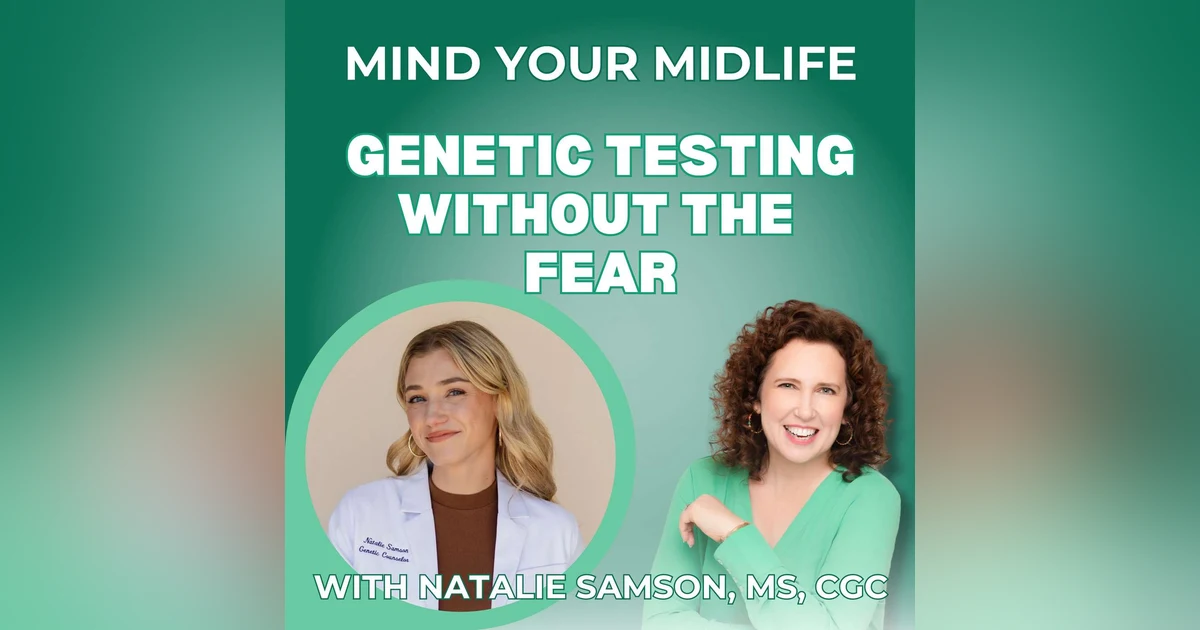
110. Genetic Testing for Better Health Without The Fear, with Natalie Samson


Quick Summary:
Genetic testing isn’t only about finding scary disease genes. Board-certified genetic counselor Natalie Samson explains how today’s testing can help midlife women prevent problems, catch them early, personalize their nutrition and exercise, and find out which medications work best for their bodies. It’s never too late to use your DNA to take better care of yourself.
Intro:
Has a doctor ever suggested genetic testing and you felt a wave of dread? Me too. In this episode I talk with Natalie Samson, founder of Golden Genetics and a board-certified genetic counselor. She has a master’s degree in human genetics and genetic counseling and certifications in integrative healthcare, nutrigenomics and functional medicine. Natalie shows how genetic testing has changed. It isn’t a verdict anymore. It’s a tool you can use for everything from gut health to strength training to choosing the right medication.
What You’ll Learn:
- ✔ The four Ps of genetic testing: how preventative, proactive, personalized and precise care can lengthen your health span, not just your lifespan.
- ✔ Why trends don’t fit everyone: the probiotic story that shows how a “healthy” habit can backfire for your body.
- ✔ How to test wisely: what insurance may cover, the risks of direct-to-consumer tests, and how to find a qualified genetic counselor.
Links & Resources:
- Golden Genetics, Natalie Samson’s practice: goldengeneticshealth.com (book a logistics call through the Contact Us page)
- Free Self-Care Menu: cherylpfischer.com/selfcaremenu
- Episode 101 with Laura Lambe, on menopause information overload
Frequently Asked Questions:
Is genetic testing only about finding diseases?
No. Natalie Samson explains that besides medical diagnostic testing (cancer, preconception, pediatric), there’s a whole area she calls functional genomics, which uses your DNA to optimize things like inflammation, detox, mood, bone health and exercise.
What are the four Ps of genetic testing?
According to Natalie, genetic testing helps you be preventative, proactive, personalized and precise. Together, these support a longer health span, meaning more years of good quality of life.
Can genetic testing help with gut problems or figuring out which supplements to take?
Natalie describes a client who took every popular probiotic and ate fermented foods, but her gut pain got worse. Testing showed she has trouble breaking down histamine. Once she cut those foods and supplements and went low-histamine, her symptoms improved within weeks.
What is pharmacogenomics?
Natalie explains that pharmacogenomics looks at how your DNA affects your response to medications, including dosing and which drugs might cause side effects. She says it’s especially helpful for psychiatric and pain medications, where people often go through trial and error.
Does insurance cover genetic testing?
Natalie says insurance often covers disease-risk panels when there’s a family history. Functional or optimization testing is usually paid out of pocket. Her team works with labs and billing to keep costs down.
How do I choose a reputable genetic test or counselor?
Natalie recommends a board-certified genetic counselor for disease-risk testing; these counselors are often available through larger medical systems if you ask. For any lab, she suggests checking for scientific or medical leadership, a clear privacy policy, and a good explanation of which genes they test and why.
Episode Chapters:
00:00:00 - Why Genetic Testing Sparks Fear
00:01:05 - Midlife Reset And Sponsor Message
00:01:49 - Science Changed Since We Were Kids
00:05:08 - Nature Nurture And Epigenetics
00:10:41 - The Four Ps Explained
00:12:12 - Preventative And Proactive Care
00:21:25 - Personalized Genes For Gut And Mood
00:26:30 - Precision Medicine For Better Meds
00:30:06 - Insurance Costs And Access
00:32:11 - Avoid Bad Tests And Bad Advice
00:35:32 - How To Choose The Right Expert
00:42:10 - Never Too Late Closing Takeaways
Music: Cartwheels by Good News Tunes, licensed by Premium Beats. YouTube ID: NOYTHM5TOK62B7JY
Why This Episode Matters:
Fear keeps many of us from using information that could help us. This conversation turns genetic testing from something to dread into a practical tool for advocating for your own health at any age.
Take a little bit better care of yourself in midlife.
This episode is for educational purposes only and is not medical advice. Talk with your healthcare provider about your own situation.
Lucid Podcast Advertising
Grow your podcast with promos placed on shows your future listeners already love.
Disclaimer: This post contains affiliate links. If you make a purchase, I may receive a commission at no extra cost to you.
🌸 Liked this episode? Share it with fellow Gen X women navigating hormone balance, an empty nest, and/or self-confidence!
🫶 Love this show? Leave a review to help more women over 50 find us.
💡Want menopause advice, mindset shifts, or support with midlife transformation?
- Find out more about the Midlife Recharge at cherylpfischer.com/recharge
Let’s talk health after 50, self-talk, and redefining aging for women — without the “midlife crisis” narrative. Every week I'm adding new success strategies for midlife women.
Connect with Cheryl: Instagram | LinkedIn | Website
---------------
💡If you are a brand, author, or business wanting to reach an audience of women in their 40s and 50s who are focused on health, success, and taking care of themselves and others well in this stage of life, consider sponsoring Mind Your Midlife podcast. More information here.
00:00 - Why Genetic Testing Sparks Fear
01:05 - Midlife Reset And Sponsor Message
01:49 - Science Changed Since We Were Kids
05:08 - Nature Nurture And Epigenetics
10:41 - The Four Ps Explained
12:12 - Preventative And Proactive Care
21:25 - Personalized Genes For Gut And Mood
26:30 - Precision Medicine For Better Meds
30:06 - Insurance Costs And Access
32:11 - Avoid Bad Tests And Bad Advice
35:32 - How To Choose The Right Expert
42:10 - Never Too Late Closing Takeaways
Why Genetic Testing Sparks Fear
Cheryl Fischer
Okay, so this has happened to me, which makes me think that it has happened to you, or at least a lot of you. And that is, I was in a medical appointment and looking at some blood test results, and the medical practitioner said to me, Well, you may want to consider genetic testing. And it wasn't about a disease, it wasn't, you know, a cancer or anything like that. It was general know more about this. And I immediately was just struck with fear. Is that you too? Let's talk about it. If midlife was only about hot flashes, 3 a.m. wakeups, silly injuries, and worrying about everyone from aging parents to adult kids, we'd all be unhappy and isolated. And that's just not true. Whether you're frustrated at work, stressed about retirement, or just looking for the phone that's already in your hand, you're in the right place. Let's change the story around midlife and start loving this chapter. This is the Mind Your Midlife podcast.
Midlife Reset And Sponsor Message
Cheryl Fischer
Growing a podcast is hard, and the listeners most likely to love your show are already out there listening to other podcasts. Lucid helps podcasters reach them. Lucid writes and produces a short audio promo for you. You approve it. Then they place it on podcasts whose topics, audience, and tone are a good fit for yours. You can track where your promo is running from your own dashboard. You can choose an ongoing subscription or a single one-time campaign. If you've been looking for a hands-off way to introduce your show to new listeners, use the link Cherylpfischer.com/ lucid to get $25 off your first month. That's my affiliate link, and using it supports the show. Now back to the
Science Changed Since We Were Kids
Cheryl Fischer
episode. I think we all certainly recognize that science is advancing quickly. Maybe we don't see it directly in front of our face. But here's a funny story. When my daughter was in high school and she is now out of college, so you know, this is some number of years ago, she was getting some tutoring in biology from a colleague of mine I was teaching at the time. And I remember overhearing some of the things that they were talking about and saying to my colleague, I don't think I ever learned any of that. And she said, Well, that's probably true because I don't think we even knew it when you were in high school taking biology. And that just stuck with me. What an impactful statement. Science is changing and it's changing fast, and they're discovering more and more and more. And what we're talking about today is related to a particular area of very quick change, and that's genetics and understanding our genes as humans. I wanted to talk to our guests today because, as I said a minute ago, I think genetic testing instills a lot of us with fear. It feels like, oh no, I'm gonna have the particular cancer gene that means I'm always gonna get that cancer, and there's nothing I can do about it, or oh no, I'm gonna have this or that other terrible thing, and there's nothing that I can do about it. And that's not, apparently, I'm learning along with you, that's not what genetic testing is about at all in this day. So I'm excited to talk to Natalie Samson today. She is the founder of Golden Genetics. She is a board-certified genetic counselor with a master's degree in human genetics and genetic counseling, as well as certification in integrative healthcare, nutrigenomics, if I'm even saying that right, and functional medicine. And she founded this practice to take a holistic approach to genetic counseling and testing, meaning look at the whole person, personalize care, personalize prevention, and whatever else we might be able to do in the case of genetics. So welcome, Natalie. Thanks for joining me.
Natalie Samson
Yes, thank you so much for having me. I'm excited to chat today. I am too.
Cheryl Fischer
This is such an interesting topic because I have to confess, and I think this is very common, that I really thought of genetic testing as a very negative thing because it seems like a topic that is mentioned to us when there could be some big problem. Something is wrong, and we need to find out more, and that's scary. So it has this just aura of scariness. So I feel like what you're gonna say is that that's changing. So tell us more about that.
Nature Nurture And Epigenetics
Natalie Samson
Yes. Yeah, thank you for bringing that up off the bat because we have so many patients that come to us with a lot of fear and hesitation with doing genetic testing. A lot of people are exposed to genetic testing, like you said, maybe through cancer genetics or preconception genetics when something might come up with baby or pediatrics. So, like you said, those can be very emotionally impactful situations where genetics is involved involved, but there is so much more to the world of genetics that a lot of people don't know about. So in our practice, we we do cover things like disease risk and things that can come up, which gives us guidance to be preventative, and we'll talk about that too. But we also cover a whole world of using the information we get from your DNA to optimize your health. So when I like to answer this question too, when people ask me if it's nature versus nurture, I get this question all the time. Yeah. A lot of people think that I think a lot of people think in black and white. So it's either, yes, it's genetic and that's why it's scary, or it's all in our environment. So why would we do genetic testing? But the reality of the situation is it's both, it depends on the gene and how we can utilize that information to optimize our health. So in the world of genetic testing, there is medical diagnostic genetic testing. And that is what most people have heard. That's also where my traditional training actually stems from. So that is the cancer, preconception, pediatric, so, you know, developmental delay, things like that. Those are diagnostic conditions. But there's a whole world where if you have a change in a gene, that doesn't mean you have a diagnosis of something. And that's what our practice actually really loves to cover is the whole world of, I like to say functional genomics. It doesn't really have a good term because genetics is moving so quickly. We just don't even have good labels. But that side is let's say someone might be prone to inflammation. There's so much we can do about it to support lowering the infl inflammation. And that is where that the nature versus nurture and the epigenetics piece is really relevant. And so in our practice, we combine all the worlds and we really our goal is to make people make sure they feel empowered when they're leaving the session and not more scared. And so it's really about utilizing the information for optimization. I perfect.
Cheryl Fischer
Well, so well said. That makes complete sense to me. And clearly, this this feels different than like 10 or 20 years ago. And you said it's changing fast. So you agree. Yes.
Natalie Samson
100%. Yeah. And even when we first started doing genetic testing for health, the first genes were like the BRCA genes, the BRCA, which many people are hearing about now too, with Alex Searle, it's in the news. But those those genes, we we basically had recommendations for screening and surgeries. And that those recommendations have stuck, but now we have so much data and research to understand also how we can support lowering cancer risk through nutrition, lifestyle, targeted supplementation. There's so much more that we can do and that we understand when it comes to risk. So it's not just like here's the information and you're doomed. Now it's and you have to be careful with who you go to because that can exist, but that's not how it should be. So in our practice, it's very much like okay, everyone has something in their genetics. We've identified this. Then what how can we work with it instead of against it or avoidance? So that's where, you know, screening and surgeries can sometimes be important, especially we like to talk about screenings to catch things early, but the nutrition, the lifestyle, the supplementation, potentially medications are all very important to also address when we're thinking about like ways to be proactive and optimize our health.
Cheryl Fischer
Yeah, I I like that approach because I mean this podcast is all about mindset in midlife, right? So if we're just being told that we're doomed about this and we're doomed about that, mindset is a big deal when with regard to health. So that we're down like a spiral of negativity right there. So I think I appreciate very much that we're going in a different direction.
Natalie Samson
I know. And I think women throughout our lives get told that, you know, when I'm experiencing it with pregnancy, it's just like, oh, you know, it is part of it's just part of pregnancy and you just have to get through it. And then menopause, same thing. Oh, it's just part of the symptom, you know, and it's like we always get told, like, oh, there's nothing we can do. But the reality is there's always so much we can do, and genetics is such a good tool to support, especially midlife. So yeah, I love that you brought that up because I I like never take that for an answer anymore now that I've been in the health space and the functional space. I'm like, there's always things we can do to support.
Cheryl Fischer
Yeah, and that helps whoever's listening too, because I guess what we're both saying is don't let someone tell you this is the way it is, and there's nothing you can do. And I appreciate that because we do deal with that. Those of us who are dealing with menopause, we do deal with that with a lot of medical professionals who don't know as much about it yet. Yeah. 100% yeah. Okay.
The Four Ps Explained
Cheryl Fischer
So you told me when we spoke earlier about the four Ps related to genetic testing. So tell us what you mean by that and let's kind of walk through it.
Natalie Samson
Okay. So basically I came up with the four Ps when I was studying genetics. I had, well, originally my career actually started in oncology. So I was seeing patients who were diagnosed with cancer, sometimes late stage. Um, and I actually expanded then into dementia in the traditional space. So while I was working with those patients, I really had this epiphany and it started to be talked about more in my space about the goal is really not just to increase our lifespan, which traditional medicine is great at, but the goal is actually to increase our quality of life. So it's not just the goal getting to the end in a wheelchair. It's can we get to the end and play with our grandchildren? Can we travel? Can we do things independently? Um, and so when I was studying genetics, I had this realization that if we genetic testing helps us optimize four Ps. And when we optimize those four Ps, that gets us closer and helps us increase our quality of life, our health span, not just our lifespan. And so the four Ps are preventative, proactive, personalized, and precise. So I can go through each. They sound similar, but they're different.
Cheryl Fischer
Okay, perfect. You're started with preventative, yes.
Preventative And Proactive Care
Natalie Samson
Perfect. Okay, so genetic testing helps us be preventative because one, it helps us first identify what could come up. So, like we were talking about earlier, a lot of times people will come to me and say, um, I'm doing all this thing, all these things to prevent breast cancer because my friend had breast cancer and that's really scary for me. But when we do genetic testing and we look at their, you know, family history, personal history, it they're not actually at an increased risk of breast cancer, but they might be at increased risk of high cholesterol or heart disease. So the efforts of prevention shift towards being more personalized, which is the third P but, basically uh understanding what you where your efforts should go when it comes to prevention. And so also addressing what prevention is, the way that we view prevention is stopping things from happening in the first place. And so we, when you identify maybe you're at increased risk of something, there are things we can do to never have that happen to you, as long as of course you're not, you're not having a genetic diagnosis. And so if you're predisposed to high cholesterol, how can we work with those genes through diet, lifestyle, maybe supplementation, so that you can prevent heart disease from occurring? So that is prevention. And those genetic tests are really more though those are the disease. The two Ps really focus on the disease risk category. And then the last Ps are more of the functional. So that's that's the first P.
Cheryl Fischer
I appreciate that you're saying lifestyle, diet, all of that, and not just always it's gonna be straight to some type of medication or something, because I know a lot of people who let's take cholesterol, for example. Lipids have a very bad reputation in a lot of circles right now. Like, don't go straight to that, try to eat differently, try this, try that. So I appreciate that you're putting all of that together.
Natalie Samson
Exactly. Yeah. And so we take such an integrative approach and we also make sure the patient's in the driver's seat. So, like, for example, um, you know, sometimes medication can be considered, but in our eyes, there's so much we can do outside of that too. So, you know, we we really of course value modern medicine, but and bring and we recognize all the importance of the other pieces too. So yeah. Yes, of course. And I think I said the wrong word, but you knew what I was saying.
Cheryl Fischer
So Yeah, I know what you're saying.
Natalie Samson
I think I think statins is yeah. That's what I meant to say. Yeah. Yeah, I knew what you're saying.
Cheryl Fischer
And now we fixed it for the listener. Okay. Yeah. Um, so that was preventative.
Natalie Samson
Tell us about the next one. Okay, so the next one is proactive. So something we always like to say is that if disease comes up, it's no one's fault. A lot of patients, for example, like if a patient comes to us with cancer, oftentimes we hear, what did I do wrong? It's all my fault. And so we always want to take that away because of course, prevention and preventative habits are so important, being healthy, but you know, there's only so much we can do. Sometimes things happen at random. And so we never ever want to make the patient or want the patient to feel like anything was their fault. The way proactive care comes into play, proactive is about catching things early if they come up. So that is where screenings do shine. Um, I always say like cancer caught early is a much different story than cancer caught late. I didn't realize until being in healthcare that stage zero or stage one cancer is usually just a surgery. Stage three or four is radiation and chemotherapy with no promise that those work. So it's a very different treatment.
Cheryl Fischer
Yeah.
Natalie Samson
And so being able to first identify what we are trying to catch early and then using the modalities and the tools, you know, it's not just screening. We now have different types of blood tests. There's one in the cancer world that we're very excited about that has been around for, I would say, like the last couple of years, but still new Galleri by GRAIL, which is a blood test that can catch cancer early. So we can use the modalities, and I'm I'm addressing cancer, but there are other things too with diabetes, heart disease, Alzheimer's and dementia to be able to catch things early. Okay.
Cheryl Fischer
Okay. And as soon as you said Alzheimer's and dementia, I got this wave of fear again. It's so interesting because it's still fighting against that inclination to stick our head in the sand, right?
Natalie Samson
Yeah. I know. And dementia and Alzheimer's, I will say, is is a tougher one for sure for most people. And one thing I haven't mentioned is that our job and my role as a genetic counselor is never to convince anyone to do testing. So it's not like if you come to us, you have to find out every disease that you might be predisposed to. I think people think that they're like, I don't want to know about dementia. And I'm like, that's actually okay. Like you don't actually have to test those genes to still optimize your health. Um, but when we do test for dementia genes, we're not talking about the early onset Alzheimer's genes. Those are different. We, we, those are rare and we test for those usually when someone has a diagnosis. But for late onset Alzheimer's, there's a lot we can do about. And they're actually more, it's more common than people think. So when we do test for those, that is when we are talking about like the four Ps and really how to optimize and lower that risk because it's always uh, you know, reminding the patient like we're not talking about a diagnosis here.
Cheryl Fischer
Yeah, yeah, you're right. That's a good, that's a good point. And you're if you want to be proactive, it could make a big difference. Yeah.
Natalie Samson
Yeah.
Cheryl Fischer
Yeah. Okay.
Natalie Samson
I've calmed myself down. No, it yeah. And I'll give an example too. I think sometimes um it's helpful, like, and again, we talk about all of this with the patient before testing. So it's not like the patient has to feel ready to test immediately. But we had a patient who there are simple things that you can do. And again, everything's personalized, so it depends on your chart. This is not medical advice, but talking about research, you know, we had a patient who did have a predisposition for Alzheimer's. So for example, having him go on omega-3 supplementation is really supportive, very easy thing to do. He actually had a sauna, and we know in research that sauna four to seven times a week reduces risk of Alzheimer's by 66%.
Cheryl Fischer
Whoa.
Natalie Samson
Yeah, there was a study done with Finnish saunas that showed the heat shock proteins inhibit amyloid plaque development. That's like a lot of science gibberish, but it basically means it lowers the risk. So little things where all of a sudden, you know, he felt great in the sauna. He felt it was easy to incorporate four times a week, and that's all of a sudden reducing his risk dramatically. So I like to talk about how some of these are just like little tweaks that make such a big difference. You know, he started doing brain games instead of scrolling Instagram at night. And like all those little simple things starting early can make such a big difference.
Cheryl Fischer
I agree. That makes sense. And I'm I'm sort of acting as someone who might be listening to this. On one hand, why wouldn't everyone then go and do saunas four to seven times a week? Right. But this is gonna help us focus because you can't do everything. You can't run around like doing 15 different things to prevent everything.
Natalie Samson
Exactly, exactly. So I love that you brought that up. Like sometimes sauna doesn't work for people also because they might have heat sensitivity. Or for like you said, sometimes it's like if we're trying to be preventative against cancer, maybe it makes more sense to focus efforts on, you know, getting more cruciferous vegetables in and like meal prepping versus trying to get in a sauna four times. So exactly like you said, it's about prioritizing and not trying to follow like every trend, but really understanding what's working best for you.
Cheryl Fischer
Yeah, that's a really good point. Yeah. I always say to my listeners, I'm not ever gonna tell you that you have to do like 21 things when you wake up in the morning and 17 things when you go to bed at night. Like, no, it's too much. We gotta like focus and yeah.
Natalie Samson
Yeah. Exactly the same thing with that's exactly how we run too. It's like personalized. Then we'll get to the third P at personalized care is literally a big piece of it, is weeding out things that don't make sense for your body. Because, you know, we have patients that come to us taking 20 supplements, and it's like, well, maybe a few of them make sense, but a lot of them might not even make sense for your body or need, you know, you might not need those. So that is a big part of it, is like, how can we prioritize and make it more simple so you're not overwhelmed? And that's all personalized care.
Cheryl Fischer
Okay, good point. Yeah. And um in fact, in I'm trying to remember the episode, in episode 101, I think it was, I had a conversation with a menopause specialist, and she was saying, I think the answer for most midlife women is stop taking so much stuff because we're we're taking everything that we heard about from our friend and from Instagram and from, you know, who knows whatever else. And it's probably not all gonna make that much of a difference for driving ourselves nuts like that.
Natalie Samson
Yeah.
Personalized Genes For Gut And Mood
Natalie Samson
So I'll give an example too of so with person, so the third P being personalized, that's really where the optimization type of genetic testing shines. And an example of someone who came to us that made a big difference with this test. So they this this woman was having terrible gut pain. She's she says, you know, she can't really remember a time when her gut wasn't an issue. She came to us where she was bloated. She was taking every probiotic she saw on Instagram, every influencer's probiotic. She was eating the fermented foods. You know, the dietitian, which I love dietitians, but she was looking to for general advice, you know, eating more fermented foods, eating the yogurt, all the things. And when we did her optimization genetic testing, we found that she has issues breaking down histamine. And so the histamine is actually produced in fermented foods. It's produced from yogurt. It's produced from probiotics. And so she was taking everything and making it worse. And so once she cut all of that out and went more anti-inflammatory low histamine, her gut issues, she emailed us like two, three weeks after and was like, I can't believe it took me this long to find these answers. So that's an example of also like it's not just about saving money on things that may not work for your body, but it also sometimes it could be harmful to follow a trend that doesn't work for your body. We always say like trends are very one size fits all. It might work for that one person raging about it and maybe the other person who got hopped on, but it might not work for everyone. It usually doesn't. And so that's why we that's like a huge part of genetic testing to avoid the trends.
Cheryl Fischer
That's such a great example because again, I'm just stuck in this rut of thinking that we're only talking about diseases and that's it. And that's not at all what we're only talking about. Just how your gut works. I mean, that's incredible. Yeah.
Natalie Samson
I know this that is my favorite test. So the first piece really cover the disease risk, but the really the test that we run on most everyone because it's so helpful. And, you know, that's also, I would say, like this can be helpful, I would say, for pretty much anyone. We even have, you know, we we've run this on children because it tests for celiac genes. So in that space, we're looking at like celiac genetics, we're looking at inflammation, um, detoxification, we're looking at glucose and insulin, cholesterol. We're even looking at mood and behavior. So how you process dopamine, serotonin, and adrenaline, which all of these things too really help with menopause because a lot of these are linked to which symptoms you experience and how how much or how severe. So it's really helpful for that too. Like, you know, bone health, we look at, you know, risk of osteoporosis and why. It's not just you're at risk, but it's are you processing vitamin D differently? Do we need to get you on something where you can absorb vitamin D better? You know, cholesterol, blood pressure, all of these things, even what activities work best for your body. And that sounds woo-woo, but like it actually is we're looking at genes that dictate if you're more or less likely to develop fast twitch or slow twitch muscles. So that's like endurance versus power. So it helps us optimize your training plan because most people are trying to do one exercise and they're like, I never respond. And we're like, well, that's because you're all endurance. And so, you know, with weight lifting, we have to take a different approach. So yeah, that type of testing can be extremely helpful for anyone at any age.
Cheryl Fischer
I'm fascinated. I'm fascinated. And so just to kind of create an example out of that, everyone says that where when we're in our 40s and 50s, we need to be lifting weights. But maybe is it that what you're saying is you might need to lift heavier weights and fewer times, or you might need to lift lighter weights, but a lot of it, like the endurance side, is that kind of the idea?
Natalie Samson
Exactly. So if someone leans really endurance and we really want to support bone health, yes, we want to incorporate weightlifting. And like you said, it might be more of an endurance type of approach. And we also want to make sure we're incorporating things that help them. So, for example, certain exercises that help with bone support outside of weightlifting, balance exercises, because they might just be less of a responder. So giving them validation and permission to, you know, still utilize that approach, but also have all these other tools in the toolbox to not just rely on that one thing. Whereas sometimes we have the reverse patient, they're like bodybuilder physique, but they hate endurance. But we might want to increase cardio for cardiovascular support. So how how does that look for them? You know, and so yeah, that's where it's like very specific. Interesting.
Cheryl Fischer
Personalized, as you said. Yeah. Exactly. Yes. Okay, so what about the fourth P then?
Precision Medicine For Better Meds
Natalie Samson
Okay, so the fourth P this is where we are kind of going back into the traditional, more modern medicine world. So precision medicine is a field that's definitely exploding. When we say precision medicine, it's mostly focused on medication or treatment. And so, for example, there's a test called pharmacogenomics. It's a very long word, but this means this is the study of how you respond to medications based on your DNA. So we know that medications can be important. We do not need to have a one-size-fits-all approach with medication. So, precision there is pharmacogenomics can help us understand what dosing you might need or what medications to potentially avoid because of side effects. And this is a very validated test now. It's very underutilized in our opinion. And so, you know, it's so helpful for anyone. I mean, it covers pain medications, psychiatric medications, even um cancer treatment. So even if you're not on medication now, sometimes I mean I believe it's helpful to just have in your medical chart because, you know, at one point you might have to take a pain medication. And so it's kind of like a directory of, well, what's going to work for my body and what isn't.
Cheryl Fischer
Oh my gosh, that's fascinating.
Natalie Samson
Yeah. So cool. Especially in a big use case is psychiatric medications because still people are doing trial and error. And it's, you know, that's we don't have to do that anymore. So it's really, really helpful for we work with a lot of psychiatrists and pharmacists actually to support that testing.
Cheryl Fischer
Wow. Yes. I have a relative who went through depression and anxiety and a couple of medicines that really made it worse for a while until finding something that helped.
Natalie Samson
Yeah. Yeah. It's a terrible process to do the trial and error with psychiatric meds. It's, you know, if we can avoid that and we can, you know, it's of course we have to take it into context, but having this information is so helpful for those patients. So that's that's huge in precision. And then the other thing I'll say on precision medicine that's really exploding is targeted uh cancer treatment. So this is using genetic information from the tumor of the cancer to optimize the treatment. So instead of just the general chemotherapy, some people might qualify for a different chemotherapy or something called immunotherapy. So we can now be precise with treatment, which is amazing because I many people don't know that sometimes the side effects from chemotherapy are actually worse for that person than you know what they're going through with the cancer. And so how can we optimize for it to work for exact for exactly that cancer? And that's so exciting in the genetics precision medicine space. It's crazy. That's it's amazing. Truly.
Cheryl Fischer
It's amazing.
Natalie Samson
I know. And I always I yeah, and I always say be a be a patient advocate because big centers, um, the the place I used to work with oncology was actually doing that all the like they ran that on pretty much every cancer patient or patient who is diagnosed with cancer. So I always say, like, if if that's not being done or an option, if you know someone who you know who has cancer or you know, you are diagnosed, just make sure. I always say, like, be a patient advocate. You can request, like, is there any precision medicine or genetic testing I can do to support my treatment plan?
Cheryl Fischer
Okay, that's a great phrase. Yes. So if you're listening, save this and come back to that. Write it down. Yeah.
Natalie Samson
Yeah.
Insurance Costs And Access
Cheryl Fischer
Yeah. Yeah. Now, how what is the situation with insurance for people who maybe can't afford to do this? Are insurance companies coming around to the idea of covering this?
Natalie Samson
Yes. So many people are surprised to learn that insurance actually can cover a lot of different genetic tests. Of course, there are genetic tests where the functional genomics space, we're usually paying, patients are usually paying out of pocket. But if we are doing a disease risk panel and there's family history, most of the time insurance will cover the test. So we work with our job too is we always meet with the patient first. And a big part of our job is actually working through billing to support making this accessible. So we always we have patients come in that say for preconception, for example, they pay $3,000. And we're like, oh, you should never have to pay that. So we work with billing, we work with the labs to really reduce costs and support using insurance when we can. And for example, like our the lab that we work with for cancer, which is an amazing reputable lab, charges $250 out of pocket if insurance doesn't cover the test. So that's just important. You know, I think people think like all of them are thousands of dollars. And of course, things can like get expensive when we're considering lots of tests. But I think it's helpful to know that a lot of these tests can, you know, we can use insurance. So we we always try to use insurance when we can for the testing piece.
Cheryl Fischer
Yeah, that's good to hear. And it makes sense to me because I mean, even if you're thinking about just the insurance company wanting to make a profit, the sooner they can get you healthy, the less expensive you are to them, I think. 100%.
Natalie Samson
Yeah. So yeah, saving healthcare costs in the long term is huge part of this, which, yeah, very underdiscussed in the world in genetics.
Cheryl Fischer
Well, good. You've given you've given us like a window of hope that it wouldn't be so, so, so expensive. Absolutely. Yeah.
Avoid Bad Tests And Bad Advice
Cheryl Fischer
Are are there any potential downsides to doing genetic testing or something people should keep in mind?
Natalie Samson
So I would say it's very important to make sure or to remember that not all tests are created equal. And also it's very important to make sure that you're getting the test interpreted by a genetics expert. So the genetic testing world has exploded from a direct-to-consumer lens. So that means now patients can order their own tests, which, you know, there's benefits and negatives. The benefits is like awareness and people can access this information, of course, and that's amazing. But the negatives to that is that now like the sales business world is involved in just convincing everyone that they have the best test. But the thing is, we have over 20,000 genes in our body. So a panel that tests for five genes and says, like, this is the test you need to get your health in check and has a bunch of supplements for you to take from five genes, it is so hard for us because we're like, those five genes might not even be relevant for that patient to learn about. You can't really give like 20 supplements from five genes. Like it just doesn't work that way. So, so be aware of like the marketing and the sales. And there are amazing labs, but there are unfortunately labs that there isn't even anyone's scientific on the board. So, and and the other piece is privacy. So, you know, of course, just being aware, like we are a HIPAA compliant medical practice, so everything is private and secure. But labs, you have to be aware, not all labs have that security in the direct-to-consumer world, most of them don't. And so the last is interpretation. So a lot of patients will come to us freaking out that they have a diagnosis of something from this one, like, you know, MTHFR test, and that, you know, a lot of that is is not accurate. And so, really just making sure, like, if you are considering testing, make sure that you're starting off with the test that makes sense for you and you have someone to support you and understanding it.
Cheryl Fischer
Yeah, that's a really key point because I I wish it didn't happen this way, but modern medicine, what seems to happen because we all have a portal and we can all see our test results before we probably talk to the doctor. It's scary because you see all of this scientific, and I'm just thinking about blood tests, you know, general things. You see all of this scientific, you see red or yellow instead of green, and you don't really understand what it is. And so that it's just added stress that I wish we didn't have to deal with.
Natalie Samson
Yeah. Oh, 100%. Yeah. And, you know, a lot of people talk about methylation and MTHFR. This gene has like kind of exploded in popularity. But the the changes in this gene are actually common. So if it comes back as, you know, a change in this gene, many people will freak out, but people don't realize 60 to 70 percent of people have that change. So it's you know, it's one of those, and and there's things that you can do about it. We're not saying it's not important in the integrative space, we pay attention to that, but it's, you know, what does that actually mean for you? And it's not, you know, it doesn't mean you have a diagnosis of something.
Cheryl Fischer
Right. Yeah, that's
How To Choose The Right Expert
Cheryl Fischer
important. So if someone is trying to figure out where to go, I mean, maybe they can come to you. And in general, how do we know that it's a place that's gonna actually take all of this into account?
Natalie Samson
Yes. Okay, yes. So of course, bias, definitely feel free to come to us. We are a virtual practice and we see patients in many states. But in the world of genetics, it's tricky because disease risk. I definitely highly recommend seeing a genetic counselor for that type of testing. Um, genetic counselors are actually often available through the through your medical system. They're in big medical systems and clinics and hospitals. So a lot of times people just actually have to ask, like, can I book with a genetic counselor? Um, if you're not referred. And then in the functional space, it's hard because you you do have to kind of do some vetting to find someone who understands that world. Um, and that's why, you know, we love that we combine both. But uh anyone who's actually has like training and certifications and medical background, we are genetic counselors, which means we have a master's degree in human genetics, and then there are genetic coaches that don't have any degree in genetics. And so paying attention to that. And when it comes to labs, things we think about too are like who's the founder? And you know, is there anyone scientific on the on the board with a background in genetics or medical background? Um, we also check with the lab on like what is the privacy, how do they take, you know, what is their privacy policy? What do they do with the information? Uh, what genes are they testing for and why? And like what is their process for putting the genes on the report? So things you can always like ask the lab directly to. But you know, we can feel free to reach out to if you're wondering about reputable labs, because there are so many out there now. And our part of a big part of our job is vetting, vetting them.
Cheryl Fischer
So yeah, it's right. You're right. I think you said this, you're right that it's exploding. It's like this it's yes, there are a lot.
Natalie Samson
Yeah, so many. Yeah. And we're excited about that because of course, like genetics seems so abstract to people, and we want, we want it to to we want more information out there, but then the other reverse end is you know, unfortunately, that means a lot of labs that aren't aren't the best. So just making sure, you know, navigating that appropriately. Yeah, absolutely.
Cheryl Fischer
Well, on that point, tell us how can people connect with you? What's your website, all of that?
Natalie Samson
Yeah, thank you so much. So anyone who uh has questions, we always say please reach out. We know this stuff is complex. So we are always available on our website. If you hit contact us, it's www.goldengeneticshealth.com. So that's goldengenetics with an s health.com. And then we always recommend starting if you're wanting to explore if it makes sense to work with us, we recommend starting with a logistics call. And the reason is because everything we do is personalized, of course. So we don't have one package or one protocol or one test that we run on everyone. We don't get paid by certain tests or supplements. So everything we do is personalized. So the logistics call with our patient relations manager, she's trained to help you talk about if we're a good fit and what options we have for you, and that makes sense. And then from there to get scheduled. So we always recommend starting with that call.
Cheryl Fischer
Okay. That yeah, that makes sense for sure. And I know you said you work in a lot of states. So is that list available for them to look at on the website as well?
Natalie Samson
Yes. And uh so it is on our website. And also just as a side note, some states we can work with you for certain indications and not others. So we always try to, you know, assess, like definitely fill out the call form and book the call if you're in a state that's not listed, because we sometimes have options. And if we can't help you, we have amazing referrals and resources to get you to someone who can. So please still feel free to reach out for help.
Cheryl Fischer
Okay, that's a great point. Yeah, because that then maybe there's a level of comfort there that we're not going off and trying to figure this out on our own. Yeah, exactly. Yeah, yeah. Perfect. Okay, so the thing that I always ask guests is somebody's listening, they're distracted, they're doing the dishes, whatever they're doing, and they're not gonna remember everything we talked about. What is the one thing that you really would want somebody listening to take away from this episode?
Natalie Samson
Good question. I would say that there is so much more to genetic testing that you think it's never too late. There's always there genetics can actually very much be beneficial no matter what age, no matter what you're going through. So, you know, and it's not just about disease risk, it's very much about optimizing health. So definitely, you know, I think it very can be very scary or abstract, but I want to take away that those feelings and confusion and just, you know, have listeners understand that it can be simple and it can be so helpful for their health. And it's never too late.
Cheryl Fischer
Perfect.
Natalie Samson
I love that.
Cheryl Fischer
Yeah, yeah. Sometimes we feel like, all right, we're on the we're on the second half of life now, like, oh well, we'll just slide through.
Natalie Samson
But yeah. Yeah. We get that all the time. And, you know, it if anything, we actually say it's like a very perfect time to help optimize because things start coming up. So it's how can we address those early still? I mean, we've had patients in their 80s even have benefits from genetic testing.
Cheryl Fischer
So And they've they've seen real benefits even in their 80s.
Natalie Samson
Yeah. A lot of our older patients see benefit for one, definitely optimizing their health, to understanding themselves in their life. Like we've had patients say, like, wow, this is so validating. I can't believe I thought like all of this was my fault my whole life. So there's there's that too, and like understanding why they are the way they are. And then the third too is those patients do find benefit for family members too. So passing on the knowledge and wisdom there. So yeah, never too late.
Cheryl Fischer
Yeah. And you know, it occurs to me that the whole taking multiple medications and how are they all interacting with each other thing is probably a bigger issue as we get older.
Natalie Samson
Yeah. 100%. There's so many different things, yeah, that you know, they're taking at that point that we can get more info on.
Cheryl Fischer
Interesting.
Natalie Samson
Okay.
Never Too Late Closing Takeaways
Cheryl Fischer
All right. Well, you've changed my general feeling about this. And so we're gonna call that a success.
Natalie Samson
It is a success in my eyes, too. Thank you so much for having me. Definitely my passion. So I'm very grateful.
Cheryl Fischer
It's not too late. I find that to be so empowering. It's not too late. It doesn't matter if you're 40 listening to this, you're 60 listening to this, you might happen to be 80 listening to this. It's not too late. And the idea that we're not just looking for disease markers when we do genetic testing. We might be looking for even how our digestion works and what kind of medicines will work better for us. I'm experiencing and absorbing this right along with you, and that is amazing. Obviously, none of this, as Natalie said, is medical advice, but we want you to be informed so that you can advocate for yourself and you can ask the questions that are powerful. And that is us feeling more empowered and feeling like we have options and we have choices as opposed to we are just being led down a path and we don't have any choice, and that is not a great feeling. So I hope this makes a difference for you. I would love for you to tell me, find me on social media, tell me if this made a difference, how it helped you. That I love to hear those stories. It's amazing. And in the meantime, I'm also going to say if you don't yet have the free self-care menu, go to Cherylpfischer.com/selfcare menu. And I'm just gonna give you a list of what you can do to kind of calm, relax, reset, whether you have a minute or whether you have 30 minutes or something in between. It's a reference that you will want to have around, so make sure you grab it. And until next time, keep remembering midlife is your time to take just a little bit better care of yourself. And by that, we're talking about the outside taking care of your body and the inside taking care of your mind. It's powerful, and just a little bit more care makes a big difference.
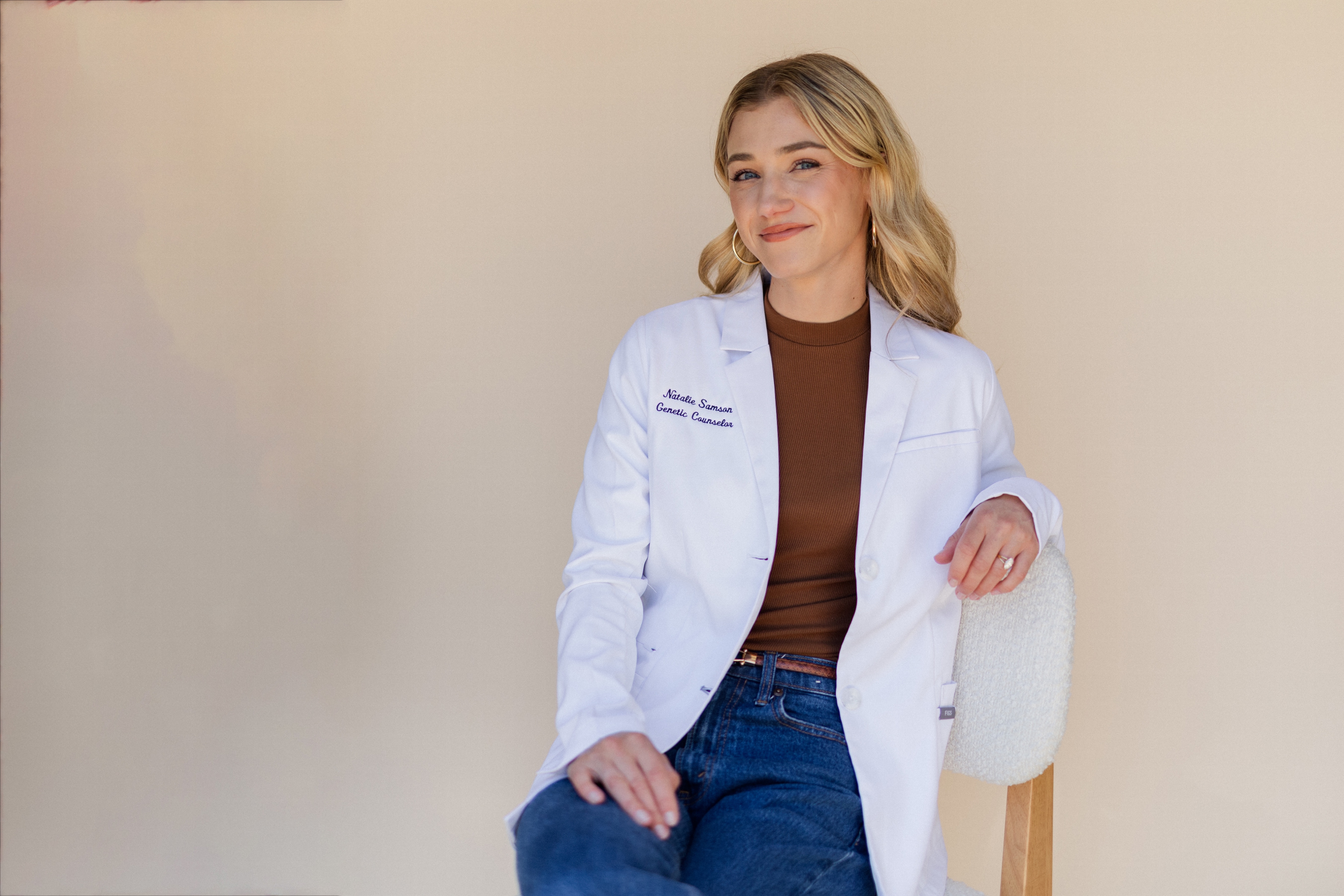
Integrative Board-Certified Genetic Counselor
Natalie is an integrative board-certified genetic counselor dedicated to advancing healthcare through personalized, proactive, and integrative genetics-care. She earned her master’s degree in human genetics and genetic counseling from Keck Graduate Institute and has completed additional certification programs in integrative healthcare, nutrigenomics, and functional medicine.
She founded her private practice, Golden Genetics, to bring a holistic, evidence-based approach to genetic counseling and testing. Her work focuses on whole-person, deeply personalized care, using genetics as a starting point to guide prevention, lifestyle, and long-term health planning for her patients.