104. How to Look Great in Photos & Be Camera Confident After 40, with Helen Rayner
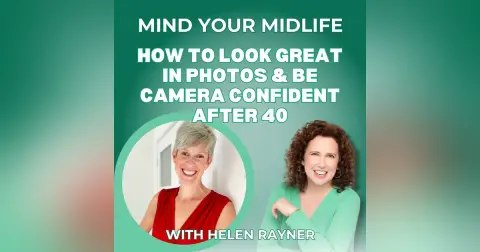


Quick Summary: In this episode, Cheryl talks with Helen Rayner, a camera confidence expert and professional photographer, about why so many women in midlife dread being photographed and what to do about it. You'll learn why phone cameras distort your face, simple posing tricks that flatter, and why the most important thing is simply to be in the picture.
Intro:
We've all been there. The group photo gets taken, everyone huddles around the phone, and suddenly it's "Oh, not that one!" Most of us are far harder on ourselves in pictures than we would ever be on anyone else, and it's costing us memories.
In this episode, I welcome camera confidence expert and professional photographer Helen Rayner. Helen has spent 15 years helping women feel more confident in front of the camera, and her Instagram tips stopped me in my tracks. We talk about why the camera really does lie, how your phone distorts your face, and the simple posing tricks that help you feel great in photos. We also cover why the most important thing you can do is just get in the picture.
What You'll Learn:
✔ Why the Camera Lies: How phone lenses warp your face, and the simple trick of holding the camera farther away and zooming in
✔ Posing Tricks That Work: Stand at a 45-degree angle, put your weight on your back foot, leave a little space between your arms and body, and what to do with your hands
✔ Why You Belong in the Photo: How your family and friends see the person they love, not the wrinkles, the arms, or the bad hair day you're fixated on
Links & Resources:
- Helen's Camera Confidence Masterclass (with 20% off for Mind Your Midlife listeners)
- Helen's Instagram: Helen Rayner Photography
- Cheryl's Midlife Recharge: cherylpfischer.com/recharge
- Sponsor: Barre3 Arlington (first class free, plus $10 off a class package with the code ARLMINDYOURMIDLIFE)
- Interested in sponsoring Mind Your Midlife? cherylpfischer.com/mymsponsorinfo
- You might also enjoy episode 87 about the mindset of style and episode 82 about how to love your menopause body
Frequently Asked Questions:
Why do I hate photos of myself?
Helen says one reason is that we believe "the camera never lies," so a bad photo becomes our reference point for how we look. In midlife, that lands on top of other insecurities, so we pick out the flaws and avoid being photographed.
Why do I look different in photos than in the mirror?
The camera turns a 3D image into a flat one, and phone cameras use a wide-angle lens that distorts your face, especially when held close for a selfie.
How can I take a more flattering photo with my phone?
Have the phone farther from your face and zoom in, which distorts less. Portrait mode gives a blurry background that makes you stand out, but as far as Helen knows, it doesn't fix the distortion.
How should I stand to look better in photos?
Turn to about a 45-degree angle, put your weight on your back foot, and leave a small gap between your arms and body. Standing straight-on makes you look wider.
What do I do with my hands?
Hold your fingers lightly in front of your midsection with your arms relaxed. Helen says broadcasters do it, and it looks classy and confident.
How do I look good in a group photo?
Skip the end of the line, where you'll be closest to the camera. Stand in the middle, angle toward the person next to you, and keep your weight on your back foot.
Episode Chapters:
00:00:00 - Why Group Photos Feel So Hard
00:02:12 - Your Brain’s Bias Toward Criticism
00:05:40 - Why Midlife Photos Hit Different
00:18:30 - How Phone Lenses Distort Faces
00:24:45 - Easy Posing Fixes That Work
00:33:27 - Headshots Jawlines And Video Angles
00:37:35 - Be In The Photo For Them
00:43:09 - Masterclass Link Sponsorship And Closing
Why This Episode Matters
Pictures are memories. When you stop tearing yourself apart in photos and start seeing yourself the way the people who love you do, you stop hiding from the moments that matter most. Be in the picture.
Take a little bit better care of yourself in midlife.
Barre3 ArlingtonBarre3 is a guided fitness practice, offering classes that combine strength, cardio, and mindfulness
Disclaimer: This post contains affiliate links. If you make a purchase, I may receive a commission at no extra cost to you.
🌸 Liked this episode? Share it with fellow Gen X women navigating hormone balance, an empty nest, and/or self-confidence!
🫶 Love this show? Leave a review to help more women over 50 find us.
💡Want menopause advice, mindset shifts, or support with midlife transformation?
- Find out more about the Midlife Recharge at cherylpfischer.com/recharge
Let’s talk health after 50, self-talk, and redefining aging for women — without the “midlife crisis” narrative. Every week I'm adding new success strategies for midlife women.
Connect with Cheryl: Instagram | LinkedIn | Website
---------------
💡If you are a brand, author, or business wanting to reach an audience of women in their 40s and 50s who are focused on health, success, and taking care of themselves and others well in this stage of life, consider sponsoring Mind Your Midlife podcast. More information here.
00:00 - Why Group Photos Feel So Hard
02:12 - Your Brain’s Bias Toward Criticism
05:40 - Why Midlife Photos Hit Different
18:30 - How Phone Lenses Distort Faces
24:45 - Easy Posing Fixes That Work
33:27 - Headshots Jawlines And Video Angles
37:35 - Be In The Photo For Them
43:09 - Masterclass Link Sponsorship And Closing
Why Group Photos Feel So Hard
Cheryl FischerTell me if this scenario feels like it rings a bell for you. You're with your friends, you're in a group. Let's take a picture together. Someone takes the picture and you take a few because then everyone in the group needs to take a second and look at the pictures and say, oh, not that one. Oh, not that one. Oh my gosh, you can't share any of these. Not that one. Does that ever happen? Has that ever happened to you? So I would say it happens to us all. And maybe we're super critical of ourselves all the time in a picture, or maybe we know people who seem to really struggle with this. It's a thing. So let's talk about it. If midlife was only about hot flashes, 3 a.m. wakeups, silly injuries, and worrying about everyone from aging parents to adult kids, we'd all be unhappy and isolated. And that's just not true. Whether you're frustrated at work, stressed about retirement, or just looking for the phone that's already in your hand, you're in the right place. Let's change the story around midlife and start loving this chapter. This is the Mind Your Midlife Podcast. Big thank you to this episode's sponsor, Barre3 Arlington. Created for women by women, Barre3 is a full-body, low-impact workout that combines barre, Pilates, and strength training to build strength, improve flexibility, and increase energy. It's unique for its focus on mind-body connection, love that, and real-time modifications that help you personalize every movement. So expect movements that support your everyday life, helping you feel balanced and strong from the inside out. It's fitness on your own terms, allowing people of every fitness level to create sustainable change from the inside out. So experience Barre3 Arlington's community in classes at the corner of Wilson and North Quincy Street in Ballston in Arlington, Virginia. Your first class is always free, and listeners can get $10 off a class package using the discount code ARL MindYourMidlife. Go down to the show notes and grab those details. Now
Your Brain’s Bias Toward Criticism
Cheryl Fischerback to the show. If you've listened to this podcast really at all before now, you will have heard me talk about the fact that our brains can lean very negative. It's a safety mechanism. Your brain wants you to be safe, alive, comfortable, calm. And so your brain is looking for anything that poses any sort of risk. And while that's going to keep us from running into the street when a car is coming, it also holds us back in a lot of subtle ways. And one of those subtle ways is it keeps us from, I'm going to air quote this, putting ourselves out there in pictures. Because we look at a picture of ourselves, and you may not do this, and if you don't, I applaud you because it's a challenge to move through this. But we look at a picture of ourselves and we go, oh, my chin. Oh, the wrinkles. Oh my gosh, the wrinkles. Why was I doing that? Oh, my posture. Oh, oh, get rid of that picture, get rid of it. We've all done it. We've all done it. We get super critical of what we look like in the picture. And I just want to pause for a minute and say, do you do that to the other people in the picture who are with you? Do you look at your sister or your friend or your husband or your whatever and go, oh my, look at those wrinkles. Look at that posture. I don't think you do that. And I think if they do that to themselves, you're thinking, oh my gosh, why are you saying that? It's a great picture. It's such a mind-bender. It's such a mind-bender. So we need to talk about this because I want to feel great in pictures. And I want you to feel great in pictures. And my guest today, Helen Rayner, wants you to feel great in pictures. She is a camera confidence expert and a professional photographer. She has spent 15 years helping women feel more confident in front of the camera. I found Helen on Instagram because she was sharing such amazing lessons and making these points about how we are with pictures that really made me pause and think. Welcome, Helen.
Helen RaynerThanks for joining me. Thank you so much for having me, Cheryl. I'm really excited to be here and to talk about this on your podcast. It's very exciting.
Cheryl FischerI'm excited too. And if you're listening, I'm going to give you a little insight into the background of this podcast because I usually talk to guests ahead of time for a few minutes, just pick a topic, whatever. And when Helen and I chatted, I had so much fun that I know this is going to be a good episode.
Helen RaynerI'm not sure if that means I talk too much or um I'll I'll take it as a positive.
Cheryl FischerTake it as a
Why Midlife Photos Hit Different
Cheryl Fischerpositive. That's how it's meant. Okay. So this is a topic that is very emotionally fraught, I think, for a lot of women. And it doesn't need to be, and I wish it wasn't. So we're gonna sort of start at the beginning. Why is it that so many women, especially as we get into midlife and we age and things about our appearance change, but why is it that we just don't like pictures of ourselves?
Helen RaynerOh gosh, Cheryl, there are yeah, there's so many reasons. Um that phrase, the camera never lies, is actually a lie. So um, so when we think, oh, it we because we're all so familiar with that phrase, the camera never lies. So if there's a photograph of me, well, that must be how I look. And it's just not true. There are so many things that the camera does and distorts our body shape and our face shape, and different lenses can make us look really awful, and so we're seeing those photos, and we that becomes a reference point for how we feel about ourselves, and then it's tapping into the securities that we feel in midlife where we feel we've given out so much, we've given to our families, we've given to our careers, there's actually not a lot left. We look in the mirror, there's a lot more lines than we want to see. We've put on a bit of weight because we've been so busy looking after everybody else, we haven't been to the gym in the last three months, and then somebody takes a photo of us from a bad angle, and we think that's how we look. And then from and then that becomes the reference point, and we then think, well, I can't be in any photos because I just look horrendous and everyone's gonna laugh at me. So it taps into so many insecurities in us, yeah. And and it's sad, Cheryl, it's really sad. It makes me sad because I've felt it too when I've seen horrendous photos of myself and thought, gosh, I thought I was a babe. And then I look at these photos and I think, I'm really not. It's quite disappointing.
Cheryl FischerLet me tell you, my nephew a couple years ago took a picture of me. We were just, I don't know, goofing around on this hike, and I didn't even know he took a picture and he showed it to me, and I was like, Oh my god. It was the worst photo I'd ever seen of myself. And it's still, I like, why am I talking about it now? It did like he didn't share it anywhere. It just haunts me.
Helen RaynerYes, and that's and I had exactly the same. Bizarrely, I was at a wake and I saw an old friend, and we got on so well, and there was so much joy at this wake, and we were laughing so much, and he took some photos of me, and I was mortified that at this wake there were loads of people I hadn't seen for a long time, and I saw this photo and thought, oh my goodness, that's what they thought that I looked like that day, and it was horrendous because I was laughing so much and my mouth was really big and my eyes were really squinty. And it and I like you say it haunts you. So I am on a mission, Cheryl, to change this about us midlife women. Why we oh, why we do this to ourselves? Why is it not just okay to be laughing in a photo and have a big mouth and squinty eyes? And the chin. Maybe it's fine.
Cheryl FischerThe chin.
Helen RaynerOh yeah, gosh. And the chin, yes.
Cheryl FischerUh I mean, okay, so I know, I know that we're hard on ourselves. I talk about this all the time that that our self-talk tends to be negative. It's our brains keeping us safe, it's very normal. But you also said something earlier when we talked about how different that is from how our friends and family and people in our lives look at us. And so I want you to say more about that because I thought it was a really good point.
Helen RaynerYeah, Cheryl, it's it's really interesting because I've photographed so many women over the years. Usually the first thing they say to me is, Can you photoshop me? So they arrive to their session feeling not good enough. And then if I say, you know, we're just usually we will chat for ages first so that I can relax them a little bit. Um but then they'll say, Oh, don't don't get my arms in, don't, don't have my arms in the photo, or like you just said, we've got to be careful of our chins and all those kind of things. When they see a photo of themselves, they will pick out all their insecurities. They literally hone in on it, and they might be looking at absolutely gorgeous hair and makeup done, but their arm will look awkward or their arm will look bigger than they want it to look, and that's the bit they focus on, and then it taps into all those other insecurities that they think, oh yeah, I've put on weight, oh, oh, oh, and they think that everybody is looking at that arm, for example. And actually, what happens if I say to them, if your mum or your best friend saw this photo, what would they see? They're like, oh but my best friend or my mum would just see Cheryl and she and they would think, gosh, Cheryl, you look alive, you look well, you look happy, or the joy is coming through in your face. They're not thinking, Oh, she's got those wrinkles look a little bit deeper today, or that arm looks massive. They literally will go, Cheryl, you look amazing in green. Why don't you wear that colour more? Or you know, they will see the person that they love.
Cheryl FischerYeah.
Helen RaynerNow, about I don't know how long ago, eight years ago, we lost my mum. And when I see photos of my mum, my mum struggled with her weight forever. She was always dieting and she never managed to lose any weight. But when I see photos of my mum, I don't look at her and think, oh, that was a time she was she was a bit heavier then. I look at photos of my mum and I think gosh, I wish I had more photos of you. And I'm not criticizing her in the way that she would have done. I'm just thinking, this is the most precious thing because it's my mum.
Cheryl FischerYeah.
Helen RaynerDo you see what I mean?
Cheryl FischerI do.
Helen RaynerAnd yet what so for people that I'm photographing that say, Oh, photograph the kids but don't photograph me. I'm like, no, no, no, no. They need to see you in the photo because you're mum and there's only one of you.
Cheryl FischerYeah, I have a picture. Gosh, this was, I think it was in the 70s. So this is a long time ago, like when you went to a little photo shop in the mall or something, and you got your pictures done. I have a picture of my sister and me with our mom. And she told us a story when we got a bit older that we had on cute little matching outfits, you know, whatever we were like elementary school age, and she didn't match with whatever she was wearing. And she said the photographer made her get in some of the pictures. And she was like, I wasn't dressed for it, I wasn't prepared, I didn't match the outfits, blah, blah, blah. But I love that picture. And I love that a photographer made her get in the picture. Like, no one would ever look at it and think, well, why didn't her outfit coordinate with their outfits? Like, I'm just like, isn't this such a cute picture? So it's exactly the same as you're saying. Yeah.
Helen RaynerYeah. It's so important. We went recently, we were invited to a barbecue, and my friend said, No, no, don't bring anything, don't bring anything. But there were six of there's six in our family, and six of us turn up at a barbecue. It's like rent a crowd. And I was like, Well, what can I take that will that because she was definite, don't bring anything, no food, nothing. So actually, I just took my camera, and when we got there, I said, We're just gonna do some family photos for you today. And she was like, Oh no, no, no, no, I'm not, I'm not ready. And I was like, I know, that's the fun of it. And when I gave her the photos, you know, she she had her hair up, she was in the middle of a barbecue and you know, whatnot. But actually the pictures were just of her cuddling her kids and her husband, and there was one photo where her husband was just looking at her with so much love, even though she'd just taken her apron off and her hair was everywhere. And when I sent her the photo, she just said, Do you know you gave me the biggest gift? And just capturing that moment in time when everything's imperfect, but actually for her, it really meant a lot, and it was probably better than taking some chicken drumsticks for the barbecue. Yes, they probably had enough food, right? Probably appreciated it more, but yeah, it's funny just because she didn't have time to worry about it and overprepare and whatever. But actually, the real her is the her that we love. So yeah, it's really important.
Cheryl FischerIt's it's like you're doing some kind of magic. In fact, I saw a post you did on Instagram very recently where you showed some pictures with you in it, and you said, But you can't tell that I'm not happy about my hair today, and you can't tell that I my stomach isn't flat or whatever. And it was true. Like no one, I would have never looked at any of those things or noticed any of those things. And it feels it feels kind of like magic to be able to do that.
Helen RaynerYeah, do you know? I since I've started my Instagram page where I'm putting myself out there every day, Cheryl. And I um I started off really cringing because of all my hang-ups and you know, all the things that I'm insecure about. And actually like exactly like I said in that post, other people aren't seeing those things. They're looking at that photo thinking, gosh, hasn't she got pretty daughters? Hopefully they're thinking that because my girls are gorgeous. Or like there was one of the pictures is of me with my son on his graduation day. And yeah, I was having a really bad hair day and having about a million crises in my head, but actually, it was about him and how proud I am of him. So who cares about my hair? Like, you know, really it's we just need to get over ourselves, don't we?
Cheryl FischerWe do, we do, we do. We do need to get over ourselves. Oh my gosh. Yeah. I've always felt like I need to, I need to at least keep the critical stuff inside when I'm looking at pictures of me as an example for my daughter. I don't want her to, you know, learn this habit of being so self-critical. And I don't know whether I'm doing well at that or not. I I would have to ask her. I think I did a good job of keeping it inside, but I wish I wish that wasn't my go-to still, you know, that I would just go and look and pick everything.
Helen RaynerYeah. I know it's we are so hard on ourselves. And and I've been very aware of it actually, because my my daughters are now 21. They're twins, and they hear me talking about myself and my insecurities. And recently I said to one of them, I said, Oh, am I just being really negative today? And she said, No, Mom, the only time I hear you be negative is when you talk about yourself. And I was like, Oh my days, that's so bad. And I just thought, gosh, I need to change that narrative because it's there, they are obviously really aware of it. And so, yeah, it's brilliant if you're more if you're aware of it already, because I'm still learning that.
Cheryl FischerI mean aware, I don't know how well I'm doing, you know. So I'll ask her when I when I next see her and see what she says. I'm not sure.
Helen RaynerP icking apart our body image in front of our daughters obviously is not helpful. And actually, I don't tend to do it. My insecurities are way bigger than just my body. Oh, all of us. All of us. That was all I had to worry about. Believe me, Cheryl. Life would be great. But actually, I don't um I don't tend to to pick apart my body insecurities because of all the obvious reasons of having teenage girls growing up and all of that kind of thing. And I've I've kept that very much more inside. But yeah, but I st but there's I've still got we've all got a long way to go with this, haven't we? We do. We do.
Cheryl FischerYeah. We do.
How Phone Lenses Distort Faces
Cheryl FischerOkay. So let's we've established that we're all quite hard on ourselves about pictures. And let me circle back to what you said at the beginning. The camera does lie, is what you're saying. And so why what's going on with that? Why is it that we're a three-dimensional person and now it's like showing us on this flat thing? Is it what is it that is that distortion that's happening?
Helen RaynerSo there's a lot, there's a lot that goes on there. It's that thing of when we look in the mirror and we think, oh, I'm having such a good day and I look gorgeous today, and then we see the photo and it's all gone wrong. And actually, what the camera does is compress the image. So it's it's taking that 3D image and making it 2D, and then we as photographers, we try and add that third dimension in by using different lenses and different settings on our camera. But depending on the lenses, they do distort your face shape. And the lenses that we are using most, not as a photographer, but just as Joe Public, the lenses we use most are our phone cameras, and they are the ones that distort our face the most, because it's quite a wide-angle lens, and it has therefore a sort of fish eye to it, just to fit everything into the lens. So if you bring that lens quite close to your face, like you do with a selfie, it actually warps your face shape. And we look at it and we go, Oh my goodness, that's not what I see in the mirror. And then we think, well, that's what everybody else is seeing because it's on my phone and I've shared it on my Facebook and whatever. So it does actually distort it. And for the younger generation, they do a lot of this 0.5 setting on your camera, on your phone, where it literally makes it um, where it warps it to make it really wide, and you can get some really long noses or big foreheads or whatever, depending on where you hold the camera. So that actually is an incredibly good example of it's just um accentuated, but actually the normal setting on your camera is doing a slight fish eye, so it is gonna warp your face shape. So the better way to do it is to have the camera, to have the phone further away from your face and then zoom in, because it doesn't warp it quite as much. There you go. Little Helen's handy hint for you. Oh my goodness, I had no idea. Wow. But that's why when we see photos of ourselves, we think, I thought I looked really good and now I'm horrified. Because so for me, like I have quite a big nose , Cheryl.
Cheryl FischerBut if you're not watching the video and you're listening to this on audio, she does not have a big nose.
Helen RaynerPlease continue. You're so sweet. But um because actually generally my features are quite large, my eyes are quite big, my nose is quite big, I don't need something distorting my face shape because it makes my eyes and my nose look bigger and it makes my cheeks look narrower, and then I just look horrendous. So usually a professional photographer will have a specific portrait lens that they will be their go to, which doesn't do that. In the same way, which is so when I see when when I have clients with me and I'll show them a photograph and I because sometimes I get overexcited, I'm like, look at this picture, you look amazing, and I'll show them and they're like, oh, I've never seen myself like that. And it's because obviously, as a photographer, I spend sometimes thousands on lenses to make sure that I'm not getting that face distortion because it's really important.
Cheryl FischerThat was a very long answer to your question. I'm sorry. I'm fascinated. So it wasn't too long of an answer. I'm fascinated. I I have long thought that I probably needed to learn how to use actually the camera properly on my phone, but I've never done anything about it. And no one hands you a user guide like they used to long ago for anything, you know. So I guess maybe that's something I need to I need to just learn. You said something about a portrait. I know there's a portrait mode on the phone. Does that help with any of this?
Helen RaynerWhat the portrait mode on your phone does is give that lovely blurry background. It doesn't actually, as far as I know, change the distortion in the lens, but it will try and add in that three-dimensional thing that you get with the aperture setting on your normal camera. So you can get a nicer effect and it will make you stand out from the background more, which can be more flattering because it puts you in the frame rather than having the clutter of the background. But as far as I know, it doesn't actually deal with that distortion. Okay. Sadly. Yeah, but it's affected.
Cheryl FischerBut the can't you're saying the camera being a little bit farther away helps with that.
Helen RaynerYeah, definitely. Yeah. So if somebody else is taking the photo, if it's not a selfie, if they stand further away and then zoom in, that distortion doesn't happen in the same way. Wild. That is wild. Wild. Yeah, see my um my husband did passport photos for my daughters and got in far too close and they just look horrendous. And then he went to do mine, and I was like, no, let me show you how to do it because I'm not looking like that for 10 years on my passport. So my poor girls look horrendous, and I actually look all right.
Cheryl FischerOh gosh. Yeah, well, you're supposed to look horrendous in the passport photo. It's okay. Exactly. Yeah, that's right. That's right. Okay, so that the what did you say? Helen's handy hints. That was really good about the camera.
Easy Posing Fixes That Work
Cheryl FischerLet's talk about some tips that you have for women who like me want to, you know, accentuate the positive, hide the negative. What other tips do you have for feeling good about our pictures or for how we should stand or sit or all those things?
Helen RaynerCheryl, I have been blown away by the um reception that I've had on Instagram when I started posting these things. There are loads of people talking about this, but for the younger generation, and that's how they all know how to do it, because there are loads of gorgeous young, you know, really, really beautiful young ladies telling our youngsters how to pose, how to be in front of the camera. Very rarely are they aiming it at ladies of our age that might have a little bit of an extra tummy, might not be at the gym having these beautiful toned arms that all the young people have. So there are a few go-to things that we can do, and it's really helpful to have a little toolkit that you know that there might be three things that you can do as soon as a camera comes out to take away that absolute dread that you feel inside. So the first thing to remember, which I bet you're gonna practice this in the mirror tonight, if you stand straight onto the camera, you're going to look wider than you are. So your chest will look wider, your tummy will look wider. So what we want to do is stand at more of a 45 degree angle. We don't want to be sideways on because then the lumps and bumps really show. But 45 degrees is a is like the known sort of go-to of the most flattering angle. So as we do that, if we put the weight on our back foot when we're standing, it shifts the weight away from the camera. So your hips will automatically look slimmer. So that is your first go-to, Cheryl. 45 d egrees, and weight on the back foot. Because if the weight's on the floor, it will make your hip stick out and that will be the closest thing to the camera. So the closest thing to the camera is gonna look biggest.
Cheryl FischerOkay.
Helen RaynerSo if I have my arm like this, my arm looks really wide.
Cheryl FischerYeah.
Helen RaynerWhereas if I keep it like this, it's a whole lot more flattering. Interesting. So that's the yeah, that's the that's the first thing. To leave a little bit of space between our arms and our body. So I don't know if you can see well enough here, there's a little bit of fresh air, a little gap between my arms and my body, rather than keeping everything pinned down. That just gives us a little more breathing room and it's a bit more flattering.
Cheryl FischerOkay.
Helen RaynerThe one thing that everybody says to me is, What do I do with my hands? Yeah. Because we we just feel so awkward and suddenly we have too many hands and we don't know what to do with them. So the easiest thing to do is just to hold your fingers in front of your midsection and just relax your arms down. And once you once you started, once you have this as a go-to, you will notice broadcasters do it, noticed recently the royal family do it. It's just a really classy way of not fidgeting. And you just sort of hold your fingers in front of your midsection, and then you will never worry again what to do with your hands. Especially like even if you're on a stage waiting for your turn to speak or something like that, if you just hold your fingers, it just makes you look a little bit more in control and a little bit more confident.
Cheryl FischerI love it. And I've seen you share pictures of the royal family as well. And I've seen that they do this, and it's and it looks so natural. It looks relaxed, exactly as you're saying. And I I think I was always uh you say everyone says this. I was, should I put my hand in my pocket? You know, what do I do? So good point. Should I put it on my, you know, do I put it on my hip? Yeah. And then you look a little sassy, which maybe is the right thing, but maybe not. So this is a very good tip. But I have a follow-up question for you on that one. What if you're in a group? I'm gonna put you on the spot. What if you're in a group and everyone's kind of putting their arms around each other? I've seen pictures of me doing this where I was like, oh my gosh, my chest looks huge. I'm standing so weird. Like, what in the world? But you don't necessarily want to be the person who doesn't put their arm around someone else. So what is your thought on that?
Helen RaynerOkay, so this is a really good question, and I do get asked this a lot because what we all tend to do is go like this. And as you say, this bit is then the closest to the camera. So if it's not this bit, if our tummy is bigger, we just look huge and we're then standing straight onto the camera. So the best thing to do is firstly to not be the person on the end. Yeah. Because they usually it makes a bit of an arc, and then you're the closest to the camera, so you're gonna look wide, isn't it? It's hideous. So get in the middle and then snuggle in with the person next to you so that you're at 45 degrees, and so are they. So they're this way and you're this way, so your tummies are almost touching, and have one arm round, and then have either this hand either in your pocket or down by your knee, and then get this person to come around the back of your shoulder. So then their midsection is hidden by your elbow, and they can kind of come in here, and it's a much more intimate photo than everybody standing like this.
Cheryl FischerYeah.
Helen RaynerAnd it it's much more flattering. So if everybody stands at that 45 degrees and the two in the middle are angled towards each other, it's an absolute win. And then everybody feels good about themselves. And if they've all got their weight on the back foot, everybody's gonna look slim and fabulous. It's like a miracle. I know, exactly.
Cheryl FischerSo your arms are gonna be showing though, right?
Helen RaynerYes, but if they're not squashed down, if they're squashed down at your side, it will look wider. If you have that little bit of a gap there that I was talking about, and you might be holding your clutch bag or a glass of champagne, but have a little gap there, and then that elbow hides the other person's midsection, and your hand here hides your midsection. Ah.
Cheryl FischerBrilliant. Yeah.
Helen RaynerNot that everybody's paranoid about their midsection. Some people love it, but for those of us that are a little bit not wanting that bit on show, that can really help.
Cheryl FischerWell, you know what, in midlife, we're all we're all a little we're all a little paranoid about it because you can be the thinnest person, but you know what, there's that weight that comes in the middle that is really hard to get rid of. So it's a thing, yeah. For sure.
Helen RaynerYeah, absolutely. Yeah, it really is. But do you know, Cheryl, whenever I'm photographing ladies, I just want them to feel better about themselves after the experience than they felt beforehand. I know that people come to me nervous and I know that everybody hates being in front of the camera. And actually, if we can just as a community of midlife women, if we can just call out the beauty in each other rather than um rather than picking out the the niggly things, if we can just call out the beauty in each other, I think we'll all be a lot happier and a lot more encouraged.
Cheryl FischerI agree with that completely. And and that is how we treat other people. So it's it's then focusing that back on ourselves as well. Yeah.
Helen RaynerIt is, because actually as women, we are so I'm just constantly inspired by the people that I meet who have had to reinvent themselves so many times and then end up running a podcast or end up running a business, or you know, they've been a mum and they're doing this, and they've reinvented so many times, and there is so much strength and so much depth. And if we then pull ourselves apart just because we saw a bad photo, actually we're missing the point, aren't we? Of just what incredible creatures we really are. Yeah, absolutely right.
Cheryl FischerAbsolutely right. That felt a bit like a mic drop there, but we're gonna keep going anyway. Okay, so let's see. We uh do you have any other tips about our our you know, standing, looking, turning kind of ideas? Or those those will do it for us.
Helen RaynerI think something else to bear in
Headshots Jawlines And Video Angles
Helen Raynermind. If we if we're having headshots done, for example, for our LinkedIn profile or um, you know, or or for annual reports or that kind of thing, again, if we stand straight onto the camera, it's not gonna look great. But if we if we angle ourselves away and lean into the camera, so our face is actually in front of our chest, that is a really good one. Because for ladies that are feeling that their chest is larger than they want, or they're being judged on it a bit, or they're trying to look professional but they feel a bit chesty. If their face comes mid-frame, that the rest of it kind of falls away a bit. And it's it's against our confidence level. Normally we want to shrink back from the camera, but what that does is bring our chest right into the frame. So if we bring our face into the frame, it hides that bit. So there's another Helen's handy hint for you. Excellent. Excellent. Because that has been a problem. You're gonna be making notes, Cheryl. You'll you'll be making notes on all this and trying it all in the mirror later.
Cheryl FischerI will be. You're absolutely right. And if you're listening, I feel like you're gonna be doing the same thing. Just listen again, it'll be fine. Okay, so this whole lean forward. So here's another behind the scenes little piece of information. I s I got the advice once, which sounds like it was good advice, to put my chair a tiny bit lower when I'm recording and to sit kind of my butt back in the chair and lean forward a little bit. And it was because I was concerned about my double chin, which I hate, but it it makes my face be more the center and like everything else back a little bit. And it's a tiny bit, but I've been doing that for a long time, and it sounds like exactly what you're saying.
Helen RaynerYes, it is, and I think our natural reaction when the camera comes out or on video or whatever is to shrink back from it. And actually, then what happens? This bit around your jawline looks horrendous because it kind of compresses. I know it's just not a good look. Um, but that bit really compresses, and then chest is in the frame. So you're absolutely right to do what you're doing because it's your face that people are going to connect with. It's your eyes that they want to see, it's your smile that they're that they're um mirroring. So, yeah, to have your face in the frame is is the best thing you can do.
Cheryl FischerOkay, then then let's go into the face a little bit because I do worry about my jawline. And I, you know what? Some people have uh, I don't even know the right words for it, but some people have just a more dramatic jawline and other people have a softer jawline. And that's just how we're shaped, right? Like how we're shaped. But if I'm smiling and laughing, this is the first thing I look at. And it drives me bananas if I'm like, ugh.
Helen RaynerI know, it's so unflattering, isn't it?
Cheryl FischerYeah. So what can we do? Is there is there an angle we should look at the camera at, or is there anything we can do for for face concerns?
Helen RaynerYeah, so there are a few things. I've talked about this on my Instagram as well, actually, where I think on one of them, but it may have been quite a while ago, there's actually quite a good demo of it from the side, which I I won't do because it's really unflattering. But if you bring if you think a little bit like a turtle, but not an accentuated turtle, so you want to bring your jaw out and down and then slightly angle it. So if I do it straight on for you, so if I sit like this, this bit is a bit compressed, but if I come forward and bring my jaw out and down and slightly like that, it defines this area much more. And it's an and that doesn't make sure so actually if I was at that 45 degree angle and do out and down and then angle, it just it defines it. So yeah, it does help.
Cheryl FischerI love it. I love it. Love it. That see that you're changing people's lives, which is why we're doing this I'm telling you.
Helen RaynerJust one photo at a time, Cheryl.
Be In The Photo For Them
Cheryl FischerOkay, so let me make sure, since you are changing people's lives, let me make sure to ask you where we've talked about your Instagram, where can people find you? How can they connect with you and all of that?
Helen RaynerYeah, absolutely. So I am on Instagram, which as I was saying has grown momentously in the last couple of months because I think it taps into everybody's insecurities. Um, and that is Helen Rayner photography. So that's probably the easiest place to connect with me. But Cheryl, I've also got a link for you for um the camera confidence masterclass, which I have put together. And for um your listeners, there's a 20% off on that masterclass. So that's really exciting because that covers all of this. It talks about the iPhone distortion that we talked about, and it gives it's got photographic examples in there and the what we were talking about with our double chins. Just yours and mine, obviously, nobody else has them. Oh no, of course not. Just yours and mine. Um, but things like arm placement and how to be photographed when you're sat down and things like that. So that's all in that masterclass, and it's 20% off for your listeners. So hopefully we can give them a big boost of confidence.
Cheryl FischerOh, I hope so. And I will definitely be doing it. So thank you for that. And the link, if you're listening, the link will be in the show notes. So grab it for sure. I'm really excited about that. So I think you've been dropping all sorts of brilliant tips for us throughout this whole conversation. However, I also think that people tend to listen to podcasts while they're doing something else and they're sort of half paying attention. And so, what I like to ask towards the end is if somebody listening is gonna try to keep in their head and remember one thing from this conversation, what is it that you want them to remember?
Helen RaynerOkay. So how we sit and how we stand, those are all important things and they can all help us with our confidence. But the most important thing, Cheryl, that I think to our families, we are the only person that fills that role in our families. And to our friends, we are the only friend that does what we do. So we need to just be in the photo with them and to forget whether it's a good hair day or a bad hair day, or you know, there's all these tips and tricks that can make us look a little bit better in the photo, but actually let's just get in the photo because it's it would be such a shame if we avoided all the pictures because our body at the age of 50 or 52 or whatever wasn't quite what we wanted because we're never gonna be this young again.
Cheryl FischerYeah. That that's really, really important to remember. And I look back on when my kids were growing up and there were periods of time where I had pictures of them. I had pictures with my husband in it, but I wasn't in the picture. And thankfully I was enough that that you know, pictures exist. But yeah, good point. Just get in the picture. Yeah.
Helen RaynerYeah, absolutely. And don't wait to be perfect because you never, it's it's never gonna happen. You might lose half a stone, you might put on half a stone, you might be a bit more toned. But it really doesn't matter at the end of the day. What matters is that when you're not around, your family have got memories of you and that you were present in the life that you lived. And that's what's really important.
Cheryl FischerYeah, I love that. Well, Helen, this has been fascinating. I've already learned a ton, and that means anybody listening has already learned a ton. So thank you so much for joining me.
Helen RaynerCheryl, it's genuinely been a joy to talk about the my passion, and I love that we can encourage your listeners as well and give them just a little bit of a boost to get out there and feel a bit more confident. So, yeah, thank you very much for having me. Okay.
Cheryl FischerThe one thing that you want to remember, be in the picture. Be in the picture. And maybe I'll add to that the other thing that Helen and I have kind of both said as we had this conversation. Look at your picture the way you would look at the other people's photo. You wouldn't rip their photo apart. We just wouldn't. Why would we do that? We never would. See if you can look at yourself in that way as well. Think about how your sister or your mom or whoever looks at a picture of you. Be in the picture. And go down to the show notes and grab that link for Helen's masterclass because if we can just have some of these little sort of tools in our toolbox to feel like we are probably gonna like the picture, the how we put our hands or how we put our face, all of that, how we use the camera, that was a new one for me, then even better. Go down to the show notes, grab the link. I'm super excited about that. I will be doing it myself. I hope that this episode matters for you. Because even if you're thinking, we're just talking about pictures, like, come on, it doesn't matter, it does matter. Pictures are memories, pictures allow us to look back happily onto things, pictures allow us to remember people, and that's a big deal.
Masterclass Link Sponsorship And Closing
Cheryl FischerNow, as we wrap up, let me say if you are a brand or a business looking to reach savvy midlife women who want to live their life well, then find the information about sponsoring Mind Your Midlife. We do have a few slots remaining in the next few months. Go to Cherylpfischer.com/mymsponsorinfo, grab the information, see if that is something that will work for you. And everybody keep remembering midlife is your time to take just a little bit better care of yourself. On the outside, meaning take care of your body, and on the inside, meaning take care of your mind, just a little bit better makes a huge difference.


