62. What Every Midlife Woman Needs to Know About Money and Retirement Planning, with Shari Rash
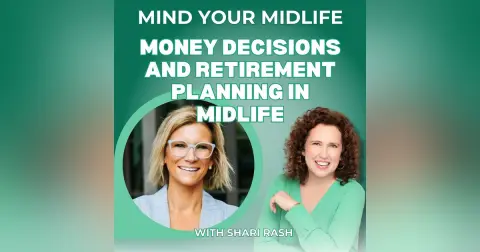



Are you a woman over 40 or 50 feeling stressed, behind, or unsure about money, retirement planning, or your financial future? You’re NOT alone — and you’re not stuck. In this episode of Mind Your Midlife, financial advisor Shari Rash joins me to break down money mindset, retirement planning, financial confidence, and the real emotional side of finances for midlife women navigating career changes, aging parents, kids leaving the nest, and the fear of not saving “enough.”
If money makes you anxious — or if you’re ready to feel more empowered, confident, and informed — this episode is for you.
What You’ll Learn:
✔ How money mindset affects financial decisions for midlife women
✔ Why women over 50 often feel behind on retirement planning
✔ Practical steps to build financial confidence in midlife
✔ What women REALLY need to save for retirement (and how to understand it)
✔ How to balance enjoying life now with planning for long-term financial wellness
🎯 OMG Moment:
Your mindset about money matters just as much as your bank balance. When you shift how you feel about money, you transform what becomes possible.
Take Action Today:
- Connect with Shari at gwawealth.com and listen to Everyone's Talkin' Money podcast
- Listen to Shari on OMG Teach Me and learn more about money mindset
- Review your retirement accounts; check whether you're getting your full employer match; start or revisit an emergency fund
- Choose ONE small step to build your financial confidence this week
Why This Episode Matters
Midlife is a powerful turning point. It’s when so many women feel the weight of money stress — from paying for college to caring for aging parents to wondering whether retirement will be possible.
You don’t need perfection — you just need a starting point.
Text me to ask a question - I'll answer on the podcast!
🌸 Liked this episode? Share it with fellow Gen X women navigating hormone balance, an empty nest, and/or self-confidence!
🫶 Love this show? Leave a review to help more women over 50 find us.
💡Want menopause support, mindset shifts, or support with midlife transitions?
- Build a mindset for success with the private bonus episodes!
- Book a free Mindset Coaching / Intro Call: cherylpfischer.com/coaching
Let’s talk midlife body positivity, self-talk, and redefining aging for women — without the “midlife crisis” narrative. Every week I'm adding new success strategies for midlife women.
Connect with Cheryl, Midlife Coach: Instagram | LinkedIn | Website
00:00 - Dreaming About Retirement
02:43 - Why Money Feels Like A Foreign Language
06:45 - Start Early Or Start Now
10:56 - Emergency Funds Before 401k
14:40 - Roth IRA And Roth 401k Explained
20:13 - Order Of Operations For Saving
23:45 - How Much Do You Really Need
28:53 - Avoiding All-Cash Portfolios
33:53 - Filling The Income Gap
37:55 - Early Retirement And Bridging Strategies
42:47 - The Mindset Shift Of Retiring
0:00 I am in my mid-50s. And if you are anywhere around that age range with me, I bet you we're all thinking, gosh, wouldn't it be nice not to have to go to work every day? Maybe retirement could be fun. Or we're watching people who are a few years older than us retire and we're thinking, wait, they're traveling, they're living at this amazing place, they're doing whatever they want. It seems amazing. And yet, we need to do some planning to get there, and maybe we get a little stressed about the money involved.
0:40 So let's talk about it. Welcome to Mind Your Midlife, your go-to resource for confidence and success, one thought at a time. Unlike most advice out there, we believe that simply telling you to believe in yourself or change your habits isn't enough to wake up excited about life or feel truly confident in your body. Each week, you'll gain actionable strategies and oh my goodness, powerful insights to stop feeling stuck and start loving your midlife. This is the Mind Your Midlife podcast. Now, maybe what I just said is not at all how you're thinking.
1:22 You're thinking, I cannot imagine retiring because I would be so bored. What would I do during the day? Fair, that's fair. And I think we all want to have more power over our day-to-day lives. We all, to a certain extent, varying extents, like the idea of being in charge of our own day. And that's certainly a piece of what retirement gives us. So as we look forward, maybe as excited as me or maybe not, we have to take into account that if and when we retire, we need to be able to afford to eat and live and maybe travel.
2:04 So there comes the money topic. And my guest today is going to talk with us about some very practical tips for how to plan for retirement with your money, different types of accounts that you need to be aware of. And also, we're going to talk about the mindset piece. Because if we have kind of a weird relationship with money, or if this whole thing is just making us extremely stressed, we need to kind of work that out too before we're actually in this retirement time period. So Sherry Rash from the podcast Everyone's Talkin' Money is joining me today.
2:44 She helps women ditch guilt, own their financial power, and build real wealth without shame and without all the spreadsheets. That podcast I would strongly recommend. It is a New York Times-named top four money podcast. So everyone's talking money, have a listen. She's also a mom of four, and so she is living what we're talking about. Welcome, Sherry. Thanks for having me. I'm excited for our conversation. I am excited for her conversation for her. I am excited for our conversation as well. And if you're listening, I am also going to link to an episode in the show notes when many eons ago, Sherry joined me on the OMG Teach Me podcast before the current version.
3:34 So you can go have a listen to that as well. So I know that women having a positive relationship with money is a powerful topic for you. So tell us more about why that's important to you and how that came about. Yeah, one, I am a woman when it and I talk money every day since I you know graduated college. I've been in finance my entire career, and it's what I talk about. So it only comes, it obviously comes very natural to me. So I know no different of like not being comfortable with money and talking about money.
4:14 So then as time would go by and I'd speak to other women and um clients, and it it not everyone feels the same way I do, which was interesting, or not everyone even has a desire to understand money. And I can't go changing anyone's mind. I'm only one person, but I can try my best. Um and but I and I think why people women are intimidated is because they've been hearing a man's language, a man speak about it forever. And so by default, when you you we speak English, you hear someone speak French, I have no idea what they're saying, and like I can't pay attention to it because I have no idea what they're saying.
5:02 That's the same way with money. If you're hearing someone speak about money that just speaks a different language than you, and most men do, we're obviously going to be turned off and not interested or feel like this isn't for me, or I'm never gonna understand it. The problem is though we don't realize it's a different language, we just think it's a fault of ours. Ooh. Ooh, can we just pause on that for just a second? Because that is such a good point. We blame ourselves and we think, oh, I just don't get it. I don't get it. I'm never gonna get it. It comes easily to other people, it comes easier to my spouse or partner, my brother, my father, my uncle.
5:42 It comes easier to all of them. It doesn't come easy to me, so it's a me problem. And it's not, it's just no one has spoken to you about money in a way that connects with you. Not even in a way that you understand, because it's not an understanding issue. Um, it's a way, it's a connection issue. One of the things that I always think about also when when talking about women and money is it's been in my lifetime since women could even have our own credit cards and our own bank accounts without a husband or a father's name. And when I first learned that, I was shocked, but it was in the mid-1970s. And it's crazy to think about that.
6:26 It is, it is, it is crazy. And it's like, well, no wonder why we feel behind or we feel all of these things. Cause yeah, I mean, fish it's only been 50 years. Like, that's not that long of a time that women have had the same rights as men when it comes to their money. So it by default, of course, we feel like we're behind or we don't know as much because like we are in the sense of being able to do the same things. And then when it's men talking at you about money and they're talking a different language, then that just adds it's like a you know adds insult to injury, if you will.
7:12 Yeah, so true. I I want to segue us into talking about retirement, but I'm so glad we've just had this discussion because it I just want to say again, you know, if you've always thought of if you're listening, you've always thought of yourself as I don't get it, I'm not gonna understand, I don't get the stock market. What are they talking about? Maybe it's because you just haven't heard it explained to you in a way that makes sense. I love that angle. Yeah, I love that angle. Okay, so let's say that I'm listening to this and I'm in my 40s, which I'm not, but let's imagine. And we're gonna start talking about things to think about when we're looking at or towards retirement.
7:57 But if I'm in my mid-40s, I'm not gonna retire for another 15 to 20 years. So is that too early to start planning for retirement? Or when is kind of the right time if there is one? It's like that saying. Um, and I hate it, but it it makes complete sense. What you know, when's the best time to plant a tree 10 years ago, 20 years ago, when's the second best time today? Yeah. That's that's money. That's money too. So I have clients that I get introduced to because I'm working with their aunt, for example. Well, you have to meet my niece. She's just graduating college. It's probably too early, but she's just graduating, and I want someone to talk to her and like tell her all the things like I should have been told, right?
8:45 And so I'll I speak to these young adults, and it's like, yeah, I know it sounds weird that you just went through these four years or however many years to get your degree, to then get a job. But now, yeah, you we are gonna have to start thinking about retirement, which sounds crazy. Because if you want to make your life, your future life as easy as possible, start doing something as early as possible. Even if that's today, right? Even if that's today, start doing something because the the earlier you start investing, the less you in general have to save, invest.
9:27 Yeah. Because someone that started saving the the um, you know, the second they started working, 22 years old, started saving for retirement. If it was like 25 bucks a month, 50 bucks a month, that money is doing nothing but growing for 40 years. And you think, well, it's only 25 bucks, it's only 50 bucks. Yeah, over growth, you know, 7% on average, compounded growth for 40 years, that 25 bucks is gonna become a substantial amount of money. Right. When you're closer to your destination, when you're closer to retirement, so if you're in your 40s listening to this and you're like, well, I haven't started yet, to get to that same dollar amount at your endpoint of retirement, 65 years old, 67, whatever we're gonna call it, you need to save that much more because your money doesn't have as long to work for you.
10:19 So it's any amount, so eat so don't even think like, well, it's such a little amount, it's not even gonna make that big of a difference. It does. It does. So it's always the right time to start, if you're wondering. I like that. I like that. It's always the right time to start. And so when you say save, what are what are some ways that that we can do that? Yeah, so there is a risk of saving quote unquote too much for retirement or in retirement accounts. I I fell victim of this.
10:59 So when I graduated college, I started contributing right away to my company's 401k. They're very generous with the match. I am very shiny object syndrome. So as soon as money hits my checking account, it is being spent. So I liked the idea of it being automated, and then that I was, and I was getting a match, and then I liked seeing it grow. So I got excitement from that. I got, I got like joy from that. So I started putting more and more and more money away in my retirement. Well, that's great, but well, one, now I really don't have to save anymore for retirement because I've done, I did a good job in the beginning.
11:40 Then now I can just let my money grow. I'm 40. I can just let my money grow for 25 years and like I'll be in a in a good position. But conversely, why that's a risk is that when you put all of your money in a retirement account, which I'll talk about all the all the different retirement accounts, when you put your money in a retirement account, it's for retirement. You can't use it, you can't touch it. True. Right. So I at 23 years old, when I had, you know, this money in a retirement account, if I had an emergency, I didn't have enough cash saved, I was kind of out of luck. Because you can't pull that money out without paying a 10% penalty if you're younger than 59 and a half.
12:22 Yeah. So 10%'s a big penalty. Yeah. It's a big penalty, plus all the taxes you have to pay on it because it was pre-tax money. So as far as like, I want to start saving and where should I save? Okay, first and foremost, we want to have enough cash. We want to have enough in a bank account. That's an emergency fund, right? So we want to do that first. And if you say, well, I have debt, so should I pay off the debt first, then start saving in my emergency fund? No, I want you to do both. I want you to tag team it because if you focus all of your energy on the debt and then you have an emergency, you have to bring on more debt to handle the emergency.
13:08 You don't have the cash. Kind of the theme is like the extremes. We don't want to go extreme in any one direction, right? We will we want to, you know, stay, stay down the middle. So we want to make sure you have enough cash saved in a bank account, you know, emergency fund. Then if it's like, okay, well, Sherry, I did that, like check that box. Awesome. Now, if we want to save for retirement, there's a couple of different ways to do it. If your employer offers an employer-sponsored plan, 401k, 403B, contribute to that up to the match. That's the match is free money. They're giving you money just for contributing.
13:49 So we're doing that. Okay. Then there's also in the theme of retirement, there's also IRAs, individual retirement accounts. So these are accounts you open up on your own outside of your employer. You do it yourself. And you can do it at like a Fidelity and e-trade, Schwab, companies like that. You can open up these accounts for yourself. And the IRA is um pre-tax, meaning you get a tax deduction for contributing to it and it grows without paying taxes. And then when you make the withdrawal, you pay taxes. Right. So you pay taxes when you when you withdraw in retirement.
14:30 The Roth is what my favorite thing is: the Roth IRA. Or if and if your employer offers a Roth 401k, that's like that's that's awesome. That's great. I feel like everyone's heard this term Roth and no one knows what it is. So I'm glad you're talking about it. Yeah. So a Roth is um, it's a retirement account. You contribute to the Roth with after tax dollars. So money that hits your checking account, you've already paid taxes on it. You contribute to the Roth, and the Roth then grows tax deferred, meaning you're not paying taxes on any of the earnings. But here's the best part you make the withdrawals in retirement and you don't pay taxes on them.
15:13 Wow. So you essentially pay taxes once and never pay taxes again on this money. Assuming you follow, I have to assuming you follow the rules of it, but say we wait till retirement, you're never paying the taxes again. Um, that's very powerful. So 23-year-old Sherry that was setting aside money in her Roth 401k, future Sherry's gonna be very happy with her because then I'm gonna have a nice pile of Roth money that I'm not gonna have to pay taxes on. Right. So we want to do things that like our future selves are gonna be happy with us for, right? How much how much are we gonna appreciate that? And also, to your point, hopefully not causing 23-year-old Sherry to have to go into credit card debt because you didn't have enough money to live on because it was all going in the Roth IRA.
16:04 That's right. That's right. Yes, yes, okay, exactly. Okay, but yes, I get certainly the concept that if we're taking the money after tax now, so we've paid taxes on this part of our income, and then we're never paying taxes on it again. So we're earning money and we're not paying taxes on the money we earn. That's amazing. Yeah, it's great, it's fantastic. So there's and there's really no catch. Like you you have just have to follow the rules of the Roth. So once you put it away, you just have to think to yourself, I'm not using this until I retire. You can you can withdraw your contributions tax-free. Like you, so you can do that, but even still, let's just like forget about it.
16:48 Let's we're gonna have enough money saved in the emergency fund and all of that stuff that we're not even gonna need to access it. Right. There are some income limitations to the Roth. If you make too much money, you can't contribute directly to the Roth. There are ways around it. I don't want to get too deep in the weeds. Yeah, that's okay. Um but so but don't, but even if you say, well, you know, I read if you if I make so much too much money, I can't do it. You you can. It's just a convert a backdoor Roth is what it's called. It's easy to do. It sounds more complicated than what it is. But that would be the best way if if to start, in my opinion, to start saving for retirement is one, if you're if you have an employer sponsor plan, contribute up to the match, get all that free money you can.
17:39 Don't feel the need to go over and above that match amount, um, then let's look at the Roth. Okay. Then that would be the next step. Okay. If you then are like, all right, I'm going up to the match, like as far as like order of operations go, we're making sure we have enough cash in the bank, we're then contributing to our match, we're then doing the Roth and contributing there and maxing that out, um, which based on your age, you could do seven or eight thousand dollars a year. Then if you're like, well, if I still have money, I still want to do more, I can do more. I'm ready, I'm saving, I'm I'm ready to, you know, be nice to my future self, then you could look at, you know, then going back to your 401k and increasing your contribution there, or saving in what's called like an after tax account.
18:27 And this is money for future you, but like not retirement future you. Like this is, I want to go on a really awesome vacation in three years you, I want to do a home renovation. That's uh the next type of account you could save for, which is called um uh uh you see a couple different names: brokerage account, individual account, after tax account. They all have there's different names, but they all mean the same thing. Yeah, very good point because we know we need money for retirement. We're probably working with our aging parents now and hoping they have enough money and all of that stuff. So we know we need that, but we also might need money in our 50s or whatever, or want, not even need, want.
19:12 Yeah, good point. I like I like that you've said a couple times that we need to make sure we have money on hand because when we get to talking about this retirement topic, I think it sort of feels like, no, don't spend anything now, put it all away for later. But that's not realistic.
20:04 It's not realistic. And also we want to be real, we need rewards, right? We need to feel like we're doing something, we need to feel like we're achieving something. Um, so to put everything away into retirement, you're not doing anything to help yourself today, right? So after a while that's gonna get exhausting, and then you're gonna start resenting your savings. Right. And yeah, life is for living. I and I I say that with all of my clients like you, you, you, you work hard, you need to enjoy yourself. There ever there's there's it's the extreme. Extremes on either side are not good, right? The oversaving is not good, and then but then the undersaving is not good. So we need to not fall into the extremes and you need and and but planning for different times of your life.
20:48 Retirement is only one part of your life. Your midlife is another part, and you need to plan for that financially as well. Yeah, I like that a lot. Okay, so I'm gonna ask you the question that personally weighs on my mind a lot. And my husband and I talk about this a lot. And so, given that probably if you're listening, you're in your 40s, 50s, 60s. Here's the big question: how much do we need to retire? Oh I'm aware you can't just give us a number, but I still am asking the question. Okay, what does your husband say? I think he is he doesn't give really an answer except that let's make sure we have as much as we can, you know, like we're we're not sure.
21:38 Yeah. So when my clients, I just I just had a meeting with one of my clients the other day, and she's like, I read this article that you need like three million dollars to retire. She's like, What do you think about that? I said, I said, I hate, I hate that stuff. I hate that because it's it's clickbait, it's just trying to get a reaction out of us, right? So the answer is there is not an answer. Like I cannot say you need a million dollars to retire because I everyone, what they everyone's spending is different, everyone's income is different, everyone's needs are different. There's so many factors to to to look at.
22:19 So when I'm working with with my clients and we're, you know, we're having these retirement conversations, which I'm having at least five years out. So it's not as if my clients are retiring next year and we're starting planning then. No, I know I want five years because that's when I start to make changes to their portfolio. Because a mistake people make, and I'm I'm gonna take a detour for a second. A mistake people make is they think, well, I'm nearing retirement or I'm I am in retirement. I can't afford to lose any money. So I'm I need to make my portfolio conservative. I need to be conservative, like move everything to cash. Yeah. That's a mistake because yeah, part of the thinking is correct.
23:02 Remember the extremes. Part of the thinking is correct. Yes, you don't want to have a market downturn blow up your plan, right? That is correct. But then the other side of that, so, so, so putting it all in cash makes sense to address that risk. But then you're leaving yourself wide open to another risk, inflation. Stuff just costs more. So, especially healthcare costs in retirement, right? So if you're putting everything in cash, and yeah, we were getting decent rates for a while on our cash, but that's not happening as much anymore. So now that coupled with inflation, you're now losing money. Your money has less purchasing power each year.
23:44 So sticking it all in cash isn't the answer. But then leaving it wide open to volatility isn't the answer, right? So what is? It's a little bit of everything because you also want your money to grow. Because if we do it right, we're living 25, 30 years into retirement. Absolutely. So we need this money to grow for all of these years. So just because you're in retirement does not mean your you your money stops growing. It has to grow because we need it to last 30 years. So that's just like a quick aside on like some of the investing mistakes people make. So the answer is a little bit of everything. You still need a portion of your portfolio to be aggressive, because it has a 30-year time horizon.
24:25 You still need a portion of your portfolio to be down the middle because to smooth out some of that volatility, then you still need a portion of your portfolio to be conservative. And so that's what I do with my clients is I start putting their money into silos because the e the each silo has a different purpose. But how much money do you need? So when I'm working with my clients and we'll talk about this, I never talk about a lump sum. It's what do we need year by year? So the first thing is, how much do you think you're going to need in retirement? And the answer is not, well, whatever my income was. Because when you're when you're income, you're likely saving a good portion of that.
25:08 It's a good portion, right? Yeah. So we're no longer saving when we're in retirement. We are not actively saving. We may have extra money left over that we stick away, but we're not actively saving. So right there, that changes how much we need in retirement. Good point. Is your house going to be paid off by then? Are you going to get a second home, right? So could you have more housing expenses? All of this stuff. So, how much do we think we're going to need in retirement? And that's what we that's our that's that's the starting off point. Because how can I tell you how much you need if I don't even know how much you need until each year? Right. It depends where you live, how you're gonna live, what you're gonna do.
25:50 Yes, absolutely. Exactly. Exactly. And then what you want to look at is anything guaranteed coming into you. So Social Security, for example, is yeah, yeah, is it a is it a mess of a program? It is, but it's still here and it's still giving money, right? Um, so how much are we going to get from Social Security? That then it is that then then goes to the need, the amount you need. So let's just say you need $100,000 a year in income. Okay. Now Social Security is giving us $60,000. That then leaves $40,000 as like the the gap.
26:32 Right. So that's what, assuming there's no other pensions or annuities or anything like that, now there's a gap of $40,000. And that's where your savings comes in to supplement. Right. Okay. So some people could have a gigantic gap, some people could have a minuscule gap. It's funny, the the woman that asked me about the $3 million, she has Social Security, her pension, her husband's pension, and annuity. She has so much guaranteed income that I'm like, you don't even need to come close to, you know, having that $3 million number saved that they, you know, that you clicked on the article, because you have so many other guaranteed sources of income that your investments are a tiny role in it.
27:16 Yeah. So that's why so that, so then if you, okay, so then if we really want to go and take, say, okay, it's 40,000 is my difference, and that's what I would need my investments, then you know, 40,000 times 25 years, 7% inflation, like, or if we want to look at that, yeah, then we can work backwards to a number of what you need. But sometimes that number would also do more harm than good. Um, it may be overwhelming or seem unrealistic. Um, so I like looking at it year by year and making sure that you have enough to cover you year by year in retirement. And to your point, if we can make sure that that money is still making money, then it's not as if we decide to retire and here is the one number, the amount that we have, and we better stretch it.
28:05 It could grow. In in a perfect world, when my clients are making withdrawals, their investments are earning that right back. Like that's perfect. Like, if like that if that happens, like yes, that this was a great year for us because you're exactly where you started, even after taking all of these withdrawals all year. Yeah, yeah, that's a great point. It's it kind of relieves some of the stress, I feel like, thinking about all I'm gonna do is draw down my money now. Yeah. So another thing that I end up chatting with my friends about all the time that's sort of related to this, is we see people who decide to retire early.
28:49 I'm doing air quotes. This could be any range of ages, but let's say, you know, 59, 60, 61, they're not getting their social security yet. And we're thinking, how in the world are they doing that? So I'm curious if you have any thoughts about that. I know you can't say how did that person do it, but these are not people, I don't think, who are, you know, million and billionaires. I don't know. It's interesting though. That is interesting. I mean, retirement is very different today than what it was even 10 years ago. Um, COVID has changed a lot of that, has changed that for us because now working virtually and and and all of that.
29:33 Um, so retirement, I have clients that are retiring early, but they're doing something else. They're, you know, starting to work for themselves or even they're still working for the same employer but part-time to hold on to benefits or something like that. So I am seeing a lot of working still in retirement. It's more just like a life change than retiring, but we don't have any other good words for it. So we just call it retiring. But how could someone like so if you so like how could someone retire at, you know, in their late 50s, early 60s, not be on Social Security and it's still like work for them? So, you know, it could be that they are um that they do have some guaranteed sources of income coming into them.
30:18 They do have a pension. Um, that that would be a big one. If they're younger than 59 and a half, they cannot access their retirement accounts at all without IRAs without the penalty, right? So that would lead me to believe that they're not using that money. I would hope they're not using that money. So that means that then they have a lot of that after tax money saved to bridge that gap. Okay. They could have their house paid off. Like that could have been their focus of we're just getting rid of the house payment. That's gonna be our focus. And so then we can lean live more leanly, more leaner, and and and not have the mortgage come retirement.
31:00 Right. You know, no debt on the car, no, no car payments, no debt. When you don't have those big bills, you don't need as much money. Um so that I mean, just that those are kind of my initial thoughts when I hear scenarios like that. They they could have, you know, received an inheritance, their parents could have passed away, left them a little bit of money. Even if you're left money, retirement money as a beneficiary, a non-spouse beneficiary, if it's retirement money, you have to liquidate it within 10 years. Oh. Yeah. So for example, if if you were to receive $100,000 in in your mom's retirement account and she passes away, you have to have it down to zero after 10 years.
31:45 The the guidelines aren't clear on do I take 10% a year or can I take as much as I the guidelines aren't really clear on that, but that could be another scenario. Like, well, I have to withdraw this money anyway. I have to pay the taxes. Uh, maybe, maybe I do retire and then maybe figure it out in 10 years or in a couple of years. But it gives this gives me the breathing room to be able to do something like that. Yeah, that's a good point. I mean, obviously not something that's happy and and good news, but certainly does happen regularly. Yeah. Interesting. Let's bring it back around to mindset for a second because you said something to me when we were chatting before about the fact that there's also a lot of mental shifts that we have to make when we're close to retirement, when we retire.
32:34 And so I want to talk a little bit about that because right now at my age, I'm kind of like, wow, that would be amazing. But it's years ahead, right? So I don't really have to think about it. But what are some of those mental shifts that that will come about or that we need to maybe handle properly? Yeah, what I have come up with my clients when they retire or they're thinking about retiring is oh, this like this sounds good. I want to do it. But then when they really start thinking about it, they that's when they start to get cold feet. And it's not necessarily um that they don't want to, they really want to, but they realize like this has been my who I am for so many years.
33:18 This is my identity. Maybe the kids are in college now or they're adults and they're doing their their own thing. So it's like, okay, I don't have that anymore. I have my job, or like you don't have kids. My so my job was my main focus. I mean, that was that was my identity. I haven't had that shift. So now I'm losing a big part of it. Some people are concerned about the routine or lack there of a routine of what am I gonna do every day. A lot of people are scared about just switching from someone paying you, especially if you were never really active in your finances. You never had to think about your paycheck. You just had to work to earn it. That's all the thinking you you did. And then it appeared, and that was great. Then you have to switch from wait, I now have to pay me versus someone else paying me.
34:03 And that's really scary for a lot of women because we weren't that active in our finances to begin with. And now not only do I have to participate more in it, but now it's I'm responsible for it lasting for the rest of my life. And that's really scary. Oh, it's just easier if I work. I'll just keep on working and put that off. So I see that happen and some concerns. So there is a huge mindset shift. And just like it takes me five years, like I want my client to give me a five year heads up when they're preparing for retirement. You need to do the mental work as well. You know, we're only gonna enjoy it's you know, it's sleeping in till 11 o'clock is nice, but not for not every day, right?
34:46 For the rest of our lives. So we're gonna enjoy it for a little bit, but then that's it. So, what can you do to make it easier for you? Finding out how are you gonna fill your days? So, what are the causes you like? What clubs are you going to join? My, I have a girlfriend and I, and we're like, we're gonna kill it in retirement because we're already doing the book clubs, the mahjong, like we volunteer every we're we're, you know, we're on the PTA, so we're gonna have to find a new PTA, or maybe we'll be like the grandmas on the PTA. I'm like, but we are going to kill it. Like, we know what we're gonna do in retirement. I do the mahjong as well. I knit. I'm like, I got all the stuff.
35:26 Yes, yes. But you have to find things you're passionate about and things that you're gonna fill up your days with and gives you a purpose though, too. Um, gives you a purpose and and starting to get involved in that now instead of waiting until you're in retirement. Because then it's like it's it's like the first day of school, like all over again when you're in retirement. All right, I'm retired. Now I need to go make friends on top of it and do all of these things. So make the friends now, start doing that stuff now. Um and and if and if money is part of the concern, you know, really trying to understand it. And that doesn't mean understanding how it's invested and all of that stuff.
36:06 Like I'm not talking like stocks, bonds, all of that, but knowing where it is, what is it doing? How is it is it how is it set up to achieve your goals? If you work with a financial advisor, like having those conversations with them. And if you're not getting from them that, find someone else. Like just because you meet one advisor means you only met one advisor. Like you could go to the advisor right next door and have a completely different experience. So if you're not getting what you need from if you have a financial professional that you're working with, find someone new. And I would then I would recommend if you're not working with anyone, you have these questions, you're like, I don't even know where to start.
36:49 Find someone you like and just start having these conversations. And like they're not bad, they're they're they're not bad conversations. They're not bad questions, they're not silly questions. These are essential questions. So you should get those questions answered so you can move into this next phase with confidence. Yeah. And and I would add to that, even this is gonna seem like such a silly thing, but this is what my husband and I have been going through is where the pension information from the job from 10 years ago is because we qualified for a little bit. Like, how do we even log in? You know, the the login even is a thing for sure to work on.
37:33 Because more and more companies are not sending paper. So you can't just wait for the paper statement. Oh, well, I'll find out where it is when I get the paper statement. More and more companies are not sending paper anymore. So then it's buried in an email. So definitely organizing, figuring out everything you have during that like five-year runway is super important. Yeah. And maybe that gives us uh from the mindset perspective, maybe it gives us a little bit of peace, knowing that okay, like I have this account and I have that account, and then there'll be social security. And okay, like let me take a breath and not panic.
38:14 Hopefully that's the case anyway. Yeah. Yeah. Yeah. And you know, you unless for some you can't really mess you, we you it can get messed up, but you can't really mess it up that bad. Like, say you retire and you're like, oh, I'm concerned about the money or the money, it's it there's an issue. Like, there are ways to make money, right? And just it's and then it's just a lifestyle change. It's you're now working part-time, you're doing something part-time. Like, unless you're physically unable to work, like you can always go back to work and feel a little bit more confident, or maybe take a little bit of pressure off of your investments to fill in that gap. So nothing is really ever permanent when it comes to money.
38:57 We can always fix it, make changes. It's not set in stone. Great point. I always joke that someday I'm gonna work at the bookstore that's near my house because I just think it would be awesome to work at a bookstore. So, yeah, you can do whatever you decide to do. Absolutely. I like that. That's maybe a good place to start to wrap up what we've been talking about. This has been so useful for me, so I know it will be for everybody listening. If they are wanting to find out more about what you do, tell tell us where we can find you, connect with you, tell us again about your podcast and all of that. Yep. Um, so my financial planning firm is called GWA Wealth.
39:37 So you can go to GWAwealth.com to learn about how I work with my clients and my contact info and all of that good stuff there. My podcast is called Everyone's Talking Money, T-A-L-K-I-N. And there I put out two episodes a week. Some are solo, some are interview episodes, where we just try to get around the gunk of our money, the gunk and the junk. We're clearing it away because we need to have a healthy relationship with money in order to really feel confident. And it's so important for women to feel good about it. There was a survey that went out that, you know, there's a 94% chance that a woman is going to be the sole financial decision maker in her lifetime, whether it comes from never getting married, widowhood, uh so there's a very good chance it is all going to be on you one day.
40:33 So When that moment comes, it's so much better to be somewhat prepared and have some knowledge versus going through the emotional turbulence of a life transition, a death of a spouse or partner, then having it all on you. So have some awareness now. And again, we're not trying to, you know, you don't need to watch CNBC and see what the futures are doing. I never want, I never want that for anyone because that's just way too boring. But having knowing a little bit about what's going on is super important. So everyone's talking money is is my podcast, and I have consistent, consistent new episodes there. And you know, circling back to what we were talking about at the beginning, I love that you are a woman and there is a woman's voice that we can listen to about money.
41:19 That's excellent. Thank you. Okay, so my last question for you is let's say somebody's walk uh walking the dog, washing the dishes, doing the laundry while they're listening to this and they can't remember everything. What is the one thing that you really want somebody listening to take away from this? When under to understand how you feel about money. So if I were to say to you, when I say the word money, what comes to mind? And if it's like stress, gross, yuck, I don't like it, that just helps you to see where you're starting from. You're not wrong, it's your feeling, but that just see shows us where you are. So wherever you are, meet yourself there.
42:02 Don't beat yourself up over anything. And then just take that and just be open, more open. I love that. It's so important, and there's often so much hidden stuff back in there that we are associating with money that it's nice if we can kind of clear out that rubbish. Yeah. Agreed. Well, Sherry, thank you so much for joining me. This has been a great conversation. Thank you. Thanks for having me. I wish I could claim that I told Sherry ahead of time, make sure that your one important thing has to do with mindset. But no, listener, I did not plant that in the audience. She said that because it's important. Your relationship with money, your mental and emotional relationship with money is powerful.
42:52 So if she said that and you got like a cringe, as she pointed out, that doesn't make you a bad person. It doesn't mean anything judgy about you. It just means that that's your starting point. And maybe we can dive into where we can go from there to create a better association with money. And I will link a podcast episode about that in the show notes so that you can start there. There is also a book by Jen Sincero called You Are a Badass with Money that I would highly recommend. Lots of places that we can go to start changing that.
43:33 And coaching is another thing. Go to Cherylpfisher.com/slash coaching, set up a call with me. We can talk about whether coaching would be helpful for you in that situation. Now, wherever you are listening to this episode, if you would tap the five stars for a rating, that would be amazing. It tells the podcast apps to share Mind Your Midlife with more people. And if you are listening on Apple, right there where you tap the five stars, you can also give a review. And believe it or not, you writing a sentence or two about what you think about this podcast is even more powerful in helping other people find MindYour Midlife.
44:16 Thank you so much for doing that. And keep remembering, midlife is your time to take just a little bit better care of yourself. On the outside and the inside. Just a little bit more care makes a huge difference.

Financial Planner/Podcaster
Shari Rash is a nationally recognized financial advisor, money mindset expert, and the host of Everyone's Talkin' Money—named a Top 4 money podcast by The New York Times. She’s also the founder of GWA Wealth, a virtual advisory firm helping women navigate money with confidence, clarity, and zero shame.
With 18 years of experience and a no-nonsense style, Shari breaks down complex financial topics into real-life conversations that empower women to own their worth and build lasting wealth. She’s been named a 2024 Best Wealth Manager and Advisor Under 40 by InvestmentNews.
When she’s not talking money, she’s a mom of four, Goldendoodle wrangler, and unapologetic lover of Grandmillennial decor.


