How Decluttering Can Increase Your Happiness (And Your Family's!) with Mary Beth MacKinnon (Ep. 24)
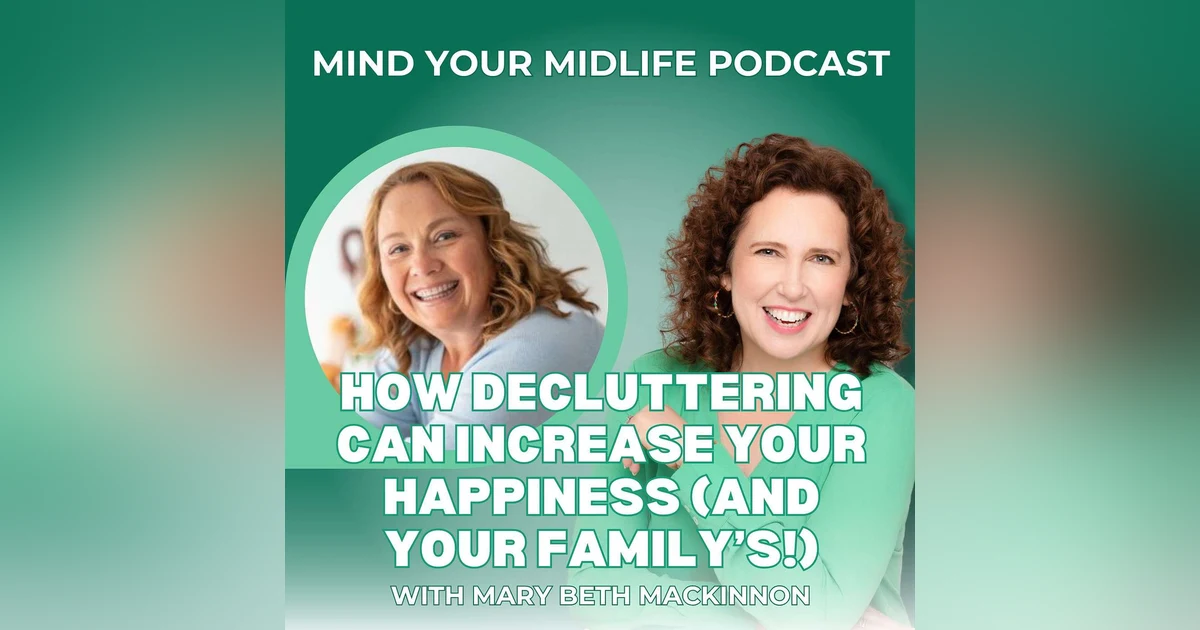


Drowning in stuff while navigating midlife transitions? Professional organizer Mary Beth McKinnon reveals why decluttering now might be the greatest gift you'll ever give your family.
Mary Beth shares her personal journey of helping clear out her mother's home after a move to assisted living—a process made doubly painful because her mother was simultaneously grieving her husband and her possessions. This experience transformed Mary Beth's perspective on our relationship with our things and sparked her mission to help others avoid leaving this burden for their children.
Far from just practical advice, this conversation explores the profound emotional aspects of our belongings.
BY THE TIME YOU FINISH LISTENING, YOU'LL DISCOVER:
- Compassionate strategies for getting started without becoming overwhelmed
- The best tip I've ever heard for cleaning out photos on your phone
- Ideas for helping family and friends with the clean out or downsizing process
- Ways to make the entire decluttering process less stressful
🎯 OMG Moment: Give yourself grace throughout the decluttering process. Perfectionism is the enemy of progress, and even small improvements create a sense of lightness and accomplishment that motivates continued effort.
TAKE ACTION:
Find Mary Beth on Instagram @marybeth.mackinnon - and keep enjoying her tips and tricks!
Grab your free StoryCycle resource from Cheryl to navigate the emotional challenges of this process as well.
Listen to Cheryl’s interview with paper organizing expert C. Lee Cawley.
WHY THIS EPISODE MATTERS:
Whether you're considering downsizing, helping parents through transitions, or simply feeling weighed down by decades of accumulated possessions, this episode provides both the practical tools and the mindset shifts needed to create more space—both physical and emotional—in your midlife.
Find all the coaching and podcast resources at cherylpfischer.com.
Text me to ask a question - I'll answer on the podcast!
Subscribe to receive bonus episodes at cherylpfischer.com/bonusepisodes.
🌸 Liked this episode? Share it with fellow Gen X women navigating hormone balance, an empty nest, and/or self-confidence!
🫶 Love this show? Leave a review to help more women over 50 find us.
💡Want support through menopause, mindset shifts, or midlife transitions?
- Join the collective by subscribing on Patreon or grab the bonus episodes!
- Book a free Mindset Coaching / Intro Call: cherylpfischer.com/coaching
Let’s talk midlife body positivity, self-talk, and redefining aging for women — without the “midlife crisis” narrative. Every week I'm adding new success strategies for midlife women.
Connect with Cheryl, Midlife Coach: Instagram | LinkedIn | Website
0:00 You're listening to this podcast right now because, like me, you're in your midlife phase and people ask me a lot what is that? Well, 40s, 50s, early 60s, I would say we're trying to figure things out and we're in a lot of transition. Maybe it's with our parents, with our kids, with both, with our job, everything, wah, everywhere. What about looking around our house and noticing we have a lot of stuff and do we want to have that stuff? Or what about our parents? Do they still have a lot of stuff? Should we help with that in some way? How would we do that?
0:40 These are tough conversations and not an easy topic. And, at the same time, if we can do some of that clean out now, what about the freeing feeling, the sort of emotional happiness that it could potentially bring? Let's talk about it. Welcome to Mind your Midlife, your go-to resource for confidence and success, one thought at a time. Unlike most advice out there, we believe that simply telling you to believe in yourself or change your habits isn't enough to wake up excited about life or feel truly confident in your body.
1:21 Each week, you'll gain actionable strategies and oh my goodness powerful insights to stop feeling stuck and start loving your midlife. This is the Mind your Midlife Podcast. This past year, my sister and I worked for a long time and, to be fair, she more than I she's in the area. We worked for a long time on cleaning out my mom's house as she has settled into assisted living, and this is a story that I'm sure you could change the names and enter your name and a family member's name or a close friend's name into a similar story at this phase in your life and as we were going through this, stuff was just coming out of every crack and crevice.
2:17 Stuff was coming out of everywhere and it's hard to deal with that. You don't know what to do with everything, and these maybe are things that matter to people, but do you know whether they matter to people? So many, so many tough decisions, and we ended up talking to each other about the fact that you know we don't want to have our kids have to go through this at whatever point. That would be appropriate, because now we see it is hard, and so today I am excited to be chatting with my guest, who I have actually known for many years. We're both in the Washington DC area and she's going to walk us through this subject, which can be very emotional and challenging and also, if you take some of the pieces of advice that she's going to give us, really emotionally freeing and just I'm trying to describe this feeling of lightness I get when I get rid of a bag of stuff and the desk looks a little better or the closet looks a little more open.
3:26 It's such a great light feeling if we can figure out how to do it and not drive ourselves nuts. So my guest today, mary Beth McKinnon, is a professional organizer and a decluttering expert. She has a fantastic and huge following on Instagram because she gives such great tips and she's hilarious doing it. So I am excited that she's going to help us with this whole. When do I clean out? How do I clean out situation. Welcome, mary Beth. Thanks for joining me.
4:06 Thanks, I'm happy to be here. This is going to be fun. So tell us first of all, how did you end up even working as an organizer? It was sort of a fluke, just kind of a weird set of circumstances. I've had a lot of different jobs in my life. I've never just sort of been the kind of person that graduated from college and like, boom, this is my job. I've been an entrepreneur, I've done lots and lots of different things and I was always really interested in organizing. I organized myself, I just thought it was really fun, which I've now found out that most organizers have that brain Like we think it's fun At least someone does Right.
4:47 Other people, like, dread the thought of it and I loved it, and so for many years I thought about doing it as a career, but I didn't know how, I didn't know what I needed to do to do it, and it turns out you basically can just say hi, I'm an organizer and you're an organizer If you know what you're doing. To become a certified organizer there's certainly a very, very long process, but I joined NAPO, which is the National Association for Organizers, and I connected with some friends and I just sort of hung my hat. My sister was my first client. I basically went to her house during COVID and helped her organize, and that's when I realized how much I really loved it.
5:30 I woke up in the morning at seven o'clock and I was so excited to work and I thought I haven't had this kind of excitement doing something in a really long time. So I came home and I told my husband, hey, I think I'm going to be an organizer, and he's like all right. So that's what I did. If I may say, cheers to all the husbands out there who say, oh, okay, cause mine is the same and I have changed a lot of times what I'm doing. And he's like, uh, okay, and I love that yeah. Yeah, it was. He was super supportive and it's been the one and I think he also saw like how excited I was and I started working a job just assisting another like very seasoned organizer. It was my very first job like real job and he saw how excited I was every day when I left the house, Like he hadn't seen that in a long time and so I think just the fact that he knew how much, how happy I was, just you know, made everybody happy he knew how much, how happy I was.
6:28 just, you know, made everybody happy. I mean, I know, if you're listening to this right now and you're getting frustrated because you're thinking I am not happy when I go to work in the morning, I know I, we know how lucky you are. That's amazing. It's amazing that you found that. Yeah yeah, yeah, and I found it at 55. So, like you, it is never too late to change your career. It is never too late to do to find that thing that you love. It's just not, thank you for that. That's such a good point, absolutely Okay. So now we have to get into the emotion of it, because you are talking about how this is fun and I'm glad it's fun, and everyone should have something to do that is fun. I think what I do right now is fun, and we're going to talk about cleaning out before a loss, and by that I mean it could be parents' house, it could be our own house, thinking ahead that our kids don't have to clean it out.
7:22 This is hard stuff, yeah. So tell us about your realizations related to doing this ahead of the emotional impact. Yeah, so I discovered this with my mom. So my dad passed away It'll be 10 years in June, 10 years ago and my dad always wanted to downsize. He did not want to be living in the big house anymore. He wanted to downsize. And my mom was a very lovely yet quite stubborn woman and she loved her house and she loved her stuff and she had absolutely no desire to live somewhere smaller or get rid of any of her things. She was very, very happy where she was and it was okay.
8:06 My dad was 80. She was five years younger, so she was 75. And they were still both seemingly quite healthy until my dad had a stroke. It's very unexpected. He was just and lost all of his, everything on the left side of his body. He had to go through therapy and learn how to talk and walk and do all the things and this is a man who was very active and all of that happened and it was very stressful for the whole family and the house was very big and there were all these things they had to do and my dad couldn't do it anymore and my mom had some mobility issues and she couldn't mow the lawn or do those things, and so it just became like this sort of thing while he was still living.
8:51 That was like we really need to get them to move. And then he had another stroke, ends up passing away and leaves my mom with all this stuff. And so after about a year we realized that we just had to move her into somewhere smaller. It was just no longer safe. It was also really expensive the upkeep and all of that stuff. And so as we were going through her home and we were getting rid of things, she was losing not only her stuff, but she was losing my dad like all over again, because she had that grief. She was still like very, very deep in grief and then she was grieving like this you know this water bottle that I've had since I was 25, like all these things that you know, like we were taking everything away from her.
9:44 And so I just sort of came to this realization that if I can save my children from that pain because it was very painful for my sister and I to see my mom going through that and if I can save my kids that pain from having to deal with that with me and my husband, that would be wonderful. But then also I want to be able to make the decisions with my spouse or whoever I am living with. What are the things that are important for me to keep as I age and when I'm ready to downsize, and I would like to not have to make that decision without my person.
10:29 Yeah, like. I want to do that together and I don't want him to have to. You know, if he has to downsize, well, he'll probably just be like, yeah, just take it. I mean I don't know what he'll, what he'll think, but I mean, I think he actually probably will be in grief as well, I hope. But it's just, it's hard, Like they just, you know, you don't know, you don't know what, what I don't necessarily know what my husband might want to bring as we downsize. Right, I might, I don't really know what might be important to him, right? So I think making those kinds of decisions together and not leaving them to your children and then also just not leaving a gigantic house full of stuff for your kids to take care of, like is like the biggest blessing that you can give your family Like it really really is.
11:15 I really, really agree with you and that is why I wanted to do this episode, because this is a hard topic and maybe I might normally not talk about something kind of this hard to think about on this particular podcast. But also the way you describe it is a shift in thinking too. It's a mindset shift. And what you're saying is how do I want to say this? I think maybe because I've gone through this with my mom and I think the way we might normally think is that we've had this whole big life and now we have to give up all our stuff, like that's awful, it's not fair, we feel defeated, why can't we have the stuff that we earned?
12:00 And you're flipping it and you're saying let's do it now and feel maybe better about the process and have the emotions be easier to handle, kind of yeah, yeah, absolutely, absolutely. And you know I have an aunt who is very much in the thought of like getting rid of stuff. She has one child and she's like I don't want to burden him and she said I'm already going through, like my pictures, and if it's stuff that I don't even know, she's like I'm throwing it away because I don't want him to have to to deal with that stuff. And so it's, it is a gift to give your family if you can do it and also while you're still healthy and you know, some of the stuff you just you don't need, like you just we have so much stuff we don't need so much.
12:48 Yeah, and you know, the funny thing is, as I've been getting ready to talk to you about this, I have this system that I use for my clothes in my closet, because I don't have that big of a closet, because we actually downsized five years ago. But I'll turn the hangers like backwards and then if a year has gone by and I've not flipped it around because I've worn it, I get rid of it, and I'm really adamant about that. But yet I have junk drawers and closets full of who knows what. So I'm not really applying the system everywhere and I guess I need to be Well it's just still it's little bits at a time. Yeah Well, okay. So then let's take in that direction. Let's say that someone is listening and feeling like all right, yeah, I have a lot of stuff and maybe I should start cleaning out.
13:34 Where do we even start you? just pick one place. You just pick one thing. You can't, I tell everybody, you cannot expect to declutter or downsize your whole house in a weekend, right, you just can't. Like you're just setting yourself up for defeat. So you start one thing at a time, like I, with my clients, with my friends, with my following on Instagram, like my whole thing is what can we declutter in 30 minutes or less in a day, or five minutes or less in a day? What is something that we can take a little bit of and get rid of, and that is that seems so much more manageable of and get rid of, and that is that seems so much more manageable.
14:16 And so if you have success decluttering your junk drawer and you can do that in a half hour, then you're going to, when you go into, like get your you know your pen or your scissors or your chapstick or whatever it is, you're like, oh my gosh. Like look at this junk drawer, like it looks so nice. I think I want to do my coffee mugs next. And you just do little things. You know, every day you do something because we're you know we're so overwhelmed right now. You know we're the sandwich generation. We're dealing with our kids who are in college or young adults. We're dealing with our aging parents who are in assisted living or nursing homes or having dementia or all the things, and we're still trying to work and make a living and make our husbands happy and do all the things.
15:02 We don't have time to sit around and do the entire closet in a day, so little things. Do your t-shirts, do an office drawer, all those kinds of things? Do your stuff that needs to be shredded from your filing cabinet? Do you know that millennials and Gen Zs they don't have filing cabinets. They don't have paper. I'm jealous of them honestly. I know they don't keep paper. Everything is automated for them and for us Gen Xers and baby boomers, we have a really hard time wrapping our heads around that. Like getting rid of the paper. Like we are, you know, our paper is like our parents' tinfoil and baggies, like you know how they wash their tinfoil and baggies and they would, you know, reuse.
15:48 Like for us, it's the paper I just have. And even for me as an organizer, like you can see, I have a four drawer file cabinet really hard for me to get rid of paper and I'm I'm getting, I'm trying to get my bills automated. I just don't really like to see all the things. So, and and for those of you listening, let me just say in the show notes I'm going to link an episode I did back in the previous, the previous version of the podcast with a paper organizer because this is the perfect thing If somebody's thinking oh, that's my problem. And we need to go listen to that episode. Okay, so what if let's? That's a great answer for starting on our own house, apartment, whatever. What if it's someone else probably a parent, but someone else and we want to help them get started?
16:34 How do you have any advice for that? Because that's tricky, it is very tricky and you have to start like. You have to come at it obviously from a place of love and a place of like service, like I want to help you. Some people are going to be very amenable to that and they are going to they. They will welcome that help Other people. It can be very difficult, especially if there's any kind of hoarding disorder, anything like that. That's a really a whole nother ball game and in that situation I would recommend hiring a professional like mental health counselor to help with that. Because even as a professional organizer, I don't typically work with hoarders because they're they're not messy, because they just, you know, had too many things like that.
17:23 It's it's a mental health condition. So you have to really be equipped to deal with somebody like that. But if it's like your parents, you have to literally come at them just from a place of love and a very, very deep place of patience, because they, you know they're sometimes they're going to feel like you're trying to take things away from them. If you, if you come to them and I wish I would have known this, you know, with my parents, because if I would have come to them and said hey, I want you guys to make these decisions together, like I don't want you to have to make this when dad's gone or dad, I don't want you to have to do this when mom's gone. I want you to do this together and I will help you.
18:04 And then also, sometimes bringing in an organizer, bringing in a third party, can be really, really helpful, because there's a lot of family emotions when it comes to this stuff. But when you have a third party there, sometimes that third party can really help bridge that gap between the emotion and what needs to happen. And you have to just also, my sister and I were very we were probably a little mean with my mom and when we were making her get rid of stuff and pack up her house, like we just we were like you're moving into a two bedroom apartment, you don't need two 30 cup percolators, like you just don't anymore, like you don't make that much coffee, and so we just you know we had to give her some tough love, yeah, but you have to just sort of read the room and you have to be able to assess, like, what your relationship is with that parent.
18:58 Sometimes you might even have to step away and just let an organizer come in and help do the work. But if you have parents that are, you know, I was talking to a friend who I've actually also been working with and her father just had a heart episode and his wife passed away a few years ago. He lives alone and he flat out refuses help. He refuses like any, and this is like health help, like in-home healthcare, like refuses. So sometimes you have a parent like that that just is going to like they're, they're just they're just gonna say no, and you have to respect that. You can't you really can't make them do things that they're not ready for or they don't want to do.
19:41 But you can find ways to encourage them. You know you can. Yeah, because that's that's really all you can do. I really love what you said about encouraging them to make the decision together while the two of them are still together. That, just it, speaks to me and, to be honest with you, my parents are divorced. They are not together, so that would not have worked in my situation. However, it's a caring way of bringing it up that I would not have thought of. Yeah, yeah, and it also comes down to too, like I was. I was really sort of like hit. My mom passed away almost a year ago and she had dementia and she was in a nursing home at the end for the last like nine months of her life.
20:23 And I would go in to see her in her room and out of her 86 years of life, all she had left was a recliner, a nightstand, a lamp and a few pictures on the wall. That was it. And because she had dementia, she didn't know that that was all she had left. But we collect all these things. We think we have to have all these things all the time around us, particularly our parents, our generation, the boomers, the Gen Xs because that's just sort of how we were brought up and our parents it was the depression, you know. And thankfully our kids now are way more minimalist, like they don't want stuff, like that trend, that change is happening and it's really awesome to see.
21:13 Like it's gonna probably put me out of business, but that's okay, like that's okay. You know, I read this article one time titled our kids don't want our brown furniture. Oh, like gosh, you know, they just don't, they don't want grandma's hutch. I'm sorry, yeah, yeah. So it's just, you know, we just all have too much. We all have too much and we have to get to the point where we're okay with, like, letting that too much go and be okay with having less. You know, one of the things I've heard people in, let's say, gen Z say and obviously we're both. This is very general, everyone might be different but one of the things I've heard them say is well, we want experiences.
21:57 We don't need the stuff, we want the experiences, because then we have the memories and I have started to love that perspective. Yeah, and that's a really great thought too and that is also something that you can go at with your parents, with, or whoever you're helping through this process is we want you to be able to enjoy your retirement, to enjoy your grandchildren, to be able to do things with us, and why don't we get you to a place where you're more comfortable, where you don't have so much stuff, and then you don't have to worry about cleaning the house all the time or having the lawn mowed or the garden or whatever it is, and then maybe you can come visit us or we can go on vacation together or we can do things that we love.
22:41 That are experiences, and you're not going to be so tied to your home and your stuff. Yeah. You know, yeah, and I think, as you said, some people will really get it and will be absolutely open to doing it, and other people are not going to get it and are going to absolutely not be open to doing this and are going to feel like we're trying to take their stuff away and we have to be made, and then that's really hard for everybody, because people are forced to move into a situation that they never wanted to do and then a lot of times they can't even make those decisions.
23:22 You know, and that's even something that kids can talk to their parents about, like, do you want to have something happen and have to move into assisted living and not even be able to come back to your house and figure out what you want to take with you? Right, you know, because that happens a lot. Yeah, happened to my mom. Okay, I'm going to brighten it up again, yeah. Stop talking about depressing things. Important but also difficult, and that's fair. So one of my I always joke that one of my love languages is pictures, and that's not really a love language, but it's still like I love my pictures, I love having pictures. I have them on the wall in the stairway, all over whatever phone.
24:04 Of course, let's say that we start going through our pictures and we say we want to clean out. Do you, do you have some advice on that? Because to me, like I have album upon album upon album and boxes and my mom has slides and you know it's all kinds of stuff, okay so well, let's talk about our photos first. okay, because again, this is where our kids are. Have the the niceness they don't have to deal with this. All their pictures are on their phones and if they want them, they will print them, but they're not like us who you had to send the film off to the clerk or whoever and get doubles. So you had two pictures of everything. Because, oh, my goodness, what if we don't?
24:46 What if we lose one, like, yes, the doubles, we have doubles of everything, right? So what I am doing right now for myself with my photos because, again, I'm just like you, I have a lot of photo albums of pictures, because when I got those pictures back, I would take the half and I would just stick them in my album. And I've started going through all of those photo albums and I'll do it just when I'm sitting down and watching tv at night, like just hanging out, and I go through them. If there are any pictures in those albums that are like blurry because, yes, I saved the blurry ones of, like the back of someone's head. If they're people, I don't even know who they are.
25:27 If they're, uh, suns my dad had about 700 metric tons of sunset photos like vacation photos from you know, like landscape picture. So I had so many of those and some of them I will keep. But for the most part I've been going through my photo albums and pulling out bad pictures, pictures that I don't know, people, pictures that are just like why is that there? And throwing them away. As a starting place, I used to be a scrapbooker so I did scrapbooks for my family. I have one kid up to eighth grade and one kid up to sixth grade and they actually love their scrapbooks.
26:09 I kind of want to finish them through high school. That may be a retirement job, I don't know. But so I still have some pictures that I printed out that I've saved, that I'm going to do that for. But the stuff from like me when I was like single and stupid not not all of those things need to be saved. Like they're still in photo albums, but like my kids aren't going to care, like they're just they're not going to want any of those. So I think it's just. You know you can keep them for yourself, but you can tell your kids you have permission to get rid of these when I'm gone. Like, if you still like them and enjoy looking at them. Keep the, keep the good ones, just go through and sort them, sort them out. If you have pictures of like family, like your parents, like your, like my mom, when I had to go through her stuff, I threw away every single picture of someone I did not know she had.
26:56 She was like she had so many pictures, black and whites, of like stuff from her childhood stuff from, I mean, and her. She had a large family but her closest sister had passed away. I knew a lot of the other. Her other sisters wouldn't know who the people were and I didn't want to burden them with the stuff. So I looked at my sister and I was like, is it okay if I throw these away? And she was like, yep, so we, just we got rid of a lot, a lot of stuff. There are a couple of different companies that will do digitization services. So if you do have some special old photographs, slides, videotapes, you can get them digitized, which is what I did with all of our like home videos.
27:39 Okay, because I, you know again, like with our kids, we had everything on the video camera. Yeah, you know we weren't able to just record with our phone. So I had all these great videos of my kids when they were babies but I never watched them because it was there's too much rigmarole to hook it up and watch it. But now I have them on my computer and it's amazing. I love it. That is amazing and I think I need to do that. Yeah, yeah, you know what? There's something about pictures for me and I'm betting I'm not the only one that if I throw it away, I feel guilty, like I like I'm throwing away the person or something. I don't know what it is. So I appreciate you giving us the permission. Yeah, you definitely have permission to throw it away. Yeah, you, absolutely.
28:20 I mean it is. Though, and here's also the way that I think about it I just I just think, like when I'm gone and my kids are like I mean there might be some pictures that they laugh at, but like when they're going through like that stuff, like I mean there might be some pictures that they laugh at, but like when they're going through like that stuff, like is that really something that I want them to have to spend time on and figure out if it's important? Like I don't want to burden them with it. Like I don't want them to have a garage filled with my photo albums in their house. Like I don't want to add to their clutter. Like that is not a gift that I want to give them at all. Like I don't want to add to their clutter. Like that is not a gift that I want to give them at all. Like, do I want to give them the scrapbooks that I made for them? Sure, but I'm not even sure they want.
29:02 They each have like one bin of papers from preschool and, like you know, the turkey hand you know from preschool. Like they each have one bin of stuff, like in our storage room upstairs. I'm not even sure they're going to want those. I'm boys, so it's that's. I think is sometimes, you know, a different sentimentality than girls. But I'm fairly certain that they don't even know they're there. And if I were to pull them out and be like, do you want these? They'd probably be like no. Yeah, well, I have a boy and a girl and I suspect they both might feel that way. She would probably want to look at it, but I don't know if she'd want to take it. Yeah.
29:43 Yeah, exactly, and I have one, my youngest. He still loves looking at his elementary school yearbooks. He's a little bit more sentimental, but yeah, they just, they just don't have an attachment to stuff like we do. Yeah. Yeah. You know, yeah, yeah. And then I also and for my other big hot tip for digital photos, right, because we all have a gazillion of them on our phone. I think right now I have 48,000 pictures or something on my phone and like 10,000 videos from concerts. I mean, it's ridiculous is and I don't do this every day, but when I think about it I do, and someone actually posted this on Instagram and I thought it was a genius idea Put a reminder in your phone every day at the same time, so it could be like eight o'clock at night, like whatever time it is when you generally are not doing anything, where you're just sort of chilling out.
30:35 At that time, at eight o'clock at night, you're going to go through your phone or your iCloud or wherever your photos are, and you're going to go back as far as you have them in the cloud every day on that day. So my cloud started in 2013. So you go back to 2013, on March 10th, and 2013, 2014, 2015,. You look at your photos for that day and you delete anything that is like a bad photo. You know, I have so many pictures of my kids playing hockey and lacrosse. I have so many screenshots and memes and just stuff. So you do it every day. So that's 12 years now for me each day, but some years I didn't take pictures on March 10th, so I won't have any photos.
31:17 But if you do that, starting today on March 10th, by March 10th of 2026, you're not going to have to do it again. Amazing, you're going to have it all. Your iCloud storage is going to just like dwindle every single day. So I don't do it every day. I try to do it, you know as often as I think about it, but I thought that was like the best tip on dealing with digital photos. Wow, yeah, okay, and if you're listening, I know you can't see me, but my jaw was hanging open as Mary Beth was saying that. Yep, yeah, it was that. I just thought that was genius. I can't remember who it was, who, who? I saw say that on Instagram. And that just kind of maybe it brings us back in a nice little wrap up here.
32:00 It brings us back to what you were saying, where if we can do this in small steps, then we don't get overwhelmed, because when we get overwhelmed, that's when the voice in our head starts going this is too much, it's too hard. I don't want to, I'm just going to make a mess. If we can avoid all that, better, better by far? Yeah, absolutely Absolutely, because it and I will say too, for um, I live with, like, everyone in my family except for me has ADHD in my house, so that it and if you know that you're neurodivergent or you have any issues with that, that that's a whole nother level of um, of like giving yourself grace, because, um, I have many clients who have ADHD and struggle with clutter, and that is also that's a brain issue.
32:48 So, having putting things in place that are going to make it easier for you to go through your day, you know just things that are as simple as, like, I have a hook in my front room to hang keys on Little things of organization and decluttering that are going to be triggers to help you remember to do things, and so I think that that's also really important to give yourself grace if you're struggling with that and know that you just have a little bit of an extra hill to climb, but it's not impossible. And if you set up systems, if you have really good systems in place, you know things, just like making your bed in the morning. You know doing little things, don't you know, when you get ready for bed at night, like, don't leave your clothes on the floor in your closet.
33:32 Like put them you know if you're, if you're not going to put them in the laundry. Like hang them back up again. Like just making little steps every day, because if you do it every day then it doesn't build up, it's just taking little bitty steps. Doing little bitty different things can really make just such a huge difference. I love that Going through your mail when it comes. You know, don't, don't put your mail in a pile, go through it immediately when you pick it up out of the mailbox. Yes, I'm trying to get better at that and it does help, absolutely does help, yeah, okay, so where, let's say, someone is intrigued, they might be in the DC area, they might be interested in working with you, or they just want to find you and learn from you online.
34:12 Where can they do that? How can they? do that, so they can find me on Instagram at Marybeth Mackinnon. It's M-A-C-K-I-N-N-O-N. Yeah, perfect, so Instagram is where I am most. I do have a TikTok, but it's just basically everything that I put on Instagram. So perfect and same. All right, I will make sure that's in the show notes. Awesome, and I do, do, I do, do I do decluttering challenges, all kinds of different things on my Instagram, and I have a private community on Facebook as well. If people are interested in joining that. All right, then my last question for you. Yes, everyone who has been listening has been learning, and they're going to come back to this episode, but what is the one thing that they should really remember, that they can hold in their brain without having to maybe listen back immediately?
35:00 What's the OMG? I have to remember this one thing. I think I thought about this and I think that the thing is give yourself grace. Don't punish yourself for the way your house looks or the way your closet looks. Give yourself grace. We are all busy. We all have busy lives. We are all doing a million things. Some of us have the organizing gene, some of us have the organizing gene, some of us don't, and that's okay. But you have to be patient with yourself. You're never going to accomplish anything. You're never going to be able to like climb that mountain if you are beating yourself up that you can't climb the mountain. You just like. You have to be able to like look at it and love yourself, love your home and want it to just be a little bit better.
35:48 It doesn't have to be perfect. There's too much perfectionism. I watch all those videos on Instagram of people restocking their refrigerator and I want to reach through my phone and punch them in the face because that's not real life. Nobody has a refrigerator like that. Like it drives me literally crazy. Like where do you put your leftovers? I hear you. Like it is, just it's. I mean, what is the present over? Perfect, I think, is a book that I was bought and was supposed to read at some point, but literally like it does not have to be perfect, it just needs to be a little bit better. No, give yourself grace. I love it Well, mary Beth. Thank you so much. This has been a great conversation.
36:29 You are so welcome. It's my pleasure. Thanks for having me. Oh, my goodness, what a great OMG moment. And I promise I did not tell Mary Beth ahead of time to give us an OMG moment. That would be about our mindset about this whole subject. She did it anyway. Be gentle with yourself, be kind with yourself. We can't move forward if we're constantly beating ourselves up. That just really deserved to be repeated again. Thank you for that, mary Beth. Now in the show notes I will have Mary Beth's Instagram you definitely want to find her and I will also have a link for my free story cycle resource to help you start to recognize, especially in some of these difficult situations, what is the emotion that you're feeling right now and what is going on in your head behind the scenes that's creating that emotion, because recognizing it is absolutely the powerful first step that you can take to start maybe switching your perspective, switching your mindset about some of these things that are difficult to deal with in life.
37:42 And make sure that you hit the follow button, because on our next episode, we're going to be talking about regret, nostalgia or gratitude, and we're going to talk about the fact that we get a choice of how we look at things from our past and, depending on how we make that choice. It really affects our quality of life. Now I'll see you then. In the meantime, let's keep creating confidence and success, one thought at a time.