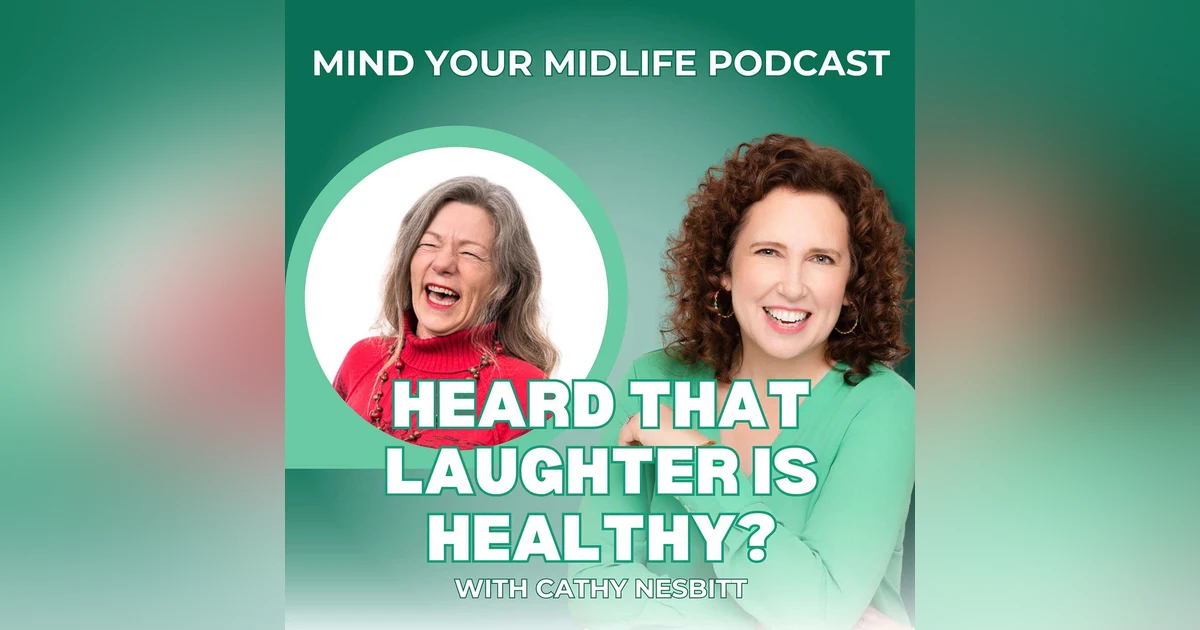
Heard that Laughter is Healthy? Laughter Yoga with Cathy Nesbitt (Ep. 6)


Ever wondered why your body feels so good after a deep belly laugh? What if that natural high could be part of your daily health routine?
Most of us have heard "laughter is the best medicine," but few know the science behind why.
In this joy-filled episode, certified laughter yoga teacher Cathy Nesbitt reveals how intentional laughter can help you manage stress and transform your physical and mental health – no jokes required!
BY THE TIME YOU FINISH LISTENING, YOU'LL DISCOVER:
- Why laughter is a powerful stress-buster that switches your body from "stress mode" to "rest and digest"
- The reason you don't need something funny to get better health from laughter
- How laughter yoga can give you rock-hard abs (seriously!)
- Simple techniques to use laughter to find lost keys, manage stress, and feel better instantly
🎯 OMG Moment: Your body can't tell the difference between real and simulated laughter – meaning you can get all the health benefits even when nothing's funny!
Take Action
Join Cathy's free online laughter club every Tuesday at 9:30am Eastern Time at cathysclub.com.
Grab the free thought-emotion resource at cherylpfischer.com/storycycle.
Why This Episode Matters
If you've been feeling stressed, stuck, or just need more joy in your life, this episode shows you how to use laughter as a free, always-available tool for better health and happiness.
🎧 Hit follow now and join me next week when we talk about making every day fun – not just Sundays!
Find all podcast resources at cherylpfischer.com/podcast.
Text me to ask a question - I'll answer on the podcast!
Subscribe to receive bonus episodes at cherylpfischer.com/bonusepisodes.
🌸 Liked this episode? Share it with fellow Gen X women navigating hormone balance, an empty nest, and/or self-confidence!
🫶 Love this show? Leave a review to help more women over 50 find us.
💡Want support through menopause, mindset shifts, or midlife transitions?
- Join the collective by subscribing on Patreon or grab the bonus episodes!
- Book a free Mindset Coaching / Intro Call: cherylpfischer.com/coaching
Let’s talk midlife body positivity, self-talk, and redefining aging for women — without the “midlife crisis” narrative. Every week I'm adding new success strategies for midlife women.
Connect with Cheryl, Midlife Coach: Instagram | LinkedIn | Website
0:00 Have you ever seen the meme? Maybe on your Instagram, on your TikTok, whatever you're into in terms of social media, maybe it's Facebook. We are in midlife, right? But have you ever seen the meme that says something about either you being the friend that your other friends can't be with in a serious situation because you're gonna make them laugh, or how great it is to be friends that make each other laugh no matter the situation. I know you've seen it. And every time it pops up, I'm messaging some of my friends from all the way back to high school, college, since then, and saying, whoops, that's me. Yep, I know, I'm the laugher.
0:41 And my sister and I, good heavens, I mean, watch out, world, when we're together. And you know what? That's a good thing. There was a time when I was trying to be a sophisticated grown-up adult when I was in my, I don't know, late 20s, early 30s, when I was trying to squash this love I have of laughing. And I was trying to be sophisticated and more serious and not giggling all the time. But the fact is, my very favorite thing to do is to laugh like a crazy person till tears are coming out of my eyes. That's why I love comedy, that's why I love books that make me laugh, and that's why I have friends who also love to laugh. Now, if this is you, you are gonna love this episode because we're gonna find out how amazingly healthy this is for us.
1:30 You know laughter is the best medicine, right? But do you know what laughter yoga is? Did you know it can give you good abs? And did you know how healthy this is for your body? Stay tuned. Welcome to Mind Your Midlife, your go-to resource for confidence and success, one thought at a time. Unlike most advice out there, we believe that simply telling you to believe in yourself or change your habits isn't enough to wake up excited about life or feel truly confident in your body. Each week, you'll gain actionable strategies and, oh my goodness, powerful insights to stop feeling stuck and start loving your midlife.
2:13 This is the Mind Your Midlife podcast. Kathy Nesbitt, a health and wellness advocate, is joining me today. She leads Kathy's Laughter Club as a certified laughter yoga teacher. And I am fascinated. So listen in. So laughter yoga is is just that. It's not jokes or comedy. It's laughing as a cardiovascular workout. I I'm so I can't I can't wait to talk about it. Let's start, though, with why laughter? What's what's so powerful and so important and healthy about laughter?
2:56 Laughter changes everything. It changes our state. I know you've heard the expression laughter is the best medicine. Absolutely. It is. And my next question is: have you had your daily dose? Dopamine, oxytocin, serotonin, and endorphins. When we're laughing, we're secreting the love drugs versus cortisol, adrenaline, epinephrine, the stress chemicals. We have two nervous systems in our body where one is only one is operating at a time. So we're either in their stress mode or we're in rest and digest mode. Laughter gets us into rest and digest. Okay, I like that.
3:37 That's a very simple way to say it and yet powerful because I think we all, we've we've said it already. You said it, laughter's the best medicine. We've all heard that. And at the same time, maybe we didn't know why. Right, exactly. There are so many health benefits for laughing. Talk therapy, I'm sure, is a fine thing, but we need to revisit the trauma, whatever it was that caused the stress. With laughter, it's it's uh it's like our body's mechanism to shift us from again, stress to rest and digest. And it and it happens by laughter, it is just a chemical biological process, chemic, chemical, electrical process.
4:21 It's simply a vibration. So when we're laughing, we're high vibration. When we're when we're depressed and anxious, we're we're not taking up much space, we're breathing shallow, and again, secreting the stress chemicals. Yeah, it's all wrapped up together. And I like how you call our our kind of calm state rest and digest, because on various episodes, we've talked about gut health on the podcast as well. And so, I mean, gut health is almost like the secret to everything health-wise. And so we want to be in that state. And so if this gets us there, then fantastic. Right. Uh uh, some people eat when they're under stress, and I would suggest not to eat during stressful times because what happens is we're in that stress mode.
5:08 Our body is not digesting all of the, not all, but blood, lymph, oxygen leaves our frontal lobe. That fluid, those things go into our muscles so we can escape the situation, even if it's just we've lost our keys and we're looking for our keys. Our body doesn't know the difference between if we're in, you know, danger or we're just like annoyed at something, like we've lost our keys or missed the bus. Our body acts exactly the same. And it takes hours for our body to recover from that. So when so when we stress eat, the food is going in, but it's coming out, and we're our body's not using the nutrients. Oh my gosh, I don't think I've ever heard anyone say that in that way.
5:52 That's really, really helpful. Thank you. I'm glad we got on to that. So that leads us then to laughter yoga. So I've heard of it. I thought, am I doing yoga poses while laughing? What does this even mean? So tell us what is laughter yoga. Wonderful. Started in 1995 by a medical doctor, Dr. Madan Kataria, he's in India, and his goal is world peace. So it's not doing yoga and laughing, it's laughing as a cardiovascular exercise. So the yoga part is the practice of the laughter and the deep diaphragmatic breathing. Because we're shallow breathers, especially we're living in a perpetual state of stress.
6:35 Laughter is the opposite of stress. So this really does help us. When we're in stress, it's just damaging. We've heard that stress is a killer. It's the truth because all of these things get compounded. We hear a bad news and we go into stress, and then we hear, you know, groceries are going up, that there's no jobs, that there's a housing shortage, that all of these things, you know, war and famine and just all the things. It's amazing we're still standing. There's a there's a English is a beautiful language, and there's an expression, and I'll I'll say this expression and then I'll break it down. So it's no laughter, no problem.
7:17 No laughter, no problem. Okay, so N-O laughter, K N O W problem. So if we're not laughing, then we need to talk about our problem. Kn O W laughter, N-O problem, and not no problem, but we can handle it better because our beautiful brain is fully oxygenated now. Solution can pour into our brains. Unlike when we're stressed, we're not breathing properly, our body's not getting what it means. For sure, our brain isn't. Wow. So it's it's a beautiful, oh, it's just, and I think again, back to talk therapy. I'm sure it's a fine thing.
7:57 It's it can be a year years and years that people go to therapy. And we do need to visit our trauma again. What laughter does, it allows us permission almost to talk about it because it frees us. Sometimes people will come to a laughter club, and in the last little while, it's happened a couple of times where people come and they feel sad after the laughter. So, what happens there is when we have an episode that causes trauma, and it can be a small thing or a big thing, we can't we can't compare our traumas. It everyone deals differently. If when something happens to us, we take a deep inhale. And if we don't do anything with that, it gets into our body, it gets into our cells, and then the next trauma and it goes on top, and they they and then it's kind of a layer of trauma that's in our belly that we carry around with us, and we think we're okay.
8:51 I mean, it can be a something, something as simple as tripping in public, and then we jump up like we're so embarrassed. Oh my gosh, someone will say, Are you okay? And we're like, Oh, I'm okay. I mean, my your head's gushing because you you're bleeding, but you know, we're so embarrassed. I don't know what how this all came about. Um, so that so the laughter sometimes can stir up because our diaphragm is attached to all of our organs. So when we're laughing, it's like internal jogging, and memories can get released. And I think what happens is now we're it's later, it's maybe years or decades later, and we might be more mature, we're able to look at that thing that caused us trauma before.
9:32 And that's all it is. This this emotion coming up, we need to kind of look at it. Oh, hello, there you are again, and then we can release it and let it go. I think that's what happens. So when when when people come to laughter and they will report after, man, I was feeling sad after, what was that about? Why did that come about? Then we can talk about it. Interesting. Yeah. I do some tapping with my coaching clients sometimes. And it's it's a similar principle that if we're tapping on these meridian points and talking through things that are bothering us is kind of allowing us to let that emotion out and kind of unblock the energy.
10:15 And it's kind of what you're saying. Some of these things may come out, but we can let them out then, right? That's it. Yes, I love that you say tapping. There's so many modalities, Cheryl, that we can use for our own self-care. And I do incorporate tapping, not the whole mantra of saying things, but tapping on stomach. I do four spots: stomach, kidney, thymus, spleen every day. And in my Laughter Club, I'll also tap on those to remind people. If you tap on these four spots every day, you're it just helps your body get into a nice rhythm. Okay, that's great. And those are different spots than what I use.
10:56 So I'm glad we I'm glad we brought that up. Excellent. Yeah, and it it seems like such a small thing, but it really does make a difference for sure. It's so powerful. It's it changes everything. Laughter has changed my life. I was happy go lucky before. Now that so I've been laughing since 2012 when I was introduced. In 2020, when the world shut down, before 2020, I was doing between 100 and 200 events a year, school workshops, speaking gigs, um vendor events where I'm displaying things. Ah, I was a hamster and I thought I needed to be everywhere, and I was everywhere.
11:38 And then the world shut down. I was like, oh, now what do I do? Like, what do now what? Yeah. So much thinking time. And I realized, oh my gosh. Oh well, I actually took a deep dive into why the expression laughter is the best medicine. Why is that? And if that's the case, why aren't we just laughing? And I realized there's science behind it. There's about 50 years of research proving that laughter it has so many health benefits. So the question, Cheryl, is if laughter is so beneficial for our body, why is it so challenging for us to receive abundant, reliable, sustainable laughter for our health?
12:21 The answer? Our critical mind. As we age, as we grow up, you know, you see kids, they're just laughing. What are they doing? They're just laughing. Nothing. They're not doing anything, they're just playing. We need to adopt more of that because our critical mind gets in the way. We hear a joke and we go, it goes through all these filters. I heard that joke before, I'm not laughing again. That joke wasn't funny the first time. Why would I laugh now? That's a dirty joke. Maybe I'm I don't like that kind of humor. Is it safe to laugh with the people that I'm with? What will they think if I'm laughing? So all of these things, and then they're super fast. Like it's not like it's it's conscious, it's just very fast.
13:04 But it goes through all those filters. The answer to to this is laughter yoga. It's not about jokes or comedy, it's intentional laughing. And people will often say, I laugh all the time. Do you do you laugh like for 10 or 15 minutes, full on, belly laughing every day? Right? Do you have rock hard abs from laughing? I do. Wow. Oh my goodness, everyone listening. There's a reason to do it right there. It's free, Cheryl. It's free. It's in us, waiting to burst out. Why do we laugh at inappropriate times? Like at a funeral, or when somebody's, you know, um somebody has fallen, and then we we laugh like it's it's not funny, but we we might laugh as a response.
13:55 That's our body saying you're too tight, you're too stressed, you need a release, and that's all it is. It's like the pressure cooker. So the laughter is is this wonderful mechanism in us. But what happened? Why is it again? Why is it so challenging? Our critical mind, and it was the Greeks like Aristotle and Plato felt that laughter was frivolous, it was it was silly. If you were laughing, so the more educated you were, the less you laughed because it was frowned upon. Wow. And and I think that is a sort of a core belief that in society we kind of still have as you're saying that.
14:42 When I do presentations and training and teaching, I do try to make sure I'm a bit more informal. And I don't want people to to you know be so stiff and bored, but I get criticized for that occasionally because we need to be more formal. I mean, not not frivolous, you know, and more serious. So yeah, it's kind of part of society that we assume that, isn't it? It's this ingrained piece because it's like, where did that come from? And if people have heard, I've been traveling around the world by podcast, over 300 episodes. I don't know how many countries I've been to. I ask every host if they've heard the expression, laughter's the best medicine.
15:25 Everybody, I haven't met one person around the world that hasn't heard that. And that's the reason that Dr. Kataria started Laughter Yoga. He was dispensing, you know, antidepressants, maybe taking a few. No, I don't know. Just the samples. Um, and he was writing an article for a magazine on laughter, and he read all this research. So he said, Wow, if laughter is the best medicine, why don't we just laugh? And he started a club. The first club had five people, and I think that's funny. He could only find five people in India. So they would meet in a park every morning, they would tell funny stories, they would tell jokes.
16:09 After two weeks, they grew to 50 people, and then the jokes started to become off-color. Two people going somewhere, not funny for those two people, not cool. And the people were like, Oh, we don't like this anymore. It was fun, but yeah, no, I don't like those stories. So he said, Come back tomorrow, I'm gonna have a solution. He didn't know what it was gonna be, but I guess he thought about it, and he got an inspiration, like, oh, kids are always laughing. Why don't we be childlike? Not childish, childlike, and so created little games, and that's how the first club came about. So there's clapping and chanting, and the clapping is palm-to-pom. So you're activating meridians.
16:49 The rhythm is one, two, one, two, three. The words are ho ho, ha ha ha. Very simple. And then we say between activities, very good, very good. So clap, clap, and then hands overhead, yay! Because when you have your hands over your head, it's not possible, it's not possible physiologically to be sad. You're like, oh, I'm so sad. No, it's you have your hands over your head. Wow. Right? And we can even trick our brain, like our okay, we can trick our body. Our body doesn't know the difference between real and simulated laughter. So when we're laughing, ha ha ha, we can even put it on, ha ha ha ha ha ha. Our brain might be like, stop it, because our brain's function is to keep us safe and conserve energy, which is why at the family function, our a sibling will say something and already we're back into that dispute we were in.
17:42 So we're we're in that friction because the brain's like, oh, I know what to do here. This is our way to override that. So we can laugh. We can just start smiling. If if if laughing is too difficult for people, you can smile. And already you start secreting the love drugs. Oh, I must be happy. I'm smiling. So this was gonna be my question. We're we're gonna be laughing in laughter yoga, but not because something is funny, and you're saying it doesn't matter. It's it's the same benefit. Yes, absolutely. It's easy to laugh, Cheryl, when everything's fine. All is well, ha ha ha, so fun. We'll let us have some fun and games.
18:24 The challenge is, and people will say it all, I hear it all the time. How can I laugh? There's so many things going on in the world. And I say, that's we must laugh. It's essential that we laugh because otherwise we're crying in the corner and we're not effective. When we laugh, it frees us up. We get secrete the love drugs, we start feeling good. When we feel good, we do good, and we can help other people. You know, back to my worm mission, Cheryl, it's 22 years selling worms by the pound. I want people to care about the planet, but when you're in a mental crisis, it's not possible. Yeah, yeah. Yeah, you have to figure out a way to take care of yourself first.
19:05 Absolutely. I get that. Yeah. And there's there's a lot going on in the world. I get that. Absolutely. Okay, so so far I've already learned a ton, as I knew I would, and I think many listeners will, because as I said at the beginning, laughter yoga feels like something we would have heard of, but what in the world would that be? And I did not realize that laughing, even without thinking something is funny, would have the same benefit. I love comedy, so I have my Instagram where I've kind of trained it and my TikTok to always show me comedy, you know, so I'll go watch something funny so that I can laugh.
19:45 But I love that this is another option. So can you give us a sense, like a little bit of practice, a short session or something like that to see what laughter yoga would be like? Yes, absolutely. Thank you. Yeah, so put your hands on your belly and and just say ho ho ho, like Santa. Ho ho ho. Ho ho ho. And you can feel when you say ho and ha, those move your diaphragm. So you can so that's what we need to do. We're shallow breathing. So take a nice deep breath in through your nose. Belly comes out, and then just go ho ho ho ho ho.
20:26 Ho ho ho ho ho. Hands on heart, new another deep breath in through the nose. This time we're gonna say ha ha ha ha ha. Ha ha ha ha ha ha. On your cheeks, we're gonna say he. So we make a mistake sometimes and we beat ourselves up. So I'm suggesting that instead of beating yourself up, you start laughing like, ha ha ha, whoops, I made a mistake.
21:12 You know, and back to losing the keys. I can't stop you from losing something. What I can do is give you a gift. Next time you've misplaced something and you're flopping around trying to find it, stop, take a nice deep breath in, laugh it off, ha ha ha ha ha. Apologize to all the people you yelled at. And you'll find your keys, your glasses, your phone. Because your brain is literally being deprived of oxygen. It can't help you as you're flapping around, as you're stressed. It's it's because the amydila, we talk back to stress, has not evolved. So it doesn't know the difference between real danger and just losing your keys.
21:55 You know what? I first of all, that was hilarious. And listeners, if you didn't hear me laughing the whole time, it was because I was laughing silently. But second of all, I tell people all the time that we have to calm our bodies down in order to get our creativity back. And that's kind of what you're saying, isn't it? Like, I'm gonna find whatever I lost or misplaced if I can just calm down, because then my creative thinking comes back. Right? Then we're it's it's for those that are science based or it's logical, they're like, oh, this doesn't make sense. Here's the sense for you that it there is complete science. It's not rocket science, it's body science.
22:36 Right? It's electrical, it's biological, it's chemical. So it's all of those sciences, and that's all we're doing. We're just changing the chemistry in our body. When we're too stressed, nothing's happening. We're just we need to get out of that stress, otherwise, our body will break down. It can't just stay in that stress state. That that stress, it intense stress was meant to keep us alive, and it did. But now it's it it's done its time and it needs to go away for a bit so we can get back into joy where we belong. And now I'm gonna be in such a good mood the rest of the day.
23:17 Right? Yeah, so yeah, that's the beautiful part. When you go to a laughter club and you experience um laughing for half an hour, and it's not full-on laughing for half an hour, you would pass out. Right, but you and you can't just ha ha ha, you're exhaling. You gotta take a nice deep breath in so you can continue. So it's again, it's this built-in mechanism that fills our beautiful body with oxygen. We have trillions of cells that you know often are we're we're very sedentary people now. We're sitting a lot, we're at our computers, we're looking down. So we actually have the physiology of depression. Whenever we're on our cell phone, we're looking down, and we have candy cane neck.
24:01 So although we might be looking at something funny, we're secreting both chemicals because our body's like, I'm confused. You your body is uh sh like you're small because you're you don't want to drop your thing. So what we do in laughter, we take up space, like take up more space, be big, rather than being small and um diminutive. We need to we need to open up and look up rather than looking down, looking up, breathing in. Yeah, I I I really think somebody needs to invent. We have a selfie stick so we can take nice pictures. We need something so that we're looking at our cell phones, yeah, with our neck straight.
24:42 Yeah. I actually saw something on Instagram the other day where uh someone was saying, lie on your back on your bed and let your head hang back over the edge to kind of stretch your neck the other way. I don't know how safe that is. I haven't tried it, so you know, be careful at home. But you're right about certainly our posture becoming an issue, but I never thought about the connection to our mental and emotional state, but it's a hundred percent true because I'm always talking about power poses. So that's like the opposite. Yeah. Right. That that's exactly it. It is exactly like Amy Cuddy in the power posing. Yes.
25:22 Love that TED Talk. So beautiful. Yeah. So if we're doing the opposite of that and making ourselves small and in, that's going to give our body the opposite message. It makes sense. Yes. Yes. So wow. Okay. Well, we've laughed and I've learned a ton, and I know the listeners have. So tell us how can people connect with you? Tell us about the Laughter Club, or you know, how they can find out more about this. Yes. Oh, attend my Laughter Club and plan. If it, if you've never attended Laughter Yoga before, plan to come twice. The first time will be awkward, or could be.
26:02 Whenever we do anything new, it's awkward. We start a new job and we wonder are we going to be able to perform? Will will the people like me blow these things? Laughter yoga is no different. It's something new. Laughing for no jokes or comedy. What is happening here? We're just, what, we're playing, what? Just laugh. Ah. Which I think the ho ho ha ha ha that helps the logical people get into their body. That's what we want. We want you out of your head and into your beautiful body. So come to my Tuesday Club. It's free, online, it's on Zoom, 30 minutes of super fun self-care, 9.30 a.m. Eastern Time. So wherever you are in the world, adjust your time. I incorporate tapping, brain gym, chi Kong.
26:44 I just want people to get out of stress and into joy. It's Kathysclub.com, and you can find out there's lots of videos there and all kinds of things to look at and learn. Why not do it for health, right? Laughter for the health of it, right? That's it. Why not? It's it's in us, it's free. Oh my goodness, Kathy. So our OMG moment today is that you want to laugh in your life. Now, I'm gonna say you want to try a formal laughter yoga class and see how it feels for you. But even if you don't get that far, add laughter to your life.
27:28 The benefits we just heard from Kathy are incredible. And good heavens you have more fun. Let's do it. Thank you so much for joining me today on Mind Your Midlife. Go to the show notes, check out Kathy's website and her laughter club. And you heard us talk about emotions again. So don't forget Cherylpfisher.com/slash story cycle for my free story and emotion cycle resource. All of that is in the show notes. If you are loving this show and you are listening on Apple, make sure to scroll down in your app, leave a rating, and leave a review. Thank you for that.
28:08 Now hit that follow button because on the next episode, I am going to be talking with you about having fun. Let's keep with the theme. So you maybe have heard this Sunday fun day phrase. Guess what? Sunday is not the only fun day. And there is a way that you can add fun and joy into your life every day. Let's talk about it. I'll see you then. Oh my goodness, let's keep creating confidence and success one thought at a time.