Ep. 70: So Much Paper! How to End Paper Overwhelm and Get Organized with C.Lee Cawley
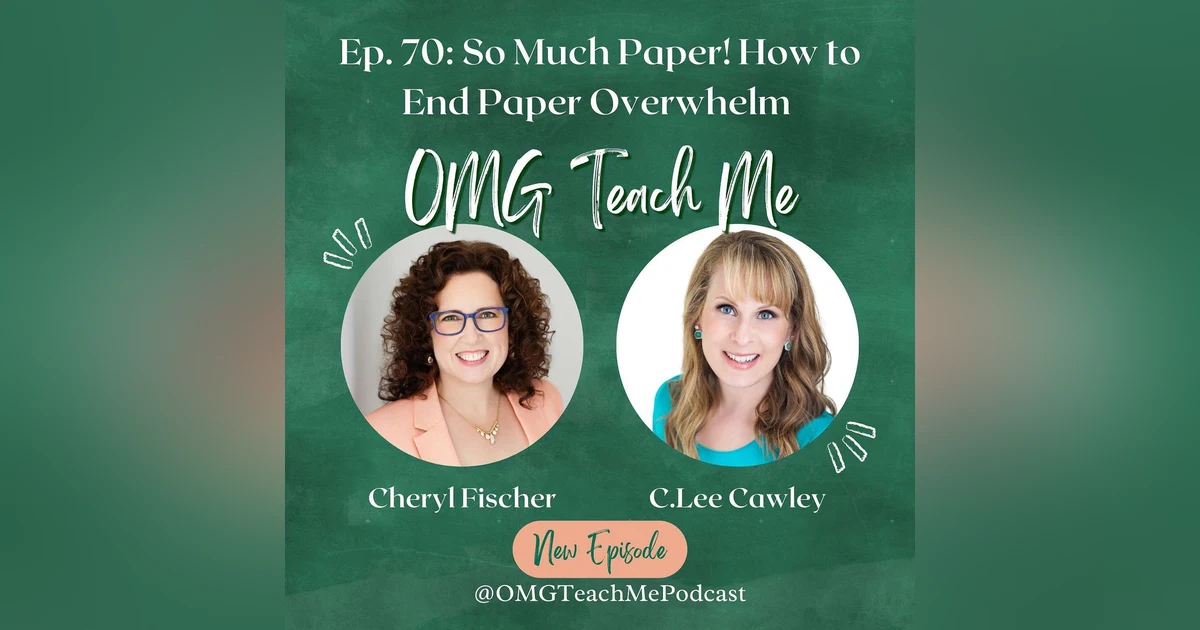


Do you find yourself drowning in a sea of papers, from junk mail to important documents, and everything in between? You're not alone! In this episode of OMG Teach Me, Certified Professional Organizer C.Lee Cawley joins Cheryl to dive into the world of paper organization with tips, tricks, and a few laughs along the way.
We'll explore the astonishing fact that 100 million trees are cut down each year for junk mail, and why we're all still juggling between paper and digital. C.Lee shares heartwarming stories of how getting organized can lead to surprising and positive life changes. Plus, you'll learn about the innovative KARMA method of paper management that can help you tackle those piles of paper step by step.
Join us for a fun and engaging conversation that will leave you motivated to clear the clutter and make space for what truly matters. Tune in and let's conquer that paper overwhelm together! 🌟
Next steps:
- Join C.Lee in her next free masterclass in August 2024! Sign up here.
- Connect with C.Lee on Instagram.
- Connect with Cheryl on Instagram - and check out all the podcast recommendations and sponsors at www.cherylpfischer.com/recommendations.
Cheers to a desk that you can actually see and use! ;)
Text me to ask a question - I'll answer on the podcast!
🌸 Liked this episode? Share it with fellow Gen X women navigating hormone balance, an empty nest, and/or self-confidence!
🫶 Love this show? Leave a review to help more women over 50 find us.
💡Want support through menopause, mindset shifts, or midlife transitions?
- Join the collective by subscribing on Patreon or grab the bonus episodes!
- Book a free Mindset Coaching / Intro Call: cherylpfischer.com/coaching
Let’s talk midlife body positivity, self-talk, and redefining aging for women — without the “midlife crisis” narrative. Every week I'm adding new success strategies for midlife women.
Connect with Cheryl, Midlife Coach: Instagram | LinkedIn | Website
31:20 - [Ad] Get Real with Heather & David
32:04 - (Cont.) Ep. 70: So Much Paper! How to End Paper Overwhelm and Get Organized with C.Lee Cawley
0:00 She had papers everywhere. Older woman, retired, single woman. And so her, these were the financial papers, and she was overwhelmed and she needed to gather up her financial information to take it to a financial advisor. What if there are things we never had the opportunity to learn? We've all been to school or training, but there are things they never taught us that actually make a powerful difference in life. I'm here to share with you all the pieces you've been missing: mindset, health, success, and more. And we'll all learn together from guests along the way. We may not have learned it the traditional way, but oh my goodness, let's keep learning how to do things differently.
0:43 OMG, hello my friends. Here we are, and this is gonna be an interesting episode because speaking for myself, being organized when it comes to paper has always been an issue. In fact, my husband and I joke that we keep our house clean, it's neat, we don't have like stuff everywhere, we're kind of minimal except the paper. So it has been for 20-some years an issue for us, and maybe it's an issue for you. And in fact, as I'm recording this, I am looking across the room and seeing stacks of files from my mom's house for things I'm supposed to be doing for her.
1:25 So I have with me Seely Collie, who is a certified professional organizer. There are fewer than 350 certified professional organizers worldwide. And she uses her advice and instruction to transform living spaces and personal lives of thousands of people. So that sounds amazing. Right now, her mission is bringing order to cluttered desks and overwhelmed minds with her signature course, The Paper Cleanse, and she'll mention that, I'm sure. And she lives near me, just outside of DC. And this is my favorite part, Seely considers herself indoorsy.
2:09 Yes. We were just talking about that. Yes, indoorsy. I love it. Well, welcome. Well, thank you so much, Carl. I'm so excited to be here. And you know, this is one of my favorite topics because it is something that plagues us all. Or most. I I mean, truly, I'm not even making that up for this podcast episode at all. Paper has been always a thing. So we're gonna solve it, right? Yes. Well, let's start with your story to a certain extent. I always, my listeners know I always do this, but I always find that we create things in our lives to really solve our own problems or because they have meaning to us.
2:51 So, how did you end up working as an organizer and then especially with this focus on dealing with paper? So I actually have a BFA in costume and set design. So this is not a natural path, but I realized that I wasn't a brilliant costume designer, but I could get things done on time and on budget. Why? Because I was organized. I went to we went and lived in England. Uh, my husband got his PhD and taught at Cambridge University, and I worked in a high-end retail boutique and we busted out sales numbers. Am I an amazing salesperson? No. I was organized, right?
3:31 I could get the inventory done and focus on clients and do client follow-up. And so when we moved back to America and my daughter went to kindergarten, I was funny, like, wow, what should I do with my life? What should I be now that, you know, I don't want to be a stay-at-home mom, I want to do something. And I realized the things, the the one thread that had made me successful as a costume designer or a retail manager or a personal assistant was that I was organized. And I thought, wow, and this was just this was in 2003, right? So it was just when, you know, we lived near DC. I'd go to a dinner party with my husband, who's a lawyer, like every other person in DC, and I'd say, Oh, I'm an organizer.
4:16 And they'd be like, Oh, for which labor union? Oh gosh. No, no, I do closets and pantries. Oh, and then the wives would be like, What do you do? Right? So it was just when you were starting to realize that this was actually could be an a way to live. And what I also realized is that it just it wasn't just that I was organized, it's that I could teach others how to be organized. And the real success was when I'd set, you know, I'd do the decluttering, set up a system, and people would be fine. Like they'd graduate and I wouldn't hear from them again. And then I knew that what I set up for them was super successful.
4:59 So that's kind of how I came to do it. Plus, it was something I could do as my own business around my daughter's, you know, school hours. My husband was traveling crazy hours, so a real kind of full-time job wasn't really didn't make sense. So I could work between nine and three school hours, or you know, take the day off and go volunteer as a chaperone for the zoo. So it was a good flexible concept as well. And it served, it served me well. And that was when my daughter started kindergarten in 2003. And so yeah, over 20 years later. So I've got a lot of experience. Excellent, excellent. And what really stuck out to me there is this idea of being able to teach people to do it themselves.
5:44 Because I mean, that's my first love is teaching. That's why we're here, honestly. And it's not something that everybody knows how to do. So kudos to you that you figured out how to do that. Yeah. Thank you. So, speaking of teaching people to get better at this, why do we even end up in this position where we're overwhelmed by paper? How does this happen? So, I I do believe, Cheryl, that there's a real divide. So I have a 26-year-old. She has a big job. She's director of product for a ed tech nonprofit. She doesn't even own a printer, right? She is a digital native.
6:25 I am a digital dinosaur. And that I think is really, you know, I still love paper. Like I've got my notes here. I I it's a tangible thing, and that's how we grew up. Because we grew up before the digital age when if you needed information, you got out your almanac or your dictionary or thesources, right? It's so so that's kind of part of it. Also, there are 300 pieces of junk mail per year per person currently in America. 100 million trees are cut down each year for junk mail. So even if you don't have a printer, if you receive mail, then you may may be inundated with it.
7:08 And I do think that there that some of us just need we want to read a real book, we want to highlight our notes. We are, you know, we still like a real newspaper occasionally. So I think that the that's why we're still in this this kind of in between. All of us have one foot in paper still, and then one foot in digital. Yeah. And sometimes it's just like, where did I see that? Was it online? Was it, you know, it's like there's so much information coming at us. So that's why I think we still have a problem with paper. And you know what? It's a good point. If we even say just a problem with information coming at us, this I fully agree.
7:50 This, I don't know where I saw that thing as a problem. Or I know she sent me the message, but where the heck was it? Instagram, Facebook message, text, email? I don't know. Yeah, yeah, exactly. It it it's just it used to be so much simpler. And that's why I think we're really feeling this overwhelm and overload. And and and it manifests itself like you you refer to your mom's papers, right? You may not have those files for home repair, but your mom does. So yes, and it's funny that as we were, well, not we, as I was sitting here getting ready for this episode, I really didn't even put that together, and that probably deserves a whole nother episode, to be honest.
8:35 Helping our aging parents. Yes. But I went to her house and I brought home all these files because I need to work on her finances for her, and they're they're sitting there cluttering up my house. So, yeah, good point. That's a whole nother set of paper. And and truly, actually, it's funny that you should say that because one of the results that a a few of my students have had, one of my students exactly, she had papers everywhere. Older woman, retired, single woman. And so her, these were the financial papers. And she was overwhelmed and she she needed to like, well, she hadn't retired, she needed to gather up her financial information to take it to a financial advisor.
9:20 So she had to organize the papers first. She didn't even know where to find the information because she was getting paper statements and things. And after she worked with me, she was able to do that. She took her her sheath of papers to her financial guy, and he's like, You can retire tomorrow and be absolutely. And it was because she had to get the papers together before she could go there, right? That was A to B. So I think it's wonderful that you're helping your mom in that way. Yeah, isn't that interesting that you might actually not only will your house be a bit neater and your brain maybe be a bit neater, but you might get some good news out of this. Absolutely, absolutely. Okay, so I know that those of us listening who have this paper issue are fully tracking what you're talking about, absolutely recognizing that we have piles and piles and it's hard to keep track of.
10:10 Let's start with baby steps. If somebody wants to tackle this problem, is there a way that you could advise that we would even just get started with you know simple steps? Absolutely. So I have kind of some uh some intangible ideas, right? And and the first is that you know, good and done is better than perfect and none. And I see this over and over again. People don't get started because they don't, they want it to be perfect, and they don't even know what perfect looks like. So it's just better to avoid that, right? So one of the things I'm gonna say is, you know, it doesn't have to be A plus work. I really encourage B minus work.
10:52 Yes. Because any pro you know, slow progress is still progress, and any progress is better than nothing. So that's kind of like the intangible. The other thing is you need to trust yourself, right? So Barbara Hemphill is a renowned organizer. She's trademarked the phrase clutter is nothing more than postponed decisions. And that's exactly what it is, right? Anything that's clutter, you haven't decided if you're keeping it, and if you're keeping it, where it goes. So until you're you can start making those decisions, but people don't trust themselves. They, oh, what if I need it? Oh, I you know, and so one of the things I encourage people to do is really trust themselves and and and in and ask themselves questions.
11:38 Okay, so what if you threw that piece of paper away? Could you find that information someplace else? You know, is it going to be valid? Is it still, you know, those types of ideas? So trusting yourself, and of course, you know, you need to learn which questions to ask yourself, but trusting that you can make decisions. Recently I had a Q ⁇ A with my members, and I said to them, who had all gone through my course, is there any paper? Here we are a year later, because we had like a little graduation, that you throw away that you regret throwing throwing away. And of the dozen or more people on the Zoom call, not one of them could think of one piece of paper that they regretted throwing away.
12:19 Wow. So, because they did it in a purposeful, logical way that they could trust the decisions they made. So then, tangible ways, right? Truly, if you want to do this, like clear your desk off, clean it completely, like get out the wet wipes. I can't tell you. Uh, you know, I had a student, she cleared her desk off, she did my method. She found not one pair of readers, but she found 10 pairs of readers. Very, she said she posted a picture of all 10 of them lined up, buried in the paper. And she's like, Well, no wonder I can't ever find any. If I find a pair, she just kept buying them at the dollar store, right? So, so clean your desk off completely.
13:01 Give yourself a fresh start, give yourself space to work, right? Yeah, and create some type of collection container, someplace that you can collect those papers until you can deal with them, right? That's a hangout spot spot until they find a home. Get make sure you have a good chair, make sure you have good lighting, right? Without those things, it's so hard. You are gonna want to sit at your desk to sort and work because your chair is uncomfortable. And this kind of comes from COVID times. You know, people just had to like make it work, right? Yes. But then they realized when they were at their dining room table, they had a lot of space, they had a big window, they had good light, and maybe that was what they were lacking the whole time.
13:46 So kind of those tangible things can really make a difference in you know, setting up your environment to be a uh to work for you instead of against you. That's a great point because otherwise I think we sort of maybe stick ourselves in a corner like it's a dungeon or something, right? Oh my gosh, Cheryl, I can't tell you how many people like, no, you need to find, even if it's just you use your kitchen table and you have a little rolling cart that holds everything so you can clear it off for dinner. If you're gonna, if if you want to be on the main level where there's light and warmth, don't send yourself to the basement because you won't be productive. So, so yeah, that's a that's a huge issue, absolutely.
14:29 So those are just a couple of things, just to get yourself started. Give let yourself do B plus B minus work and give yourself a fresh start. Yeah, I'm glad you said B minus work because I am a huge, huge fan of that principle in general. We stop ourselves in life from doing so many things because we want to do it, and I'm a definitely an offender in this area. So we want to do it perfectly. So I'm glad you said that too. Absolutely. I love a bit of sparkle and I love to feel a little bit girly, but I always struggled with manicures because either I would mess it all up before it was dry or the gel would be too hard on my nails. Thank goodness my sister introduced me to ColorStreet Dry Nail Polish.
15:12 I can create a new manicure in minutes and I don't have to let it dry. Find ColorStreet at omgteachme.com slash recommendations and check it out for yourself. Well, let's take it further than baby steps then, because you have created a method that you call the karma method of paper management. So tell us a little bit about that. So earlier, like, well, how did you fall into specializing in paper? And I didn't. It's just that that was the need. I would go to everyone's homes and they're like, oh, can you do my pantry? Oh, and then my paper. I mean, it's especially in the early 2000s, before we we became much more digital.
15:54 There was every single person, papers coming in from school, papers coming in from work, papers coming in from conferences, and so and then there's the paper you pay for, magazines and newspapers, right? And then your mom sends you something. And so, you know, I'd rather stay in a kitchen or a pantry because tangible items, you can get a lot more big results in a shorter time with tangible items. Paper can take forever because if you're doing it right, you really need to look at every piece of paper, right? You know, and that's a lot of mental effort and decision making. But I realized early on that I needed, I moved to America from England, and we lived in a fellow's flat, we didn't have a car, you know, I had national health insurance.
16:40 I had very few papers. I came to America and oh my gosh, health insurance, buying a house, buying a car, you know, all you know, chimney sweeps, landscaping, babysitters. It was I I was inundated. I was inundated, and I thought, oh my gosh, I'm an organized person. This was before I even started my business, and I can't manage this. So I came up with a really easy system for myself. And then when I became an organizer, I realized, oh, well, let me tell you what I do. I don't know if it's gonna work for you. And person after person, where I was like, yeah, that worked, that really worked. So it's the karma of paper management, and it stands for K-A-R-M-A, and the first K is CRUD, and I know I spelled it incorrectly, but I had to for my acronym because I mean what's more important?
17:27 Every organizer loves an acronym. So the CRUD is the first thing you need to make those decisions on what you're going to keep. The less you keep, the less you have to manage, right? So, really, that means there's really only four categories of paper, and all papers fall into one of these categories. They can move between categories, but it's A is action, action items or active projects. R is reference material, and some people think about that as filing, but I want you to think about it as what you would actually reference. M is memorabilia, paper-based memorabilia is huge. And the final A is archive.
18:07 And those are kind of our like cover our ass kind of papers, right? And what kind of sets my system apart from other people, lots of people have action or you know, fat file act toss or things, is that I really acknowledge that the memorabilia is a huge part of our paper clutter. And people don't know what to do with it. And once they figure that out, because those are our heart-based paper papers, right? Like the letter to Santa that you want to hold on to, or kids' drawings, or for me, you know, when a uh student sends me a wonderful note telling me how I changed their life, those are heart-based papers, right?
18:51 Those give us a lot of pleasure and joy. So, but we need to figure out what to do with them and not just pile them up and ignore them for months at a time. So that's what karma stands for. And it and like I said, it you know, it worked for my the clients I would go to in their own homes, and then now I'm teaching it as an online course. So it it kind of really found me. I didn't look for it, but it's been a really useful method that really simplifies things and resonates with with people so that they can do it themselves. Yes. You know, that's what's really powerful. You know, clients, students will be like, Oh my gosh, Steely, karma changed my life. You changed my life.
19:31 I'm like, I never walked into your house. You live in South Africa. Like, you did that, you got rid of years of things. You did it so much so that your husband got inspired and he started getting rid of his things. That's all you. I just kind of showed you a path to get there. So, what's exciting about it is I think it's almost longer lasting when it all comes from from you versus like when I used to go into people's homes and do it for them. So, yeah, it's pretty amazing. That's a good point. And I'm I'm thinking of examples as you're saying this, like, okay, well, how do I know where this or that goes? But I think your system does feel straightforward because if I'm thinking to myself, well, do I need to keep a copy of this bill or whatever?
20:20 Well, I probably don't need a record of that, and I probably could find it online. And so I'm I'm thinking, you know, maybe it is simple to think that through. Yeah, yeah. And once and once you kind of look at it from a big picture perspective, because really, why are we doing this? Yeah, we want to be more productive and we want to get our things done, but we don't want to waste much time. Like, once you get it figured out, students are like, I'm saving two hours a week. I just, you know, volunteered at my local animal shelter because I don't feel guilty that I should be at home getting organized, you know. And they're like, oh, not only did I join a book club, I invited them over to my house because my house can, you know, I can show people my house because I don't have piles of paper in the kitchen.
21:05 I can actually do buffet, uh, the kitchen counter. You know, that kind of stuff is really, really telling because those are that's when the results really make a difference to our quality of life, right? Because absolutely, you know, sorting paper is not fun. I try to make it fun, but let's face it, people, right? This is, you know, this is not fun. But if you do the work, then you can get to the fun. So yes. And you know, I the other benefit that comes to mind, and this is why my husband and I always say, ah, paper, we're incapable, is when you want to find something that you need. Yeah. Yeah. That's that's all I mean, being organized is knowing what you have and where it is, whether it's paper or camping supplies or aspirin.
21:52 You know, when you have a headache, you need to, you know, so that's really all organization is. So yeah, so so my method teaches you what the paper is and where it goes. And because you're setting up a system that works for you, a trusted system, right? Because you know, the example I always give, Cheryl, is you might call it auto, you might call it Volvo, you might call it wheels. I don't care what you call it. You just need to know what you call it, right? Yes. I had a when I was working with clients, I had this wonderful man, he was a bit of a curmudgeon, and I was working on setting up files for him. And I was like, okay, you know, at Action File, do you want me to, you know, do bills to pay?
22:34 And he was like, no, I wanted to say, pay the bloody bastards. So I got my label maker out and I was like, pay the bloody bastards, and I put it there and I handed it to him, and he kind of chortled. And years later, I ran into him with a safe way. He's like, I think of you every time I pay the bloody bastard. You know, but he got his bills pay, right? So, so yeah, so that's hilarious. Yeah, as long as it makes sense to us and we can find something later. Yes. Yes. Now, let me just kind of follow this theme for a second. I I think another trap I fall into is to kind of throw everything into the holding container.
23:20 You mentioned we need somewhere to put things, and then I call it aging the paper. I just let it sit there. And then sometimes it just times out all by itself, right? It does, yeah. It's a beautiful thing. And what's great about that, Cheryl, and I'm not opposed to that, is that then it never needed an action taken really, right? Because your mortgage is getting paid, like the things that are important are happening, right? If you have a leak, you've called the handyman. It's and you know, you you've but so those things probably never needed to happen at all. And same thing with I call it stewing.
24:00 So especially with memorabilia, we create a stewing spot, and it, you know, when you first get your playbill from, you know, Kennedy's Center, and you finally got tickets to see Hamilton, and you're like, all of that, the ticket stubs, the playbill, the t-shirt, you know, it's all really important. But two years later, you're like, yeah, I've seen like eight more shows there, you know. So you don't have to hold on to everything because if everything's important, then nothing's important, right? So just as you know, we we we need to play favorites, I think, with everything but perhaps children. And maybe that's why I only had one child, because I do play favorites, but you know, I so so you need to decide what's really important and hold on to that.
24:46 So I love that you've got that you that you let it age, like a fine one. Not on purpose, but it works. Well, and I think you just gave us permission to get rid of stuff that we thought we were supposed to keep. Is that fair to say? Yes, very much so. Very much so. Uh truly, one of the exercises in my class is I tell people like measure, measure how much you start with linear feet, or measure how much you get rid of. And so I had a student in Australia, he got rid of 250 pounds of paper. Wow. He was the first to hit raise his hand and say, there was not one thing I got rid of that I regret.
25:27 Wow. So once you can see how much it, once you start making those decisions, exercising that decision-making muscle, you're like, why did I ever hold on to this in the first place? And you just, you know, and it re you feel empowered because that what you're left with, you you trust, you know you kept it because you purposely said, yes, I need to hold on to, you know, the example I use because I'm still very paper-based, is it's much easier for me to go to my medical records folder and pull out my most recent cholesterol printout, right? Than to go into the portal and you know, find my way there because I'm organized, but I know I saved it, I know where it is, and I know I can get my hands on it.
26:14 And once you can trust that you've set up that system, you feel so empowered. So, yeah, it really helps you get rid of so much more. So my students get rid of between 30 and 50 percent of the paper they have on average. Amazing. Yeah. That feels empowering just to think about it. So we've brought it up a couple of times that some people are doing online, some people are doing paper, probably most of us have a mix. So, do you have any tips for listeners who mostly do their billing online and they don't have as much physical paper, but they kind of have one foot in each world? Yeah, no, so first of all, if it's already electronic, we don't need to print it out, right?
26:57 If you're comfortable with getting electronic statements, amen, more power to you. You will you will have less paper. One of the things is looking at the paper you do have that might still be a problem. So so quite honestly, my course is probably not going to to age very well because people under the age of 40, 30, certainly, don't have a paper problem. You know, they don't get mail, they don't, they don't look at mail, you know. So, but for those of us over the age of a you know, people of a certain age, we still have a lot of paper. So if you have most of your, you know, if you can man manage to be comfortable with the electronics, then I would encourage you to switch over.
27:41 I don't though. I still get my credit card bills and my financial statements in paper because when I get them in paper, I actually look at them. If you just send me a notice, I don't look at it. So you so you need to know yourself. Yes. But if if you're like many of my clients who would get the bank statement and never even open the envelope, then you maybe you need to go paperless and put a note in your calendar, in your digital calendar, you know, to check your statements quickly of the first of the month. Today was the 15th of the month. I pay my bills on the first and the 15th. Yeah. That's what my mother taught me. But I don't write, you know, bill paid like my mom used to do, electric.
28:24 Right. Because how often the bills got paid? I mean, they'll let me know if I didn't pay it. And even if I wrote it on that piece of paper, I'll have to pay it again. If the checkout lost the mail or whatever, I mean, I do most of my banking online as well. Bill paying, because I don't trust the mail, but I still get paper statements. So, so I think that try to keep as much as as you can. And then what I often also do is encourage people to mirror their paper reference system to their digital reference system. Right? So if you have, say, uh medical records, and I've got mine, my husband's, and then I have, I think, dental envision, then maybe in your digital files, mirror that so that they so that you can trust.
29:12 So you don't have to come up with two systems. Your system is the same, whether it's physical paper or electronic. That's a really, really good point, because someone who lives in my house who's not me is really bad about keeping track of email. And so we need to have a similar system, folders or whatever, and to make it match, of course. Yeah, yeah, absolutely. And that way everyone knows, you know, generally in a f in the household, one person is kind of responsible for the physical paper and the reference folders, right? Right. But as long as the other person knows, you know, that oh, you know, Seeley put it under Volvo, not automobile, because it's gonna take you, if you're looking under auto, it's gonna take you a long time to get to Volvo.
29:57 Um so you know, so so making sure that people People realize how you think and what your concept is. But mirroring the mirror, uh, the digital and the analog really can help be helpful. That's a great point. Yes, I think that's gonna help people for sure. Okay, so you mentioned it a little bit ago, but tell us about the paper cleanse and what you have coming up. Absolutely. Yeah, how people can connect with you. So the paper cleanse is really it's a step-by-step system to take, you know, the frustrating files and the pesky piles and turn them into really a lifetime of paper organization.
30:38 So once you set up the system, it it really is easy to maintain because you've created it. It's a system, it's not what I tell you to do, it's what you have decided to do because you've made all the decisions all the way along the way, right? But I'm gonna tell you exactly what to do. Like I say to my students, if you do what I tell you to do, it's gonna be great. You but you have to do it, right? So setting aside the time, so uh the paper cleanse is uh is this course, and then I do so you can do a self-study, but I do have a supported study so that people kind of have the ability to ask me questions, ask other people who have gone through the the course, we have a community, and you know there's lots of other bonuses, but yeah, that is what the paper cleanse is, and it taught it to hundreds of students now on five continents and counting.
31:28 So if you know anybody in Antarctica or Asia, we're gonna hit seven. Those are the two continents I'm missing. So um, yeah, so it's uh you can find me at clecay.com. That's c le c a w le dot com. And there's always the information about when I'll be launching that next. Perfect. I love it. And it's really a cool concept that someone can go online and learn from you and really change something pretty major in their own home wherever they happen to be. I love that. Yeah, it's you know, it's a like most of my students are are older because they're paper-based people.
32:12 And I'm like, if you can get on a Zoom call, you can follow my course because it's it's really simple. And it's you know, series of videos and workbooks that you can print out because we all like our paper, and but it just guides you to exactly how to make the decisions so to to identify what the paper is, right? And then where it goes so that you can find it when you're looking for it. I love it. But everybody seems to find that they can get rid of a whole lot more, and it's also about prioritization, right? This whole concept of what we must do and what we want to do, and finding time to make sure the must-dos get done, you know, setting up that system leaves us time for the want-to-do's.
32:56 Love it, yeah, love it, yes, absolutely. We don't want to be spending time on something that is not. How does I think it's Stephen Covey put it? It's important and urgent. That's what it is. Right. If something's not urgent and it's not important, why are we spending time on it? Yeah. Exactly, exactly. Because there are so much of life that we want to the things that we really do want to spend time with, right? And I think especially so many of my students are older people and they have far fewer years left than they've had. So, do you really want to be spending your golden years stuck in your office looking at that paper? No. No, right?
33:37 So let's let's figure it out. You know, people like, oh, you know, when's the next time you're teaching it? I'm not, I'm like, figure it out now. Don't put it off, especially figure out now, even if it's just for the next generation. Yeah, you don't want to leave your children with these piles of paper that they have no idea that they're gonna feel responsible to go through because they don't know if like dad was writing the great American novel and all they're gonna find is electric bills from the 1900s, you know. So yes, that is what they're gonna find. I can attest to that, yes. Well, thank you for that.
34:19 I think uh I'll make sure that the the links that you mentioned are in the show notes. Make sure that you connect with Seely or come back, make sure you're following my social media. We'll let you know when the next paper cleanse is starting so that you can grab that if you want it or at least have a look and find out more. I think that maybe it's something I might need as well. So, the question I ask everyone is what I want to ask you before I forget to do that, and that is every week I add a song to the nostalgia playlist on Spotify and Amazon music. So tell us a song that has good memories attached to it or just gives you that nice feeling of nostalgia when you hear it.
35:07 So when I read this, it's so funny because, and I'm not even a Gun N' Roses fan, but Sweet Child of Mind, do you know that song? Like me, me, me, me, me, me, me, me, me, me. That guitar riff at the beginning, it's so distinctive. And that song came out in 1987 when I was living in New York City with my two, still my two closest friends, Ramona and Lisa. So Mona Lisa and me, it was a brunette, a redhead, and a blonde, and we owned New York, and uh 1988 Halloween, Lisa the Redhead dressed as Axel Rose with the bandana and the fake tattoos, and we had like a boom box playing Sweet Child of Mine, and Ramona met her husband to be, who she's still married to that day.
35:53 So that song, and then it's so funny because again, I'm not a big fan. I like British music. That song is you know part of the lexicon. So I give birth, I'm in England, my baby learning how to breastfeed. She's a day old, listening to Radio 4, and they're like, we've got a flashback. And it was sweet child of mine, and here I am holding my blue-eyed sweet child, right? And then I have to just tell you this just last month, we were in Budapest, and we were at this wonderful outdoor fountain on Margaret's Island, kind of watching the fountain play, and they had lights and the sun was coming down, and then out of nowhere on giant loudspeakers is that guitar riff from Sweet Child of Mine, and it was this huge fountain and light and music show that we just happened upon.
36:51 So now this silly Axl Rose song has like three special meanings for me. Isn't that hysterical? That is amazing. And I I love those fountain shows. I have seen one in Vegas and seen one in Dubai as well. But why would they choose that song? What are the chances? I don't know, but it was the very first song, and it just came out and like I think other people knew it was happening. We didn't, and it was kind of like quiet, and then all of a sudden, these giant loudspeakers with that guitar riff. And and we were just we had just happened upon it, so it was kind of magical in that sense. So, anyway, that's what you're gonna have to add to your Spotify. I love it, and this is why I love it.
37:32 Well, this whole thing came about because music is so powerful for mood and and everything. And so I started asking about songs, but this year it's always been nostalgia, and they're greatest people have the greatest stories. You've had a great story, so I enjoy it every single time. Thank you for asking. Well, Seely, I know people are going to leave with some practical things they can start doing right now. And in fact, rewind, go listen to those tips that she gave us to get started with because I do think you can go ahead and get started. I'm gonna do some of them. It's sitting there waiting for me in a pile. And now more resources potentially as well to look forward to.
38:15 So thank you so much. Oh my gosh, it's been such a pleasure, Cheryl. Thank you. Absolutely. I hope you enjoyed today's episode. OMG, did you know that we have mini episodes every Friday as well? Make sure to follow OMG Teach Me in your favorite podcast app so you get all the goodies. And if you're just finding this podcast and you're kind of wondering where to start, I have a curated mini series for you to help you stop self sabotaging because we all do it. So head over to www.omgteechme.com and sign up when you get the pop up box. We may not have learned all these things in school, but they sure are powerful now.