89. Changemakers: Hypnotherapy to Find Purpose in Midlife, with Christina L. Woods


When we hit our forties and fifties, we often look around, realize our lives are pretty good, and still notice a sense of dissatisfaction or restlessness. Then, we feel guilty for feeling that way because we know how blessed we are to have families, friends, and careers we (at least) like.
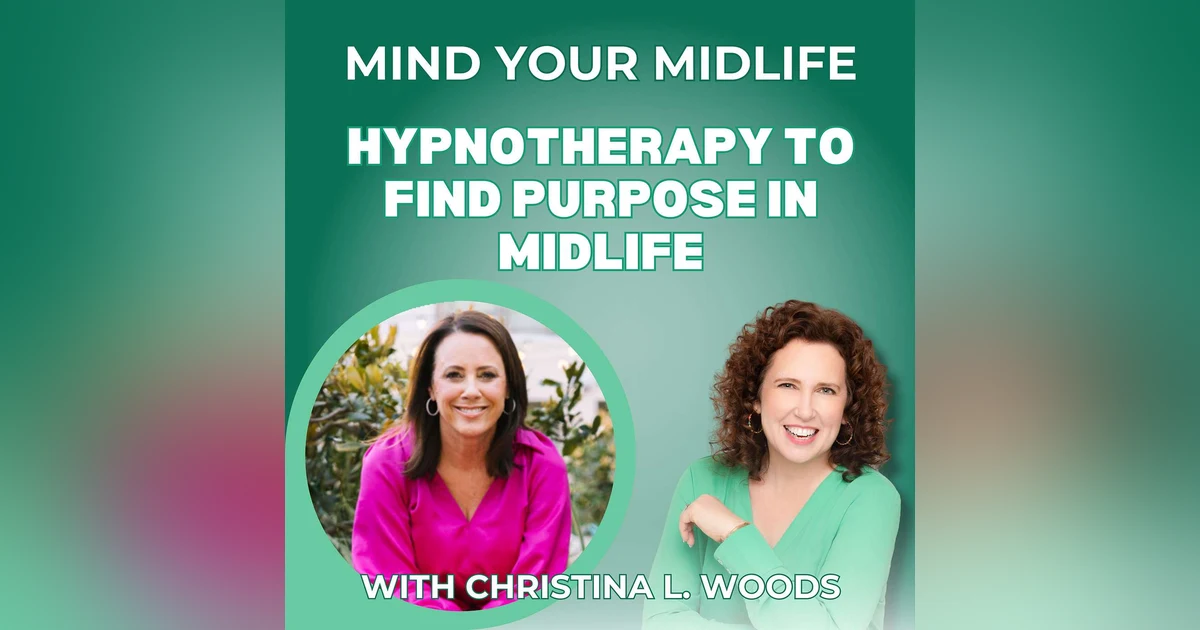
In this Changemakers episode, I'm joined by Christina L. Woods, a clinical hypnotherapist, subconscious transformation expert, and former corporate executive. Christina specializes in helping high achievers close the gap between outer success and inner fulfillment.
We dive into why smart, capable midlife women often feel burned out, why traditional logic isn't enough to break our ingrained habits, and how hypnotherapy can help you safely rewrite your underlying beliefs to find true purpose.
What You’ll Learn:
✔ The Power of the Subconscious: How hypnotherapy quiets the analytical mind—which is only 5% of how our mind operates—to access the 95% of our emotional, subconscious mind where real change happens.
✔ The Identity Trap: Why we feel guilt when our different roles (like being a dedicated mom and a businesswoman) conflict, and how to teach your mind it is safe to be both.
Episode Chapters:
00:00 - The midlife guilt of feeling unfulfilled in a "good" life
05:05 - Christina's burnout and transition from the corporate world
11:33 - How to find your purpose by remembering what brought you joy as a kid
15:55 - How hypnotherapy actually works and why it isn't scary
23:48 - You don't lose control in hypnosis; you gain it back
26:18 - Why logic can never trump your subconscious mind
31:18 - A real-life example: The surprising root cause of night snacking
36:18 - How to get curious about your own blocks
38:26 - Why midlife is the perfect time to trust your intuition
Links & Resources:
- Christina's Website: ChristinaLWoods.com
- Free Weekly Hypnosis (The Reset Room): ChristinaLwoods.com/theresetroom
- Cheryl's Free Story Cycle Resource: Cherylpfischer.com/storycycle
- Episode 69: Hypnosis for Menopause with Sarah Rubens
Why This Episode Matters
By stripping away the fear and myths surrounding hypnotherapy and giving it a try, you can finally quiet your inner critic, release the guilt of wanting more, and connect with the wisdom and intuition you've gained in midlife.
Take a little bit better care of yourself in midlife.
Grab your Vitamin G pixie sticks for detoxification and wellness at cherylpfischer.com/vitaming.
🌸 Liked this episode? Share it with fellow Gen X women navigating hormone balance, an empty nest, and/or self-confidence!
🫶 Love this show? Leave a review to help more women over 50 find us.
💡Want menopause advice, mindset shifts, or support with midlife transformation?
- Find out more about the Midlife Recharge at cherylpfischer.com/coaching
Let’s talk health after 50, self-talk, and redefining aging for women — without the “midlife crisis” narrative. Every week I'm adding new success strategies for midlife women.
00:00 - When Life Is Good Yet Restless
01:25 - Why Midlife Triggers Big Questions
03:37 - Meet A Clinical Hypnotherapist
05:05 - Corporate Success Meets Burnout And Change
11:33 - Purpose Beyond External Validation
15:29 - How Hypnotherapy Helps Fulfillment
22:52 - Debunking Hypnosis Myths And Fear
32:55 - Fast Breakthrough Stories From Clients
37:50 - How To Start And Where To Find Help
41:35 - Trust The Whisper And Final Takeaways
When Life Is Good Yet Restless
Cheryl Fischer
There is something that I notice in we midlife women in our forties, fifties, early sixties that is very prevalent and unfortunate. And that is that you know what? Life is pretty good. And we have a family we love and friends we love and maybe a career we at least like. And yet we still feel often this sort of dissatisfaction or restlessness or something, some adjective like that, and then we feel guilty for feeling that. Because how could we? We're so blessed to have all these other things. Well, if that's you, you are not alone, and I have a cool idea for you. Let's talk about it. Welcome to Mind Your Midlife, your go-to resource for confidence and success, one thought at a time. Unlike most advice out there, we believe that simply telling you to believe in yourself or change your habits isn't enough to wake up excited about life or feel truly confident in your body. Each week, you'll gain actionable strategies and oh my goodness, powerful insights to stop feeling stuck and start loving your midlife. This is the Mind Your Midlife podcast.
Why Midlife Triggers Big Questions
Cheryl Fischer
There's a couple different things going on in midlife. Not a couple, but uh the way that I'm gonna describe it now, there's a couple different things. On the one hand, this period of life that you've heard me say this tons of times before, is full of so much change that it can be head spinning, mind-boggling. And that could be family-related, career-related, physical, body-related, all the things at the same time, which is commonly what happens. And that's a challenge, right? So we have that sort of baseline challenge situation. And from the mindset perspective, we have now lived a lot of life and we've gained a lot of wisdom from living all that life. And we have maybe just maybe a little bit more mental capacity, more space in our day and in our mind to start thinking about what we want and to start thinking about our choices and maybe saying, Well, now's the time. I might want to make different choices because uh this is it. I want the next 20, 30, 40 years to be amazing and I want to do something different. So we're going through all of that at the same time. And that is what I coach midlife women to do. And I come at that coaching from a perspective of let's evaluate how you're being in the world. Let's figure out are you struggling with something like forgiveness or partnership or fear underarching everything? And then we go from there with mindset coaching. And that's one approach that might work great. There is another approach that might work great for some people as well, and that is hypnotherapy. Now, hypnotherapy is something that I'm fascinated by, and you might know that because I have done other episodes on the podcast about hypnotherapy. I'm gonna link in the show notes episode 69 with Sarah Rubens when we talked about hypnosis for menopause, and you will want to listen to both of these. So I'm just letting you know that now.
Meet A Clinical Hypnotherapist
Cheryl Fischer
And today we're coming at this from a slightly different angle. My guest is Christina L. Woods. She is a clinical hypnotherapist, subconscious transformation expert, and former corporate executive. This is Changemakers, after all, who helps high achievers close the gap between outer success and inner fulfillment. Hypnotherapy is such a powerful tool, and I think we have been conditioned by, I don't know, movies, who knows, shows about comedians doing hypnosis, which are entertaining but aren't really what you use hypnotherapy for. We've been conditioned to think that this is a complicated thing. Maybe it's a woo-woo thing, maybe it's a thing that wouldn't work for me. And that's not the case. And so I am really excited to talk to Christina today. Welcome, Christina. Thanks for joining me. Thank you. Happy to be here. I really love this topic, actually. So I'm excited to talk about it. Let's start, though, with a little bit of your journey because you spent, I think it was about 30 years in the corporate world, right? Before six or so years ago, I don't know if I should use the word discovering, beginning this hypnotherapy uh business or journey or career. So tell us about how that happened and what this journey looked like.
Corporate Success Meets Burnout And Change
Christina L. Woods
Well, I was very successful in the corporate world. And like many women or people, I should just say, you know, you get you get burned out. And but that, you know, I I didn't think anything of it. I thought, okay, I've been doing this a long time. And but I got to a point where my marriage at that point, I I knew it was over, but I also, you know, what do you do after 25 years? You don't just, you know, walk away. And so my health was dwindling, my health wasn't doing well. Um, I was struggling with I had thyroid issues, some autoimmune things that was were going on. My first son was about to graduate from high school and leave the nest. So this was like, ah, what's going on? Everything. Yeah, everything. And so there was just a lot of things going on at the time. And then I had kind of a whisper that just said, When are you going to stop making everybody else happy and do what makes you happy? And it was just one of those moments that really hit me. Like, I could have this corporate life and check all the boxes. The bonuses are huge. You, you certainly know how to do this. Everybody, you know, respects you, but you really don't like it. It's really not good on your body. You're you're gonna have to face your marriage at some point, and you're just gonna have to look at these things that you really just don't want to look at. And so that was really the point where I had to make decisions and follow the little whispers that I had been avoiding for a long time. And so that was when I dove into some more therapy and personal development and went down that road. And so I didn't just one day say, buy to corporate. It was, you know, maybe a five-year process, but it was a lot of burnout and it was a lot of realizing that I, you know, was the one that really, really pushed myself and made everybody else really, really happy. But I also got all my validation and all my identity and all of those things, all the boxes were completely checked, but I was so maxed and stressed out that I thought, is this truly, is this supposed to be how it is? Because it doesn't feel very good at all. And it was through that process that, yeah, I did find hypnotherapy. And even then it was like, wow, I discovered some things about myself in an hour that weren't even true about myself. And it was in that moment I thought, there's there's a whole world, there's a whole bunch of people walking around with beliefs about themselves that aren't even true. And slowly I started realizing, wow, that's incredible. My whole life I thought that was true about me, and it's not true. And things started changing.
Cheryl Fischer
Huh. So that was I didn't understand what you meant at first, but that was fascinating. You're saying you sort of had this picture of yourself, this self-definition. You might say, This is how I am, this is what I can do. And you started realizing that some of those things were not accurate or correct.
Christina L. Woods
Right. Right. And when when you have, you know, one of those moments where you reflect back and think, wow, that's not true about me. But that thing I thought was true about me has made me, you know, I was an overachiever. I was, you know, these weren't really bad things that I had that had turned into being an overachiever and over, you know, overgiver and all the things that I got a lot of praise over. So, you know, it it became who I am. And oh, you're such a super mom and you can travel and you can do all these things. They also made me exhausted and have anxiety and um eat too much and spend too much money and people please and say yes to things I didn't want to do and have a lot of resentment and snap at my kids when I probably shouldn't have, and you know, do all these other things that had then created shame and created anger and you know, all a lot of other guilt and things like that as well. So I looked back and I thought, is that why I told my boss I'd do a report at midnight and have it to him by 7 a.m.? Um, is that why I, you know, traveled excessively and you know took on too much when I really didn't even like that thing? Is that why I, you know, said I'd bring extra orange slices to the soccer game and blah, blah, blah, blah, blah, blah, blah? Is that that's why? Okay. I'm the oldest of four and I try to be the mommy when I'm really just the sister. Okay. So it sort of explains a lot of things.
Cheryl Fischer
Yeah, that birth order thing. I'm the older of two, and the birth order thing is real. Yeah. Yeah. So it's interesting because we're gonna we're gonna talk about women kind of feeling unfulfilled, and I feel like you were kind of in a an extreme case where you sort of had things hitting you from all directions, it sounds like at the same time. Is is that accurate?
Christina L. Woods
And and you know, I I I actually, now that I work with so many people, you know, I'm sharing this in a nutshell in five, 10 minutes, but I think it's actually the story for a lot of a lot of people in that, you know, we get to the point, I was about 50 years old when all this happened, um, where we realize, boy, I've done everything I'm I'm supposed to do that makes me happy, where we seek so much validation from the things that we do and achieve. And we get to a point when we realize, guess what? Validation's got to come from the inside. And that's, you know, and that was that was my story. So yeah, it culminated like a big, big volcano in my life. It doesn't need to always culminate like that. But, you know, we often, we often, we all do some things that we get that validation from the outside, and probably at some point we get to a point and realize it's not enough.
Cheryl Fischer
Absolutely, absolutely. And in fact, we were just we were just talking about last week's episode. You were saying you had listened to it. And one of the things that I had shared in that episode, this was more focused on men, but I'm convinced it's at least a little bit true for women, was that when people retire, they some men in particular don't live that much longer because they've lost like all this external validation from their work. Yeah. And now they it's like they don't have a purpose, which is so sad. Yeah. But that's the external.
Christina L. Woods
Yeah. And you
Purpose Beyond External Validation
Christina L. Woods
know, I I I did hear you talk about that. And one of the most important things in in my work now, and really just in life, when you think about it, they say the opposite of depression is having a purpose, is just what what makes you happy. Even if you, you know, you don't have to leave your corporate job and do do some of the things that maybe is in my story. But if you love reading and you want to just go, you know, volunteer and read an hour with other people, if you love gardening, if whatever your purpose is, you don't have to go fly to Africa and have that be your purpose and your mission. It's just what brings you joy? What is your purpose? What brings you joy? Something we all have something that brings us joy. Just bring a little piece of that into your life and weave it in in some way. In fact, one of the things that people come to me often is, is I don't know what my thing is. And we'll go back to what did you like doing between the ages of seven and eleven? And they'll say, that's ridiculous. You know, I baked cookies in my shrinky dink machine, or I did, you know, or whatever. I made, I did, you know, paint by numbers. But when we're kids, we don't think about the consequences or the this. We're like playing with rocks and dirt and dancing, doing twirly twirls. And but there's there's this freeness that we have. And if we can go back there, there is a string and a thread that might we might be able to just bring back that little spark and say, gosh, I actually really did like to sew. And I really, I do like to still knit. And I I just like to sit in the corner and just actually work with my hands. Okay, well, let's talk about that. Or I like to make stuff in the garage. I still like to make stuff in the garage. I just don't have any time. So, you know, we don't have to flip our life upside down, but what brings us purpose?
Cheryl Fischer
I okay, so that's fascinating because I can absolutely see it for myself. I have, I'm in my mid-50s now, so I have over the past couple years spent time choosing hobbies. And it's exactly the stuff I liked to do when I was a kid. How interesting. Yeah.
Christina L. Woods
Yeah. And and, you know, I I think that as we get older, we bang our head against a wall and read a bunch of books and think we need a five-step strategy to seek and find our purpose. We feel lost and it's it can be very frustrating and scary that we can't find it. And what is it? It's like a life's journey to find it. And if we actually do the opposite is quiet the noise all around us, we we can find it. It's like what lights us up, what brings us joy. And our purpose doesn't have to be, you know, creating a charity that, you know, earns millions of dollars. It might be, it might, that might be your purpose, but it also might be walking down at the end of the street and you know, holding someone's hand at the Alzheimer's Center. If that's your purpose, I don't know, whatever it might be. I know a client recently, her, she just loved actually speaking with people at a park. That was like she just loved meeting strangers when she walked her dog. She just loved saying hello to people. And so now she's found a way to just connect and speak with people that don't have any friends and family at a location. And so she's like, oh my gosh, I just love connecting and meeting new people that don't have any family. I'm like, I wouldn't have even thought of that. So there's something for everyone.
How Hypnotherapy Helps Fulfillment
Cheryl Fischer
Yeah, that's really fascinating. And and that's probably a great place for us to talk about how you help people with hypnotherapy because I know you work a lot with women who are feeling kind of unfulfilled, kind of dissatisfied, maybe a bit of guilt about feeling that because life's okay. Like what's my problem? Yes. And so how does hypnotherapy come into that and help them?
Christina L. Woods
Well, hypnotherapy is fascinating because what it primarily does is it sort of what I just mentioned is it quiets actually a lot of the logical, our conscious thinking, analytical mind, which we need, but it's only about 5% of how our mind operates. The you shouldn't do that. Why are you doing that? Everyone, what is everybody gonna think? We all have it and we need it, we're normal. But it focuses and it quiets that little, that little voice, like be quiet. And it focuses on the 95%, which is our subconscious mind, which is our emotional mind. And so it gets you in a very relaxed state, which is a natural state, actually. It's not a, you know, don't watch Netflix, anyone out there about hypnosis, because it's not true. But it's actually a very natural state. And if say someone came to me and said, you know, I need help finding my purpose, or why do I feel so guilty when I just want to spend a little time on myself? And we go back and we we find what is causing that. And we can ask your mind a question and we'll go back to the very, very root of what is what is blocking. And nine times out of ten, it's because we always have, we always, it's always an identity. So if someone is saying, for example, I I have such a great life, I have a family, I have a job, I have this and that, and I just don't feel fulfilled. You know, I feel so guilty about that because I have such goodness in my life. Something must be wrong with me, um, that I still want more. And when we go in hypnosis and we quiet the person that's judging her or him for saying that, what we find is that the identity that says, of course you're grateful for the goodness. That identity, we're gonna put that over here for a second and let that identity be quiet, because that identity isn't the identity over here that says, okay, that's fine, but you also love doing this, you also love doing that. But our conscious mind says, if you're this identity, you can't be this identity, but we know that's not true. All right. So what happens is they they conflict. So it's the perfect example of someone who is working and they feel guilty because they feel like they should be cooking dinner. And you're working and you say, Um, you know, I'm working, but I'm not a good mom because I should be cooking dinner right now. Um, no, you're actually a really good mom, and but you also run a business, perhaps. We have the identity of a mom and we have the identity of a businesswoman. And right at now they think that they can't exist together. So in hypnosis, we go in and we find the two and we say, Hey, you're safe being both, you're safe being together. And so what hypnosis does is it allows the part of your mind that is the most like a sponge, the part that is the most suggestible. And when you're the most suggestible, you can actually tell that part of your mind what is the truth and say you are open to being both of these identities, and it's safe to be both of these identities. And what it does is it allows the guilt to be relieved. So it's just like why athletes use hypnosis so that they can really take in all these really positive descriptive suggestions in a hypnotic state, and we just get it done faster and faster and faster so that in hypnosis, you can say, Oh my gosh, I can be happy, I can be joyful, and I get to go pursue these ideas and I don't feel guilty at all. And we just do it much, much faster. So hypnosis is just being in a very, very suggestible state in our mind. Right now, we're talking, we're not in a suggestible state, we're in a conscious state. So if I were to give you certain statements, they would not go in your in your mind or in my mind in a state that soaks it up like a sponge. But if I put you in hypnosis and I said, you are so joyful, you're, you know, you're beautiful, you're enough, you're all these things, you're actually gonna soak them up a million times more than you would if I just said them right now to you, which is pretty awesome. Yeah, it's amazing. If you want to make change, make them when you're like a little sponge, right?
Cheryl Fischer
Yeah, it really is amazing. And I I have interviewed for this podcast a hypnotherapist before, and we were talking about issues related to menopause and and how hypnotherapy can help with that, which is also true. So a good companion episode to this one. And it just fascinates me that I think societally a lot of us have this picture of hypnotherapy as something that is scary because we might not remember it, and maybe somebody else will be controlling us or something that won't work for me potentially, you know. It just we've overcomplicated it and made us scary somehow.
Christina L. Woods
We sure have. Yeah. And, you know, one of the reasons I chose to leave a solid career and do this was because it was so simple. It is not complicated at all. Your mind, my mind, all of our minds are literally built to accept suggestions. When we are born until we're seven years old, we are open to accept any idea and suggestion that we have. We are in this state of that's why children learn to walk, talk, learn so many languages. Our brains are like little sponges, our minds are sponges. And then at seven, that part of our mind, front part of our brain, sort of closes like a little vault. So in hypnosis, we just
Debunking Hypnosis Myths And Fear
Christina L. Woods
open up this part of our brain where it's very, very suggestive. So it's incredibly natural to say, let's go in that natural state. You don't lose control, you gain control. So it is not natural for you to think you are not enough. It is not natural for us to say, um, I shouldn't go and express myself. I should shrink and have anxiety and not express my opinions at work, even though you've been doing it for a long time. I should uh let others speak over me and express themselves and get the promotion. That is not natural. So to give someone back their voice, to give themselves the ability to not feel guilty. So to go in and find out what's blocking you, well, it's actually because a third grade teacher took your voice away and made you feel small over a little comment and you made it mean something else. We get to go back in hypnosis and find out, wow, it was actually something that someone said to you that wasn't even true.
Cheryl Fischer
Right.
Christina L. Woods
And you interpreted it that way. And now we get to go in and tell you the truth and put it in a suggestible state that's the truth, and let your mind re-reimagine something that's the truth, and it becomes your new normal. We have neuroplasticity in our mind. So those little neurons get to actually create a new highway in your brain, which is the truth now. So it's giving you back control, creating a new truth in your mind. It's not creating an untruth, it's power.
Cheryl Fischer
Yeah, cle definitely. Uh, and those memories, let's take the third grade teacher, for example, people are able to call them up when they're hypnotized. You've had that experience that some of these things come out that maybe we wouldn't have realized otherwise.
Christina L. Woods
Oh, always. I've I've never had anyone not be able to do hypnosis. That's a myth. I think everyone, including myself, always feels like, you know, will it work? Can it work? You know, that's that's our job to work with you. And, you know, and I have clients that have, you know, anxiety and you know, all sorts of things. And, you know, we work with you to figure out what is the best way and method and pace with someone so that they feel nice and relaxed and comfortable. But everyone can can do this. It's a natural state. And we're talking the entire time. So I don't think everyone realizes that. I think you think you're gonna lay there like a zombie and you know, you might get stuck. None of that is true. And you still hear the dog bark and you know, the FedEx truck. You're you're you're conscious, you're just quieting that critical analytical mind. And we are going back to what is the root cause of me feeling anxiety or whatever it is that block that you might have in your life. And we, yes, we go back to scenes and moments, and your mind knows where to go. And it might be eating cereal with your brother, and you heard a comment. And I think what's important for people to know is it does not mean anything bad happened in your life, doesn't have to mean that. You may have had you know some trauma or something, but we all have moments in our life where we made it mean something else to protect us. And our mind only cares about keeping us safe and alive. It doesn't care if we thrive or make a lot of money or even you know have a happy life. It literally only cares if we're safe and alive. Just just know that. And so let's go find out what you made it mean when you were five or seven or 10 or 12, and go make it now mean the truth so that you get to thrive and go have the life you want to have.
Cheryl Fischer
Yes, and I want to say that again because this is something I coach people on as well. We do make things mean something that they did not mean. Someone, a coach, makes a comment about running to first base, and we somehow, even if they were being not mean, we somehow make it that we're the worst runner and that's why they said it about me and not someone else. I mean, just all this craziness we create ourselves.
Christina L. Woods
Yeah. Yes. And it's, you know, and I think even before we blame ourselves, we have to remember that our minds, because I I really think most clients I have will say, you know, I I can't believe I do this. I should know better. I've been doing this forever. Why do I say that? Why do I do that? Why do I eat that? Why can't I get over it? I've had therapy. I should know better. I I've been doing this a long time. We really beat ourselves up. But I just want to say your subconscious mind is literally a million times more powerful than any logic. Logic cannot trump your subconscious mind. It is impossible. Your subconscious mind is so much more powerful every single time. So you really need to understand that. It is so much more powerful because it believes it is doing the right thing. So let's go find out what it believes it's doing for you because it thinks it's doing the right thing. Although it is not conveniently doing the most convenient thing, it's not always making you say the right thing. It's not always creating the best habit. So we can go out and find out what little kink, where is it keeping you stuck now? Because now you're 30, 40, 50, 60, whatever, and you're going, I don't really like this.
Cheryl Fischer
Yeah.
Christina L. Woods
And really inconvenient, or it's not helping me get closer to my partner. It's not, I don't always say the nicest things. I making me not go to the gym when I really want to go to the gym. It's it's making me say I'm fat and I really probably shouldn't say that. Let's go find out why. And then we can change it. And hypnosis is fast.
Cheryl Fischer
That's amazing. That's amazing. Okay, so I have been hypnotized before, uh, two times, three times maybe, with two different practitioners. And I'm fascinated by this whole discussion because one of the times we were I was frustrated because, and everybody listening, including you, Christina, is probably gonna find this funny right now. But I was frustrated because I was like blocking myself from kind of standing out from the crowd in ways that's hard for me to explain because I'm on a podcast and I stand out from the crowd by definition by doing a podcast. Yeah. But anyway, I could give you a lot of evidence. It's a weird thing that I have. And when I was hypnotized, I I wasn't totally sure. I'm trying to explain this for somebody listening who is interested. I I wasn't a hundred percent sure that I was hypnotized. In hindsight, I was. Yeah. But at the time I wasn't sure. And he was asking me kind of what did I see? And and I I kind of saw this situation when I was very young, with my parents kind of telling me to quiet down and calm down and like I was making too much of something. And I always wondered since then, did I make that up? Like I have no recollection of that. Like, where did it come from? And so what this conversation is making me think is that it must have been in there. I don't know why I would have made it up.
Christina L. Woods
Yeah. Yeah. I'm so glad you brought that up. That is so normal to say that. Like, did I make that up? Did I just see that in a photo album last week and now I'm bringing it up? Um and what is good to know is it doesn't matter what your bring the scenes that you bring up, it's the feeling and the the meanings that matter. So the the details of it don't matter because you know it's the the meanings that you made of it that matter. Huh. So what is the the meanings, like the the identities, the meanings, the who did you become in that moment that matters. So whether you were with your parents or whether this or that doesn't matter so much because it does feel like, did I make this up? Because I don't this is kind of like a memory I had, or is it a memory, or did I just search in my head too much because he was asking me too many questions? Yeah, exactly.
Cheryl Fischer
Oh, I'm so glad that we're talking about this.
Christina L. Woods
I'm learning right now. I know because it's an odd feeling. It's an odd feeling.
Cheryl Fischer
Yeah. Yeah. And so I love that perspective because if it doesn't matter where it was, I think what it was is me being in a situation or feeling like I needed to like tamp down my personality, is what was coming up.
Christina L. Woods
That's all that matters. That's right. That's right. And there's a part of us when we do hypnosis, I know for me, I'm like, am I doing it right? Am I doing it right? Am I gonna do this wrong? Are they gonna think I'm doing it wrong or right? Or yeah.
Cheryl Fischer
Yeah, fascinating. So what is a what is kind of a success example that you've seen someone make a change and it's been a pretty quick change that happened?
Christina L. Woods
Yeah. So a client recently came to me, even just in the last week, about snacking at night. And I mean, we all can relate to this one. And, you know, I always snack, I always snack, I always have to have something in my mouth, even had a story around it. My dad always had to have a snack in his mouth, and I think it's a a mouth issue, you know, like I have to have something always gum or something in my mouth, and even had the idea that it would be like a fixation thing. I think probably in the past she had smoked as well, and so thought it had to do something with that. And we went back to a moment as a teenager where
Fast Breakthrough Stories From Clients
Christina L. Woods
she had not been heard and seen, and really did not feel that um parents had really seen her in a very, very important, you know, moment in her life and time. Okay. And this really was a comfort that was bringing her to feel really, really safe now, really bringing her comfort to her body, to her nervous system, so much more than she realized. And so what I what I want to say this is whatever it is, so snacking might not sound like a wound, but the wisdom, the answers are in the wound, are in the issue. Okay. So in hypnosis, we go back and we talk to the issue, we talk to the snacking, we talk to the anxiety, we talk to the yelling at your kids, whatever it is. In this case, we talk to the snacking and we can do it. And it said, I'm here to help you feel good. I'm here to help you feel loved, I'm here to help you not feel unheard and unseen. And this is why I do it. And I came to your life when you were 10, and blah, blah, blah, blah, blah. And it made so much sense. And so when you are able to see it, like hover over it and see it, it's a paradigm shift and you can't unsee it anymore. And so I made her an audio recording and she listens to it. So this is probably, I guess, about 11, 12 days ago. She listens to it every day, and she's already noticing that she's not does have any desire to have the snacks anymore. She's feeling more confident and comfortable and just doesn't even feel like she has to go grab those things at night. But I have I have hundreds and hundreds of stories like this. But she really thought it would be about food and had nothing to do with food. Yeah.
Cheryl Fischer
Fascinating. Fascinating.
Christina L. Woods
Yeah, yeah. I mean, I I could think of one other quick story if you have one minute. Sure. Another client that wanted to quit smoking. And so we went back to uh a moment where she was three years old and a swimming teacher that she had had smokers' breath. But she loved and adored this swimming teacher so much. It was like the most loving, kind swimming teacher she had when she was three years old, but the swimming teacher had really horrible smoking breath. But she loved that teacher so much. So my client, who had some relationship problems, but she also wanted to stop smoking, she was never gonna stop smoking because the smoking reminded her of the most loving, kind teacher that she loved so much. She felt so loved and connected. She was never gonna leave that because it just brought her back to the most memory of like the most mushiest, loving, kind teacher. And so as soon as she connected it, it was we had to tell her mind that isn't love, this is love, and she has not picked up a cigarette since. Wow. Right? And so you can't make you can't guess that. I would never have guessed that. I didn't go into this session with any, you know, and she had done patches, she had done beat herself up for 30 years about smoking. And in one session, we went back to I'm three years old, I have a smoking uh teacher, swimming teacher, excuse me, swimming teacher who has smoker's breath, and and she instantly stopped to have it. But her mind connected that with love and and admiration, and her mother wasn't very loving and kind, so to her that was kind of like a mother replacement. And her body connected it with something that meant a lot to her. So there's just so many stories, but that's interesting, right? Oh my gosh, I'm fascinated. I'm fascinated. So it's the meaning we attach. The meaning we attach.
Cheryl Fischer
Yeah, yeah. And how will we, how would we figure that out if we couldn't, I see what you're saying, if we couldn't get past kind of our logic defenses and try to find what in the world is going on in there. Yeah. Yeah. Great point. Okay. So if someone is kind of thinking, wow, this seems interesting, I might be, I might be in this situation, how can how can they start? What should they do?
Christina L. Woods
Well, so, you know, just get curious and and kind with yourself about an area of your life that you feel blocked or stuck, or something that you feel about yourself. For me, it was, I always felt I was, you know, judging myself, I was bad until I realized I'm really not bad, but why do I believe that I'm bad? I need to go have somebody help me reflect on why do I believe that I'm bad when I'm I'm not a bad person, but I do believe that I'm bad. I had to get curious and go look at that. So if there's an area you feel stuck or blocked, just get curious about it and
How To Start And Where To Find Help
Christina L. Woods
get this guidance. And so with hypnosis, you don't have to know why. So just free yourself from that. So many people will call me and go, I don't know if I can work with you because I don't know why I do this. You don't need to know why. I don't need to know why either. Your your mind will already will help us get you right there really, really quick. We already, we don't need to know why.
Cheryl Fischer
So fascinating. So fascinating. Okay, then what follows from that is how can people find you and connect with you if somebody is curious?
Christina L. Woods
Sure. So my website is Christina Lwoods.com, and I offer a free weekly hypnosis and healing session. It's every Thursday at four. It's 40 minutes. And so ChristinaLwoods.com slash the reset room. And it's great for people to check out if they want to just peek in and listen to the replays, even if they don't want to go live. But I think that's nice because I try to break all the myths that you're doing right now about what hypnosis is.
Cheryl Fischer
That's a brilliant idea, and I will have to partake in that as well. Okay, so the way I always wrap up these interviews is to ask what is the one thing that somebody listening should really remember? And I ask this because I think we're always multitasking and we're doing five of the things while we're listening. And so maybe we save the episode and we go, I'm gonna go back to that. But what's really the key thing that you want somebody to take away from this?
Christina L. Woods
Well, I I love your show is about midlife because I think it's the time in our life that we tune into our wisdom even more. And so I want to remind everyone that your intuition is is gold and it's your guiding light, it's your North Star, and the answers are within. So whether you use hypnosis, you lose you use journaling, meditation, a walk, you know, a walk outside, but finding a way to just get quiet and tune into you, yourself, your intuition, your wisdom. This is such a beautiful time, midlife, to trust it, to trust it, because the answers are within you. And just listen to the whispers. They are little whispers and they guide you in the right direction toward your purpose, towards simple simplicity in life and joy. Just trusting yourself.
Cheryl Fischer
Yeah, that's a great message, and I appreciate you saying that because we often do question those little kind of intuitive thoughts and feelings and gut feelings. And every time I follow mine, I know it's been a good decision.
Christina L. Woods
Yes, yes.
Cheryl Fischer
Well, Christina, thank you so much for joining me. I'm fascinated, and I know the listeners are too.
Christina L. Woods
Great. Thank you for having me, Cheryl. I appreciate it.
Cheryl Fischer
Okay, if you're listening, you know I always say this. I love these one thing to remember. I could not possibly agree with Christina more. Trust yourself. Trust yourself, trust yourself, trust yourself. Now, don't let the weird voice in your head tell you that that's selfish. I'm not saying don't trust anyone else. I'm just saying when you get that gut feeling, like Christina just said, when you get that whisper, trust it. Do it. My example is always when I'm talking about intuition. I have a drink in my hand, let's say, and I'm about to set it down and I'm setting it too close to the edge. I will get a little feeling of, ooh, that's too close to the edge in my head. And if I don't listen,
Trust The Whisper And Final Takeaways
Cheryl Fischer
it's gonna fall. Simple example, but it has happened to me a number of times. So maybe I'm a klutz. Anyway, neither here nor there. Trust those instincts. You have been alive for a long time, and that means you have wisdom and your intuition is powerful, has always been and will be. I hope that this was a powerful episode, and I hope that you'll think about hypnotherapy because I do believe that this could be a fantastic answer for some of us when we really want to change and grow. Now, one thing you can start with is start understanding your emotions, the thoughts in your head, how those pieces work together, and what that's creating for you. And I have a free resource for you called the Story Cycle that will help you start to name how am I feeling right now? Where is that coming from? So go grab that at Cherylpfischer.com slash story cycle or click the link in the show notes, and that will be a start, a first step for you. And in the meantime, remember that midlife is your time to take just a little bit better care of yourself. Just a little bit better care on the outside, your body and all the stuff, and on the inside, meaning mind, heart, emotions. Just a little bit better care makes a huge difference.

Clinical Hypnotherapist & Subconscious Transformation Expert
Christina L. Woods is a Clinical Hypnotherapist, Transformational Coach, and Energy Healer who helps women understand what's been holding them back so they can move forward with greater confidence, joy, and self-trust.
After more than 30 years in corporate leadership, Christina followed her own journey of healing and transformation, which ultimately led her to leave the corporate world and help others create meaningful change in their lives.
Today, she combines hypnotherapy, coaching, and energy healing to help people reconnect with themselves, gain clarity about what they truly want, and create lives that feel more aligned, fulfilling, and authentic.