85. Intimacy and Sex After 40 Without Shame Or Pressure, with Jennifer Marie Summers
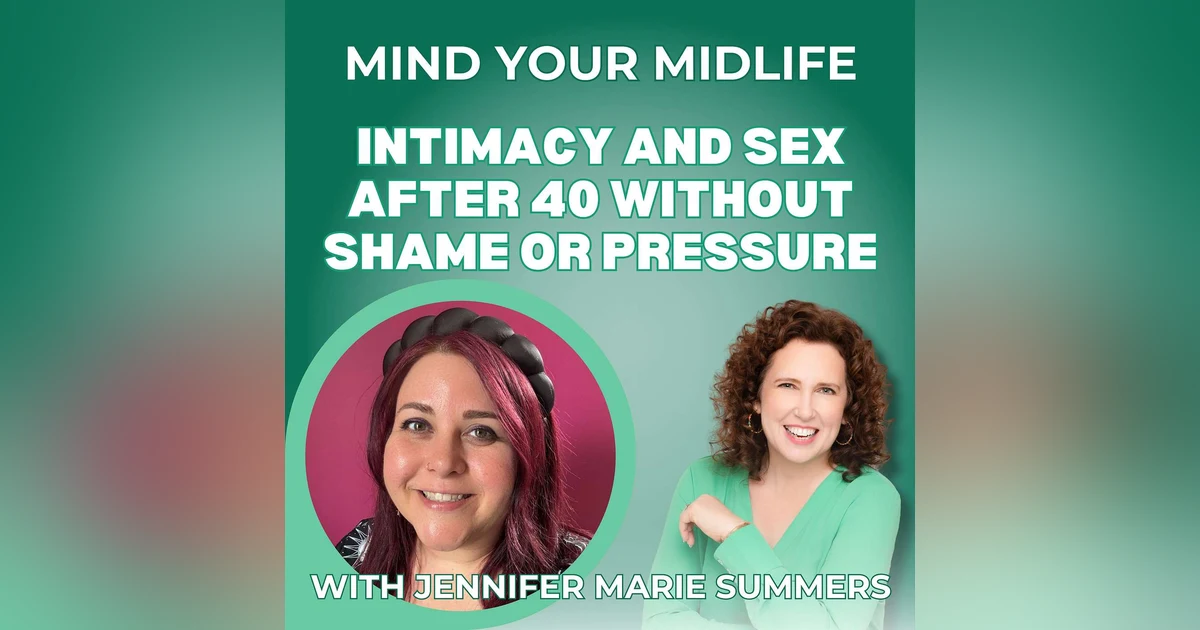


Many women in their 40s, 50s, and early 60s tend to suffer in total silence when navigating changes in intimacy. We often carry shame around our shifting desires and changing bodies, falsely believing we are the only ones struggling or that we are somehow broken.
In this episode, I welcome Jennifer Marie Summers, a board-certified sexologist, certified sex coach, and menopause coach who has been doing this work for nearly two decades. We dive deep into why smart, capable midlife women experience shifting desires, why regulating your nervous system is more important than jumping straight to supplements, and how to finally communicate your needs with your partner without feeling pressure or awkwardness.
What You’ll Learn:
- ✔ The Difference Between Sex and Intimacy: Intimacy and sex are not the exact same thing. Intimacy can look like holding hands, talking about your day, or simply gazing into your partner's eyes.
- ✔ The Nervous System Block: Stress creates cortisol in the body, which puts us into a state of fight or flight. This causes blood to rush to our arms and legs and away from our genitals, which physically prevents us from feeling pleasure.
- ✔ The "Yes, No, Maybe" Framework: Using a printed list of intimacy options helps couples discover shared desires and opens up new doors into intimacy.
- ✔ The Power of Daily Pleasure: Small actions like taking a few extra minutes in the shower to mindfully wash your hair or listening to a calming 528 hertz frequency can help you get back into your body.
Episode Chapters:
00:00 - The changing landscape of midlife intimacy and relationships
03:04 - Meet Jennifer Marie Summers and the common intimacy struggles women face
05:59 - How to figure out what you want and start practicing mindful self-care
10:04 - Moving past the societal expectation that sex is just for men
12:36 - Regulating the nervous system and trying the 528 hertz frequency
17:06 - How stress and cortisol biologically block physical pleasure
20:48 - The "Yes, No, Maybe" list to improve couples' communication
28:52 - Why finding daily pleasure is your birthright
32:05 - Finding daily "glimmers" and taking better care of yourself
Links & Resources:
- Jennifer's Website and Intimacy Products: summersoflove.com
- Free Yes/No/Maybe Checklist & 5 Secrets to Pleasure: summersoflove.com/collections/free
- Jennifer's Podcast: Sip with Summers
- Cheryl's Free Story Cycle Resource: cherylpfischer.com/storycycle
Why This Episode Matters
By stripping away the secrecy and addressing the nervous system stress driving your disconnection, you can completely change your relationship with intimacy and your body. You are not broken.
Take a little bit better care of yourself in midlife.
Find the GreenSynergy Elixir and Energy Fizz duo at cherylpfischer.com/greens. Grab your water bottle, add these, and enjoy!
🌸 Liked this episode? Share it with fellow Gen X women navigating hormone balance, an empty nest, and/or self-confidence!
🫶 Love this show? Leave a review to help more women over 50 find us.
💡Want menopause advice, mindset shifts, or support with midlife transformation?
- Find out more about the Midlife Recharge at cherylpfischer.com/coaching
Let’s talk health after 50, self-talk, and redefining aging for women — without the “midlife crisis” narrative. Every week I'm adding new success strategies for midlife women.
00:00 - Let’s Talk About Intimacy
01:13 - Why Midlife Changes Relationships
03:18 - Menopause Symptoms That Affect Sex
05:59 - Redefining Intimacy Beyond Intercourse
12:36 - Nervous System First, Not Fixes
14:26 - Simple Morning Rituals That Help
17:05 - Stress, Blood Flow, And Pleasure
20:07 - Naming Feelings And Wanting More
22:09 - The Yes No Maybe Method
26:47 - Where Sex Education Failed Us
30:16 - Pleasure Is Your Birthright
33:01 - Glimmers, Resources, And Closing
Let’s Talk About Intimacy
Cheryl FischerOkay, are you ready to talk about sex? Actually, we're gonna talk mostly about just the idea of intimacy. Because I hear from so many women in midlife, 40s, 50s, maybe early 60s, that things are changing or they don't feel good about their bodies, or something's different. And it's a little bit harder to feel good about this type of relationship. And this is not my area of expertise. So I have a fabulous guest coming to join me, and we're gonna dive in. Let's talk about it. Welcome to Mind Your Midlife, your go-to resource for confidence and success, one thought at a time. Unlike most advice out there, we believe that simply telling you to believe in yourself or change your habits isn't enough to wake up excited about life or feel truly confident in your body. Each week, you'll gain actionable strategies and oh my goodness, powerful insights to stop feeling stuck and start loving your midlife. This is the Mind Your Midlife podcast.
Why Midlife Changes Relationships
Cheryl FischerThere are all sorts of relationships that you as a listener might be in during this midlife period. Maybe you are single, maybe you're divorced, so now you're single, but you were in a marriage relationship for a long time. Maybe you're married, maybe you just got married, maybe it's remarried, maybe it's the first time, maybe you've been married for a long time. There could be so many, maybe you're dating, maybe you're seriously dating, but you don't want to get married. You get you get the point. So many different types of relationships happening during midlife. And yet there's one theme that I hear a lot, and that is that maybe intimacy is different now than it was before. Maybe it's not as common for you and you wish you could do it more. Maybe it feels awkward. Maybe you feel bad about your body. Maybe it just seems like, ugh, I don't have time for that. There could be so many different things going on. Or maybe you have a great intimate relationship with your spouse or your partner. It's worth talking about. And so my guest, Jennifer Marie Summers, is a board-certified sexologist, certified sex coach, and menopause coach. And she specializes in helping midlife women navigate changes in desire, confidence, and intimacy. And she has been doing this for nearly two decades. And she uses a lot of humor too. So you'll hear her talk about that. We're going to focus on the mindset of this, as you might imagine, since this is Mind Your Midlife. And I'm excited for you to hear this conversation. So welcome, Jennifer. Thank you for joining me.
SpeakerThank you so much for having me, Cheryl. I'm really excited to be here with you today.
Cheryl FischerI think this is going to be a very enlightening and entertaining conversation. Let's say that. Okay.
Menopause Symptoms That Affect Sex
Cheryl FischerSo here's what I want to start with. Tell me, tell us, what are some common questions or common struggles that you have heard from midlife women related to intimacy, related to sex?
SpeakerYou know, the biggest one that I hear from midlife women is that their bodies are changing and their desires are changing. And I think what a lot of people are not educated on is that it's a totally normal process that happens to women. So if we live long enough to experience perimenopause, we are going to experience changes and things like vasomotor symptoms, like hot flashes, vaginal dryness. A lot of my clients never needed lubricant before, and suddenly they're finding that it's not as wet and it hurts when they're having sex. And that's because it's too dry. And another big thing is the body confidence and the body changes. So we start to notice the breast begin to sag. We get wrinkly skin. Maybe we're having joint pain or stiffness, and we can't do those positions that we really used to enjoy in our 20s and 30s. And then on top of it, you have the stress of aging parents, young children, your career, your to-do list. Like there's so many things that happen to women at this stage in life. And I think it's really important that we normalize this conversation because there's women out there that feel that they're broken. And I'm here to tell you you're not broken.
Cheryl FischerYeah, thank goodness. Because as I'm listening to you, I'm kind of like sinking in my chair, like, oh my goodness. Oh, that's awful. Oh my goodness. Oh, another bad thing. Seriously. But yes, thank you.
SpeakerThere's something like 34 symptoms of menopause.
unknownYeah.
Cheryl FischerYeah, it's overwhelming. And I would bet that for anyone listening, at least a couple of the things you've just said that has really resonated with them because we all go through it in some way or another. We maybe don't all have the same symptoms, but we all go through it. I'm trying to think, how do we go from here? We can't solve every one of these things. What would you initially say to someone who says, you know, I'm really not interested in in sex, it it hurts. I can't, like, is uncomfortable. I can't do what I used to do. What would you kind of talk with them about?
SpeakerWell,
Redefining Intimacy Beyond Intercourse
SpeakerI think the first thing I would ask them is what they want their sex life to look like. So, you know, they I you're saying all the things they can't do. What do they want to do? You know, what's what's even possible? So, you know, that that might look like getting rid of the genital touch and focusing on non-sexual areas of touch to experience pleasure and intimacy. And I do think that many people think intimacy and sex is the exact same thing, but it's not, you know, intimacy could be holding hands and talking about your day or, you know, gazing into your partner's eyes, which neither of those are sexual. Um, but yeah, I I think it's important to find out what they want. And and I'll be honest with you, Cheryl, I I believe there's a lot of people out there who who don't know the answer to that question. So if if you're if you're listening and you're like, I don't even know what I want, I would start with focusing on the self, on what feels good. So things like, you know, touching yourself in a non-sexual way, like rubbing your hands on your skin, maybe taking a little bit of extra time in the shower just to, you know, really mindfully wash your face, wash your hair, just all of these, these touches that we do anyway, but we're not doing them mindfully. It's like we're we're checking it off the list, right? Like I'm gonna take a shower and then I'm gonna go pick up the kids, and then I'm gonna make dinner. But like in those few minutes, even just some gentle touch, some self-love and some self-care, I really think makes a difference. Doesn't have to be some big elaborate thing that we're doing. It can really begin with some small, simple, mindful steps.
Cheryl FischerAnd isn't that the truth? I want to kind of dive into that further because I think oftentimes when we have something that we want to change, we think that we have to do some sort of intricate and elaborate program with many steps that requires lots of time. And we have to do it exactly this way, and it's gonna be so much, you know, it's gonna be this extra thing now that we have to worry about. And I disagree with that as well. I agree with you. There's these little things we can do in life in general that just make such a huge difference. And so I find this interesting that if we just take a little bit better care of ourselves, like your example of washing your hair, actually try to enjoy that, is what you're saying, I guess. And think about what you're doing. Yes. That that starts to make a difference.
SpeakerIt definitely makes a difference. Because those small actions, it's an avalanche, Cheryl. It's it leads to more, right? So maybe somebody starts off mindfully washing their hair, which seems so simple and basic. But then that makes them realize like, hey, I really enjoy having those few minutes where I don't have to be a wife, a mother, an employee, you know, a child to a parent with dementia, like fill in the blank, right? Like it's it's giving women permission to feel good again. I like that.
Cheryl FischerAnd so taking care of ourselves is a big piece, I guess, of wanting to have intimacy with someone else. I was thinking that when we talked about self-care in this particular subject, in this particular way, it would be more about making sure that we felt good about our bodies being attractive. And then of course that would lead to whatever in the relationship. You're saying, maybe that's a piece of it, but you're saying it's really more about taking care of ourselves in a way that we just feel good about ourselves in sort of a bigger way. Is that what you mean?
SpeakerYeah, you know, I think I think that when we are in partnership with people, and you know, I'm speaking about like I'll say like cishet, right? So a man and a woman, heterosexual relationship, there's this division of labor that really is so heavy on the female side of all of these expectations, society, the patriarchy, our upbringing, and ourselves put on women to take on all of these roles, right? So, you know, I think of the idea of sex being for a man. Like this is something that we do to make them happy. And I want to challenge that. I think that when we feel good with ourselves sexually, intimately, pleasure, desire, all of those things, when we're in more balance, it affects all of our other facets of our life in a positive way. So, you know, when we are feeling intimately connected with our partner, we're showing up in other areas of our lives, feeling more confident, happier, more embodied. I think where that disconnection comes in is when people are carrying around the shame and the stigma, perhaps even a little bit of grief for, you know, what their life isn't like right now. And I like challenging that because we're all capable of making these small little changes at any point in our life. There's there's no time like the present to feel good. And so, you know, as a coach, I do intimacy and menopause coaching. I always start off baseline with helping my client feel good with themselves. Because if you're unhappy, you're it's gonna transfer to all of those other parts of your life, whether you want it to or not.
Cheryl FischerI agree with that for sure. Why would we want to be in a vulnerable situation when we're feeling just in some way or another, mentally or physically? Yeah, I agree. So if you have women who come to you and say, you know, that some of these things you listed out at the beginning, they're they're struggling with some physical things, they're struggling with some mental things. What are some tips that you give that maybe are kind of like low stress, low pressure? We have the take more time with yourself, certainly. So I'll give that a number one.
SpeakerBut what else? Yeah.
Nervous System First, Not Fixes
SpeakerGreat question. So, you know, a lot of my clients that come to me for perimenopause and menopause coaching assume that we're just gonna dive into supplements and hormone replacement therapy. And that's not to say that those are not amazing, incredible things that help women. And I support those things, but I like to step way back. And before we get into any of that, I start with nervous system regulation because the truth is, Cheryl, none of this stuff is gonna work if the body is in a stressed-out state. And so some suggestions I give to my clients, and I'd love to share with your listeners too, are to start off with some type of morning routine. And it doesn't have to be some complex, three-hour long thing. It can really be as simple as waking up, drinking some water with electrolytes before you drink your morning coffee, getting outside. You know, I'm in I'm on the East Coast, I think you are too, the weather's starting to get nicer, the sun is out. Some light going outside, getting 10 to 15 minutes of sunlight while you mindfully are drinking your water. And, you know, on those days where it's not so nice outside, I may sit next to a window with my electrolyte water and pet my cat or read from my book. And so, again, like really little basic things. Having a good breakfast. Uh, I'll tell you, I'm not a big breakfast person, but at a minimum, I do have a protein drink every morning. And so I get my days started with that. Another thing I really love that I didn't know about this before, and maybe you do, but it's been such a beautiful shift for me is um listening to
Simple Morning Rituals That Help
Speaker528 hertz frequency. Are you familiar with this? I am not. Tell us. Okay. So 528 hertz is a frequency that's connected to the heart chakra. So if you've ever heard of sound balls before with the with the noise that they make, it's a frequency. So the 528 frequency is it's it's such a calming technique. If you're in a stressed out state and you put this music on, it literally feels like my body is just going like, ah, it's so relaxing. And so, really, I think the key is little mindful moments of de stress because we are all living in such a stressed world where so many of us are like, okay, I'm recording this episode, and then what's the next thing I need to do? And we're just like constantly running from one thing to the next, not eating, not breathing, not even being in our bodies. We're just like this head, this floating head with this body attached. And so the biggest thing I do is I help people get back into their bodies and regulate that nervous system. So then we can work on the sleep, we can work on the exercise, we can work on the diet and the supplements and the hormones. But it really needs to start with eliminating or at least decreasing the amount of stress that we are living in day to day.
Cheryl FischerI agree with that. And and if our nervous systems are all riled up, there's so many, there's so many bad things that are happening inside our bodies. And as well, we're not necessarily able to pause in whatever we're stressed about and interact with other people in our lives in the way that we might want to, as well, which is kind of what we're talking about, right? So I absolutely agree. And I think we have a tendency to make even what you're saying become harder and more complicated because I heard you say drink water and go outside, and I love those great advice. And I know so many people that have said, well, I have to eat protein, and then I have to eat this much protein, and then I have to count the protein, and then like every little thing becomes a big thing. So I appreciate the viewpoint that we can do some little things, make them easy, make them a habit, be kind to ourselves, and that gradually builds into making a big difference.
Stress, Blood Flow, And Pleasure
SpeakerIt really does. Yeah. Small changes add up. And, you know, another thing I want to point out, especially for women in midlife, is that those hormonal shifts affect everything. So, you know, as we lose estrogen, estrogen feeds like literally every organ in the body. That's why, you know, so many things get affected as we move into that. And then add to that stress, stress creates cortisol in the body, and that adds to fight or flight. Fight or flight is when our blood essentially rushes to our arms and our legs so we can get out of danger. And uh, you know, just like a penis fills with blood when it's excited and erect, the cluterus does the same thing. The cluterus fills with blood, it gets erect. But if all of that blood is running to your arms and your legs, it's running away from your genitals. And of course, you're not going to feel pleasure. So, you know, it's there's there's a lot of factors to this, but the most basic part is how can we eliminate or at least minimize stress in our day-to-day life.
Cheryl FischerYeah. Yeah. That's such a great point. I don't think I ever thought it through quite from that angle, but even down to the basic level of blood flow. Yeah, great point. Great point. And I know it's frustrating. If you're listening, I know it's frustrating sometimes to hear the advice to minimize stress because I think oftentimes the initial response we have to that is well, that's that's nice for you to say, but it's hard to do. It's hard to do, maybe, but it's doable, right? Like we we have some new habits, we try some things. Yeah. One thing that I work with clients to do a lot is to be able to recognize how am I feeling right now. And this is kind of what you're saying as well. Am I feeling frustrated? Am I feeling nervous? Am I feeling empowered? You know, more than just happy, sad, mad. Because there's more, there's more nuance to that. And just related to what you
Naming Feelings And Wanting More
Cheryl Fischersaid at the beginning, I don't think we really know how we're feeling. We don't always know what we want. We don't always know how we're feeling. But if we can teach ourselves to recognize that, then we can have a much better sense of what's going on in our heads for sure.
SpeakerYes, I totally agree. You know, it really is just kind of stepping out of that rat race of, you know, feeling like we have to do everything for everybody else and taking a few minutes to think about what would make us feel good. And, you know, if I had a client that came to me and I said, What do you want? And they're like, I literally don't know. I have no answer for you at all. I would encourage them to, you know, take some meditative, quiet time and think about it and write down, like, you know, if if anything's possible. So like forget about, you know, you got four kids in three different schools and, you know, like all like all of the things the mortgages do, like everything. If anything's possible, what what would you want to do? It doesn't have to be in reality of like today getting done, but like let's start dreaming a little bit bigger and thinking about what could be possible. That's the first step.
Cheryl FischerAnd what about a situation where maybe it's the partner and let's say someone's asking you, you know, or telling you, here's what I want. I want to have a more intimate relationship, but I'm not sure that he does, let's say. Do you have any thoughts on that when it's that type of situation?
SpeakerYeah. So, you know, I think that couples, especially ones that have been together for a while and they kind of get into these routines, you know, it's almost like a script, right? So it's like he does this or she, whomever, they do this, and I do this kind of thing. And I think the disconnection comes in with the fact that especially, you know, we're talking about midlife women, what you liked and did and
The Yes No Maybe Method
Speakerenjoyed in your 20s may not look the same in your 40s, 50s, and beyond. And I think people really struggle with getting stuck in these, these roles or the script, like I said, to where you've done it this way for so long, you feel like you just always have to do it that way. And we don't want to deviate, you know. Um, women are raised with so much shame about their bodies, and nobody wants to be weird, right? We all want to be normal. So I think I think a good first step would be sitting down and, you know, discovering what your partner's into. I do have uh a free download on my website that a lot of my couples' clients really like. It's a uh yes, no, maybe list. And this list, Cheryl, has A list of it's about 40 different things, and it's everything from like kissing to like BDSM at a sex club dungeon, you know. So everything in between. And I recommend my clients or whomever downloads it, I recommend they print out three. So one for you, one for your partner, and then one for the relationship. And the first step is to look at the list. Okay, by yourself. Just read it. Don't do anything with it. Just check it out, let it land. You know, a day or two later, you can go back to that list and you can go through and you can check off the things that are, yeah, like, oh, I want to do that. I've done that before and liked it, or I'm like kind of curious about this. The things that are a maybe, like I might want to do that, but I'm not sure if I want to do it like today.
Cheryl FischerAnd then the nos, you know.
SpeakerAnd then your partner does the same thing separately. And then you can come together and you can review like, all right, where do we align on the yeses? Where do we align on the maybes? And what are the no's? And I always say with the no's, you know, it doesn't have to be no forever. Maybe we, you know, revisit this six months, a year, five years. But for right now, it's a no. And so we're we're not gonna focus on that. We are gonna focus on all of these yeses because listen, with 40 options, I promise you're gonna have at least three things that you're on the same page about, probably more. But this allows couples to open up that communication and discover like, wait a second, I never knew that you liked that, and I like that too. And it allows permission because I'm just checking off what the list says. I didn't make up this list, you know? So I really like that because it gives people a chance to not only explore these things together that they both want to try, but oftentimes there's things on that list that they never even considered that they find themselves getting excited or curious about. And that can truly open up brand new doors into sex and intimacy.
Cheryl FischerI'm fascinated. Wow. Uh I think that's a fantastic idea because it is something that maybe people don't talk about enough because again, it might feel awkward to just sit down and have a conversation about it. And so this means, hey, I like you said, I didn't make this up. Here's this thing. Let's just look at it. It feels a lot less confrontational or vulnerable or something.
SpeakerYeah. Yeah. Yeah. Helps to take the pressure off. And I think it could be a really exciting idea for a date night, too. So stay home, have a glass of wine, fill out your list. And then let's try something from the list.
Cheryl FischerAll right. There's an idea to remember if you're listening. Okay, well then let me ask you how can people find that? How can people find you if they want to learn more from you and about what you do?
SpeakerYeah. So uh my website is summersoflove.com. So my last name is Summers. So I have been doing sex ed meet stand-up parties for 20 years, and I have all of my intimacy products on my website, as well as some menopause support tools such as vulva balms and uh water-based lubricants that are specifically designed for women in perimenopause and menopause. In addition to that, I have a free section of my website, and the free section does include the Yes
Where Sex Education Failed Us
SpeakerNo Maybe checklist, as well as five secrets to have more pleasure in your life. All of my coaching is on there, my intimacy and my menopause coaching, and I offer free consultation calls. So that's there as well. And then my podcast, Sip with Summers, where you're on conversation around sex, intimacy, and pleasure, as well as all of my social links. I really enjoy making content around all the stuff they didn't teach us in health class growing up. I love that.
Cheryl FischerAnd I will make sure all of that is in the show notes. And and what you just said really resonated with me. I think we might all think that whatever we learned in health class, that was all we needed. Like we were done. We got we finished the class in whatever grade it was when we were kids or maybe high school, but that was it. And that's kind of silly to think that way now that you pointed out.
SpeakerWell, you know, funny enough, as I was reflecting back, because I've I've always been curious about sex. Like I was raised in a family where my mom was raised Catholic, but we weren't Catholic, but there was still all of that shame left over, right? So, you know, there's I didn't learn about it growing up. And then in school, I went to public school and they were more focused on uh planning your wedding. So instead of learning about sexual health, I had to call like florists and and venues to get pricing. So I remember at the time being like 14 years old and thinking, like, this is BS. Like, I want to learn about the body. I don't need to know about how to plan a wedding. And even now, there's like so many things coming out. They finally mapped the clitoris like two weeks ago in 2026. So, you know, there's there's always something to learn. And most of the education that we received growing up was either abstinence education or how to put a condom on a sad banana or like STIs, you know, it's all reproduction. Like there's no conversation about pleasure. I didn't even know the clitoris was a thing until I started reading Cosmo magazine, because that's not a reproductive thing. You know, the clitoris is only for pleasure, sex, and orgasm. So there's a lot of information out there that women and men are not like don't know because it's not common. And so I'm very passionate about educating on all of these things because we deserve to know about our bodies.
Cheryl FischerGreat point. And I appreciate you pointing that out because I really had not thought about where do we get this information? We get it from school and that's it, which is crazy. Yeah. So on that note, I always say, you know, people are probably listening to this while they're doing the dishes or the laundry or driving the car or whatever. So they're not going to remember everything. What's the the one thing that really you want someone to take away from this episode and remember?
SpeakerI always say pleasure is your birthright. So, you know, pleasure can be a lot of things. Pleasure, of course, you know, a lot of people think of pleasure in regard to sex, orgasms, things like that. But pleasure could be going and smelling the roses. It could be sipping a glass of wine with your girlfriends and having some girl talk. It can be, you know, going out to your favorite restaurant. It could be playing with your vibrator. Like there are so
Pleasure Is Your Birthright
Speakermany things. But, you know, the clitoris is designed for pleasure. Um, like I just said, you know, there's no biological purpose. The clitoris has 10 to 15,000 nerve endings. And I always joke, like, if you want to get on my nerves, get on one of those nerves, please. But focus on pleasure, little moments. Like, listeners, what I want you to leave with when you listen to this is I want you to go today, go find something that's gonna make you feel good. Watch a funny TV show, like something that's gonna make you feel in your body, make you feel joy, pleasure, happiness, laughter, like some type of positive emotion. And then do that again tomorrow. And then do that again the next day. And especially for listeners that are moms. I'm not a mom, I'm an auntie, but I'm also a cat mom. Uh, and I think that women tend to put themselves last almost exclusively. And I think that it's important for our children and, you know, nieces, nephews as well, for them to see these motherly figures enjoying life because it's a way of giving the next generation permission that it's okay. Like we're not machines. We're we're human beings, right? We're not human doings. So find those little moments of pleasure every day because it is your birthright. Our bodies are designed for pleasure and they're meant to be enjoyed.
Cheryl FischerI agree completely. And I appreciate that you're kind of making this broad and saying something that makes you laugh, something that just makes you happy. 100% agree. That is fantastic advice. Well, Jennifer, thank you so much for joining me. I know this is going to be an enlightening conversation for everybody listening, and I love that.
SpeakerYes, I'm thrilled.
Cheryl FischerThank you for the opportunity, Cheryl. If you listen to Mind Your Midlife on any regular basis, you will know that I could not possibly agree more with what Jennifer has said about finding a way to have pleasure in your day. Simple. It's exactly like what I talk about related to glimmers. So a glimmer would be just a tiny little moment of pleasure. She's talking about more, maybe sitting outside for a while. Maybe she said watch a funny TV show. Maybe it is intimacy related, maybe it's being out with friends. Finding a way to enjoy being in the moment is powerful advice.
Glimmers, Resources, And Closing
Cheryl FischerAnd whether it's just a quick little tiny moment, a glimmer, or whether it's more than that, the more you can train your brain to look for experiences like that and look for moments like that, the more your brain believes those moments will happen. And this expands out into all sorts of aspects of life once we get good at it. So that is a powerful thing to remember from this episode. Make sure that you go to Jennifer's website and you grab your list of 40 things. I thought that was a really smart exercise to do with your partner. And then I also want to say, you heard me mention that I coach people about understanding what am I feeling right now and what are the thoughts going on behind that. Go to my website and grab the free story cycle resource, and that will help you get started practicing that as well. And that is CherylPFischer.com/ story cycle. And both of these things will be in the show notes. You can just scroll down and click from there. And in the meantime, keep remembering midlife is your time to take just a little bit better care of yourself. A little bit better care on the inside and on the outside makes a huge difference.

Certified Sex and Menopause Coach and Podcaster
Jennifer Marie Summers is a Board-Certified Sexologist, Certified Sex Coach, and Menopause Coach who specializes in helping midlife women navigate changes in desire, confidence, and intimacy.
She’s been in the sexual wellness space for nearly two decades and is known for making sex education feel approachable, honest, and actually fun.
Jennifer offers coaching, sells intimacy products, and hosts what she calls “sex ed meets stand-up” parties, where women can learn about their bodies while laughing the whole time. She’s also the host of the SIP with Summers podcast.