79. Decluttering and Organizing Are Actually About Mindset, with Tracy Hoth
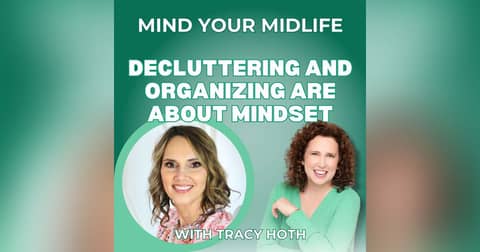
Does the word "organization" strike fear into your heart? If you have spent decades calling yourself a "piler," a "messy person," or someone who just "cannot handle paper," it is no wonder your house reflects that reality. In this episode of Mind Your Midlife, certified life and organizing coach Tracy Hoth joins me to explain why decluttering isn't just about buying cute bins at Target—it is entirely about your mindset. We dive into why we unconsciously use clutter to protect ourselves from d...



Does the word "organization" strike fear into your heart? If you have spent decades calling yourself a "piler," a "messy person," or someone who just "cannot handle paper," it is no wonder your house reflects that reality.
In this episode of Mind Your Midlife, certified life and organizing coach Tracy Hoth joins me to explain why decluttering isn't just about buying cute bins at Target—it is entirely about your mindset. We dive into why we unconsciously use clutter to protect ourselves from difficult emotions (like the guilt of cleaning out a parent's house) and how to rewrite your identity so that getting organized actually feels easy.
If you are tired of staring at the junk drawer or drowning in mail, and you want a simple, step-by-step system to finally create space in your life, this episode is for you.
What You’ll Learn:
✔ The Identity Trap: Why you can never out-perform or out-organize your own identity, and how to borrow confidence from the areas of your life where you are organized (like your career or planning vacations)
✔ The "Opt-Out" Secret: The website you need to visit today to drastically reduce the amount of junk mail, credit card offers, and donation requests flooding your house
✔ The Psychology of Clutter: How to ask yourself, "How is this clutter protecting me?" to uncover the hidden fears or unresolved grief keeping you stuck
✔ The S.P.A.C.E. Method: Tracy's brilliant 5-step system for a 15-minute declutter challenge, including why you must always sort like-items together before making a single decision
Take Action Today:
- Stop the Mail: Visit optoutprescreen.com to stop receiving credit card and insurance offers in the mail.
- Grab the Free Challenge: Go to simplysquaredaway.com/declutter to download Tracy's free 15-Minute Declutter Challenge.
- Connect with Tracy on Instagram at @tracyhoth, on the web at simplysquaredaway.com, and grab the free declutter training at simplysquaredaway.com/training.
- Take the Quiz: Are you smack dab in menopause or just in the mayhem of midlife? Take the fun quiz at cherylpfischer.com/menopausequiz.
Take a little bit better care of yourself in midlife.
*Start your day with Energy Fizz and GreenSynergy Elixir: cherylpfischer.com/recommendations (and use the code ARBONNE10)
🌸 Liked this episode? Share it with fellow Gen X women navigating hormone balance, an empty nest, and/or self-confidence!
🫶 Love this show? Leave a review to help more women over 50 find us.
💡Want menopause advice, mindset shifts, or support with midlife transformation?
- Book a free Mindset Coaching / Intro Call: cherylpfischer.com/coaching
Let’s talk health after 50, self-talk, and redefining aging for women — without the “midlife crisis” narrative. Every week I'm adding new success strategies for midlife women.
Connect with Cheryl, Midlife Coach: Instagram | LinkedIn | Website
00:00 - Organization Anxiety And Curiosity
01:29 - Why Midlife Creates More Stuff
03:51 - Identity Shapes Your Home Systems
05:48 - Paper Clutter And Mail Reduction
09:52 - Parents’ Things And Emotional Weight
17:19 - Make Organizing A Finite Project
19:09 - The SPACE Method Step By Step
23:43 - Build A Purposeful Handy Drawer
29:30 - Build Evidence For Your New Identity
32:29 - Final Mindset Reset And Next Steps
Organization Anxiety And Curiosity
Cheryl FischerOrganization. Does that word kind of strike fear into your heart? Or are you kind of energized? Yes, I want to organize something. Yes, absolutely. We really fall into one of those two camps typically. And interestingly, if I compare me versus my sister, I like the outside to be organized, but the inside, meaning inside the drawers, inside the cabinets, I don't care. She cares about the inside even more than necessarily the outside. Although, of course, she likes that to be organized too. But we have a different focus. So where does that come from? And how can we maybe make it easier if right now it feels overwhelming to deal with our stuff or our parents' stuff or the paper? Let's talk about it. Welcome to Mind Your Midlife, your go-to resource for confidence and success, one thought at a time. Unlike most advice out there, we believe that simply telling you to believe in yourself or change your habits isn't enough to wake up excited about life or feel truly confident in your body. Each week, you'll gain actionable strategies and, oh my goodness, powerful insights to stop feeling stuck and start loving your midlife. This is the Mind Your Midlife podcast. So when we're in midlife, it's possible that more stuff is coming in than is going out. It may be you have kids, and maybe those kids are gradually going out on their own. Maybe that feels like you have a bit more space and less stuff. And then you're getting stuff from your parents. If unfortunately they may have passed away, they may have left a house that you need to clean out, or they may be here, but they may be wanting to get rid of their stuff, or they're going to an assisted living and you're dealing with their stuff. So it feels almost like even more is coming in. And that can be overwhelming. So if you're anything like me, for my entire life, I've been thinking about how I can stay neat and organized, how can I declutter, but I don't always follow through. I don't always actually do it. I've got junk drawers in multiple rooms. I never quite know how to get my hand on a paper that I need. And I don't know why I don't follow through. So today's guest is going to help us figure that out. And we're going to talk about it from a mindset perspective because, as you know, everything, everything comes from what we believe about ourselves and what our mindset is about that task or that challenge. So Tracy Hoth is a certified life and organizing coach who helps women simplify their homes, their lives, and even their businesses through practical systems and mindset shifts. And she says it's so we can focus on what matters most. Love that. She's also the host of the top 1% globally ranked organized coach podcast. And she's all about empowering women to declutter with confidence and create systems that last. I am really excited for you to hear the tips Tracy's going to share with us. So welcome, Tracy. Thanks for joining me.
Tracy HothThanks, Cheryl. I'm so excited to be here. Talk about organization.
Cheryl FischerI am too. I feel like this is a topic that we all know that we need, but we don't necessarily want to do it or know how to do it. So let's make it easier.
Tracy HothExactly.
Cheryl FischerOkay, so let's start with this because you help people declutter and get organized in their home, in their business, kind of in all different ways. And you have said that we can't outperform. And I'm thinking maybe that means out-organize as well, our identity. So what do you mean by that?
Paper Clutter And Mail Reduction
Tracy HothOh, I love this question. If we think that we're disorganized, messy, you know, a piler, sentimental, all these things, we will continue to create the space around us that shows that that's true. We cannot be better than what we think we are, if that's our identity. And so when I work with people, I'm like, so tell me why you're not organized. And they'll say, like, I've always been messy, I've always been a piler, I'm really sentimental. It's hard for me to make decisions. And so until we decide that something different is true about us, we won't be able to create what we think is true about us. And so a great example is one of my clients recently. She realized that the point where she's deciding where things are gonna live. So she can sort, she can make decisions on things, but then she has to decide where they're gonna live. And she always got stuck here. She didn't know where the perfect spot for it to live was. And so she was always stuck. And now she's realized she's an excellent decision maker. And she's just testing it. So she says, maybe this will be the permanent home, but she can believe that she's an excellent decision maker because we looked into her past. She's a physician. She went through, you know, medical school, she made tons of decisions. She makes decisions about her clients. She's actually a great decision maker. She just never brought that identity with her into organizing. And it's changed everything for her.
Cheryl FischerHmm. Interesting. Interesting. Well, let me give you an example because my husband and I always say to each other that we're pretty organized, but we can't handle paper. I'm wondering what this means. Not that you can necessarily know that right off the top of your head. But the house is pretty organized, and yet we can pay the paper, the files. I can hard, it's really hard to put my finger on the document I need. It's always all over the place. I don't know what my issue is with paper, but maybe there's just something kind of mindset-wise, is what you're saying.
Tracy HothOne of my one of my clients used to say, paper is my nemesis. And I'm like, well, as long as you think about it like that. Now, I I do think also that we we're where we're at right now, and we might have a goal of where we want to be. And the thing that's keeping us from getting there is either a skill gap or a mindset gap. So there's something missing. So it could, or a combination of both. So it might be just that you don't have the foundation. You don't really know what to do to help you, or maybe you have too much paper coming in because I'll go into someone's house. I remember specifically with purses, some woman loved purses, and I don't go into houses anymore, but I remember being in there thinking, I don't even know how to handle all of these purses. There are just too many to fit in the space that she had. So paper could be the same way. There's really great ways to reduce the amount of paper coming in and stop printing stuff and stop receiving statements for things. And if you only had 10 things coming in a week, you would easily be able to handle them. Yeah. Right? Yes. Maybe. Yes. Yeah.
Cheryl FischerLike I'm affirming it. Yes. Yes. Your new identity. I can handle paper. The online, the switching to more online has helped for sure. I mean, I can think back 20 years and it was way worse for sure. Yes. But as you say that, I'm realizing I'm actually taking care of my mom's paperwork and all sorts of stuff. So maybe that's it.
Tracy HothMaybe I'm like, Yes, you have more coming in than you're used to. And if you set up a container, like a portable file box, I love that when someone's handling their parents' things, that you have a spot for the paper for her that comes in that's portable. So if you need to move it around or whatever, that's helpful. In reducing the paper that we have, I like optoutprescreen.com. People can check that out. And it you put in your information and you don't get any credit card or credit offers or insurance offers or something. It it'll cut your mail almost out. I've been doing that for 10 years. You do it every five years. You submit your information in there. And I hardly get any mail. And so it's great. Oh my gosh, that's amazing. Yeah. And you do have to put your um social in, which some people get a little freaked out about, but I've done it twice already. And it just cuts your mail down so much. Another one people get tripped up on or get a lot of extra mail is when they give to a donation place and then 400 other donation things come in regularly.
Cheryl FischerYeah.
Tracy HothSo I always say choose where you want to donate money to and give to and decide that without doing the forms. But you know, there's some people who love, like I have a client who just wants to give. She has such a compassionate heart. And when someone sends her something, she wants to go through it and give. Just know that's gonna take more time and you're gonna have more paper because of that, which is fine if that's what you want.
Cheryl FischerYeah, good point. Good point. Because they all, I guess, share lists with each other and who knows how it happens, but it happens.
Tracy HothAnd then you get the little notepads and the little return address labels. Yeah, exactly right.
Parents’ Things And Emotional Weight
Cheryl FischerAnd then you feel bad to get rid of those. Oh my goodness. Ugh. Okay, well, let's stay on this kind of parent-related issue for a second because it could be paper, but it also could be clutter and just stuff that I think can be sort of an emotional weight. You know, you're cleaning out your parents' house or they're passing things down that you really aren't sure that you want, but you feel bad to get rid of it. There's a lot of emotion there. So, or maybe it's our own clutter that we just don't know how to get rid of. So do you think we sometimes self-sabotage ourselves in that way, just holding on to all this clutter?
Tracy HothYeah, I think, well, first let's go back and just define organized means that you know what you have and you can find it when you need it. That's how I think about organized. So a lot of times when I say that, people are like, oh, that feels better. I feel like I'm more organized than I thought I was, because I my home doesn't look like one of the pictures or photos on Instagram or Pinterest, but I can find what I need. I know where things are. Most of my things have homes. So that's a good place to start. And then clutter, I think of is delayed decisions. So you have stuff that you either haven't decided where it's gonna go, if you're gonna keep it, it's kind of laying around. You haven't decided those things, or you haven't put it away. So then it's clutter. I think of it more like a protection, and maybe that's what people think of when they hear the word self-sabotage, but it's more of you, your brain is protecting you. And so when you think about it, like what's gonna happen if you make a decision to let go of something, it's protecting you from what might happen. So one of my clients has been beating herself up for the last 20 years because she got rid of some journals. And I have that episode. She gave me permission to share that on my podcast, but she was beating herself up for getting rid of these journals. And when she realized now that's why it's so hard for her to make decisions, because her brain's protecting her from getting beat up more, self-criticized more if she decides to get rid of something. We might be protecting ourselves from emotions that we will feel, maybe, especially with parents' things. Maybe we have unresolved relationships or we feel guilt or we're very loyal. So we feel disloyal if we let something that was special to them go. So we're not dealing with it or having we're having that clutter because we're protecting ourselves from these different emotions.
Cheryl FischerYeah. And I I think you sort of interpret the self-sabotage term in the way I was thinking it, meaning we'd love to feel organized and have a neat house, but we kind of mess ourselves up for some sort of protective mechanism.
Tracy HothYeah. Right. Yes. And if people just think that, oh, it's just that they have to make some decisions and deal with it and get going on it. But really, when your body is feeling all that, what might happen, what could happen, feeling facing all those emotions and the just the discomfort of making decisions and letting things go, all of that plays into it. That's why it's so fun to work with someone and see all the these things come up and see them handle them, learn how to deal with that, feel those emotions and that discomfort. And it totally then flows into the other areas of their life. It flows into, you know, goals that they have and dreams they have in other areas and how they've been honing this skill of feeling their emotions and and handling that, that they then can do other things they wanted to do that they were stuck on, also. Interesting. Because we start to trust ourselves a little bit, maybe.
Cheryl FischerYeah. Interesting. Yeah. Well, this is mind your midlife mindset is behind everything. I say that all the time. So here we are again. It's believing that you are a person who can make decisions or who can be organized or who can find what they need, or you know, there's all sorts of things we could say about that. But yeah, yeah, that makes sense.
Make Organizing A Finite Project
Tracy HothYeah. And one of the questions you can ask to see if this is what's happening with you as a listener is just how is this clutter helping me right now? What is it doing? What is it protecting me from? And it could be as simple as like, my dining room's a mess because if I have that cleared off, I could host, you know, some friends over, and that's scary, and I don't think I'm a good cook. Like it could be simple things like that. But just asking, how is this serving me right now and or helping me right now and being open to what comes up and just allowing those things to come up and think about them for a while and see, huh? Yeah, that is scary. And and affirm yourself in having those fears or emotions, guilt, maybe shame about how much money or guilt about how much money you spent on something and you're gonna have to face that. Maybe you overspent on a lot of things and you never used it, or the another big one is like this phase of your life or area of your life, especially midlife, is is gone. Like that time is gone, and that brings up a lot of emotions. And maybe you're not sure what's next. And so you're you have all those fears and emotions that come up. So just asking yourself, maybe journaling about it a little bit and seeing how is it protecting me? How has it been? And how is that okay? And what can I do to love myself through feeling those emotions?
Cheryl FischerI think that's a great way to ask it. How is this serving me? How is this protecting me? Because two things that come to mind that people struggle with in midlife when we're ever trying to do like a clean out or an organization are kids' toys, because the kids are out of the house, and parent stuff, like the parents' furniture or the parents' keepsakes, or the pictures. Oh my goodness, the pictures. How could you throw away a picture?
Tracy HothBut you can't keep all the pictures. I know I always tell people take them all out of the frames if you're not using them. At least then they're smaller and they're in a container, like put them in a container. And then just get all pictures in one place. And when you decide, I always think of organizing like a project too. So you have a start and an end date. You're really deciding this is what I'm doing. Not I have the whole house to do. It's no, this and that's why in my program we do one area a month. So this month is our bedroom. This is the month. I'm only focusing on my bedroom, and I'm gonna go all in and plan it out, and then we're gonna get the bedroom done. Interesting.
Cheryl FischerYeah, and then it doesn't feel quite so daunting.
The SPACE Method Step By Step
Tracy HothYes, because that's what keeps people stuck. They're sitting there looking around. Oh my gosh, I have so much. And then they start something and then they jump to something else because they think that's more urgent, but they never finish that. And then they jump, and then they're like, it all just goes back to how it used to be. And I'm like, yes, we need a project with a start and an end date with specific goals. So you see, this is what I did. I got that done. I finished it. I'm a finisher. I I make decisions, I finish this, and then putting little implement things in place. Like, I'm gonna tidy this up. Every time I do laundry, I'm just gonna tidy up my shirt drawer or my sock drawer or the closet. And tying that to doing laundry helps you, or like maybe you have cleaners. Every time the cleaners come, I'm going to not just throw things in a closet in a bag. I'm going to tidy them up. Maybe that's too much to do at one time. So tie it to something you already do.
Cheryl FischerOkay, so you've given some tips already for sure, doing kind of project by project and asking yourself, how is this kind of serving or protecting me? Do you have any other tips that might be helpful for someone who's listening who's feeling a bit stuck on getting organized?
Tracy HothYes. Well, I have a 15-minute declutter challenge. So to kind of walk through that, they can get that for free. It has a little printout they can get, but to know the organizing steps. And my organizing steps spell the word space because we are making space in our life. And knowing the steps and following the steps are going to help you get organized. So pick some small area, a drawer, maybe your nightstand, something small, your car or purse, and go through the steps. And so the first step is to sort. We always sort first. And someone said, Tracy, I'm trying to sort, like keep, donate, sell. And I said, no, no, no. Sorting sorting is not making decisions. Sorting is putting all paper in one pile, all office supplies, all books in a pile, all jeans in a pile, sorting like items with like items.
Cheryl FischerOkay.
Tracy HothNow you have the items that are together. And the reason is this is a fun story. I was helping someone organize their closet, their storage closet, a couple, and they had ended up after we sorted five humidifiers. Neither one of them had any idea they had five. And if I would have just brought one out to try to make a decision, they would have said, of course, keep that. That's our humidifier. But when they saw all five, they're like, where in the world did we get these? So once you have everything like with like, you can then make decisions. And that's the purge stage. So short sort and then purge. Now I always say keep your favorites, go with your favorites first, and then make decisions on the rest of it by asking, you know, all the questions you could ask. And then once you know what you're keeping, you assign homes. So you decide where is this home, where is this item, category of items gonna live. And then the fourth step is contain. Now, most people go out first and they're at Target and they see, oh, these containers are so cute, or this new planner is so beautiful. I need a new planner. It's gonna help me get organized. Do not buy anything until you get to the contain stage. And then you might need a piece of furniture or a drawer divider, shelf divider, or a bin, a basket. You then contain, and then the last step is energize. You now have energy. And I really tell people celebrate, over-celebrate when you finish. Your 15 minutes, over celebrate that you did this. You're gonna feel that energy. You're gonna use that in other areas of your life because you're not always having to organize now and energize, but to keep that energy up, that's the maintenance step as well. So you're gonna tie maintaining that to something that you already do. I love it. I love it.
Cheryl FischerAnd such a great point about the keep, donate, sell thing. We're trying to make these decisions without maybe even really knowing what we're deciding about, kind of right.
Build A Purposeful Handy Drawer
Tracy HothAnd I always think uh this one lady I helped her organize her closet. And so if I would have pulled out her short sleeve white shirt, she would have said, yes, Tracy, that's one of my staple items that I wear all the time. And after we sorted, she had 19 short sleeve white shirts. And she was like, Oh no! Like she had no idea she had that many. And then it's easy to go through, make sure you pick your favorite, the one that's newest or the brand you like, the one that doesn't have stains. And she said, I don't remember the number, but she's like, I think I can live with this many white t shirts, you know. So it's very easy to do it. And if you're doing your closet, I tell people for the 15 minute challenge, just pull out all your pants and just go through your pants. Just pull out, you know, a certain category and go through those. Maybe that's even like. Pens, gather all the pens and writing utensils from all over the house. And then decide. Go through them and then one place. You store them in one place as much as possible. The wonderful one is a tool that's very or a concept that's very helpful to people. Yeah, I like that. I think I might need to do that with scissors in my house. Yes. And I do. Like I we have one drawer we keep scissors in in the kitchen, but then my office is upstairs. So I do have uh scissors in the office. So, you know, there's two places, but we know if we need to find scissors, we know where they are on the main level. Right.
Cheryl FischerI can see that being important. Now, my challenge also is that I tend to collect just stuff in a drawer. The classic junk drawer. Yeah. And I have a couple of junk drawers in my dresser. Well, one and a half, let's say. My desk is a couple of junk drawers. I have some in the kitchen. So what is the same principle what I should do to clean those out?
Tracy HothAbsolutely. And on this training that I do, I do a free training weekly or every other week. So people can join that. But that's what I do. I show an example of me going through the space steps in my neighbor's junk drawer. So I brought her stuff over. I called her up and got that. So I show an example of that, but it's the perfect example to do or great idea to do for a 15-minute declutter. And yep, you sort and then you purge, and then you decide what is this drawer's purpose? What am I using this drawer for? And then you contain, use things you already have. I forgot to say, shop your house first. You probably have an iPhone box or you know, a check. It used to be check boxes, you know, from checks, but we don't hardly have those anymore. But any kind of container that you might already have laying around, you can use that in the drawer. And if everything has a home, we're either throwing things in the drawer because we're moving fast before someone comes, or and notice this when you're doing it. Is things in here because they don't have homes? So maybe there is a reason why there's things in there and you need to decide where is the home for, you know, paper clips or whatever. Because then you know, like our junk drawer isn't super beautiful like you would see, but it has purposes. It has little tools, it has a place for the tape measure, it has a place for the light remote for our back deck. And so it has purpose in there. And one of my clients said, or when I was doing this training, she was like, I don't like a junk drawer. I don't want to have junk. I want a handy drawer. So she called it her handy drawer, but and think this is prime real estate that we're using to just throw things in. True. One of the one of my clients, her desk drawer, her top desk drawer was just full of junk. So when she went through that doing the 15-minute declutter, now she could have purpose. Like actually, the things she needed that were piled all over her desk, she could fit into the drawer and use the drawer because that's such great real estate.
Cheryl FischerYeah, so true. So true. And then I guess that brings us back to your point from the beginning that it's also about believing that we're someone who can have organized drawers and it's easy. It's not too hard. And, you know, all of those pieces as well.
Tracy HothYes. And I always try to go back to your past. We often look to our past and think that's a reason why we can't do it. But look at it in another area. Like, you know, maybe with your calendar, you're more organized. Or maybe when you were in school, you kept your things organized. And maybe if I'm just imagining someone sitting there going, nope, nope, not with that, not with that. But one of my clients was like, Tracy, I can plan meticulous vacations down to the detail. She loved planning it. Or when she went to the office, she kept her office neat. So there are so many examples of what you can pull from the past, could be, like I said, decision making, or maybe they love when they go to an Airbnb. And it's so minimal and tidy. And maybe you're someone who likes to be able to find things when you need them. And so you are someone then who makes things neat. My sister decided she always was going to make her bed when she got married. Her and her husband decided that. And so their bed's always made, but she has piles all over the room. And then later I was like, Chris, why don't you decide that you don't pile things in your room? Because she has evidence that she just decided they were going to make their bed, and they do it because they are someone who makes their bed.
Cheryl FischerThat's a great example for me, and I'm sure for someone listening, because my husband and I do make our bed every day as well. I can't stand going into a bedroom where the bed is not made. It just makes me feel immediately sloppy. And we do it every day without exception. We don't even think about it. So great example. There's other things we could decide like that and just do them.
Build Evidence For Your New Identity
Tracy HothI don't, I'm someone who doesn't throw things in drawers because it's sloppy and it makes me feel, ooh. And now all of a sudden your drawers are gonna be so neat because you're the same as with making your bed. I love it. I'm gonna try it. Yeah, you love it's going, but where are those things gonna go? Right. And that's what you'll find. You will learn that as you sort everything out and see what categories they are. And then you decide. One of the things that comes up with a lot of people in this step is they think, well, that doesn't have a home. And I'm like, yes, we're gonna decide where the home is gonna be. And it might be an area that's not organized yet. Totally fine. Put it there as close to possible as you can get it. And when you get to that spot, you can organize it. But you are organized because you know where it is and you can find it. It's just maybe not as neat as you want it to be. It doesn't have, it doesn't fit in the space yet, but you'll get to that. So think where would I look to find this item? And that could be where the new home will be. I love it.
Cheryl FischerI love it.
Tracy HothOkay.
Cheryl FischerSo if you're listening, save this episode, listen to it again. There's a lot of tips mixed in there. Oh my goodness. We're all gonna be able to find everything.
Tracy HothYes. Yeah, let me know. Let me know what your challenges are too, so I can speak on that as well.
Cheryl FischerYeah. And I was gonna say, tell us how can people find you online or find out about what you offer?
Tracy HothYeah. So go get the 15-minute declutter challenge. My business name is simply squared away.com and then forward slash declutter for the declutter challenge and forward slash training for the free training that I offer. And then I'm also the organized coach podcast. So you can learn lots on the podcast.
Cheryl FischerPerfect. And I will have all that in the show notes and I probably will participate in some of that too. Yes. Okay, so I always say towards the end of an episode that, you know, I think most of us are listening while we're doing something else. We're doing the laundry, we're driving, whatever. And it's hard to remember everything. And there's been a lot in here. What is the one thing that somebody who's listening right now really needs to make sure they remember from what we've been talking about?
Final Mindset Reset And Next Steps
Tracy HothThere is somewhere in your life where you are organized, where you have those qualities. So think about what that is and consider and start playing with the identity of you being organized, of you being a great decision maker, of you being very tidy and you love tidy. You're just someone who relishes that. I am now thinking in my mind, as I'm going through areas of my house, I'm thinking, I want to feel elevated and spoiled when I keep something. So now I ask myself, does this item make me feel elevated and spoiled in my home? So think about that and your identity and just consider it and then start trying to find some evidence that there is proof that it's true. You just haven't thought about it in the organization realm.
Cheryl FischerI love that because I'm often saying to people, you know, we've lived 40, 50, 60 years and we've done a pretty darn good job at that. So there must be somewhere in life that we've had success or been organized or known exactly how to make a decision. I love it.
Tracy HothRight. I think of someone that sends birthday cards on time. My stepmom is amazing at sending birthday cards. So there's an example. She's super organized when it comes to birthday cards and caring for other people. So, or maybe a volunteer job you have. So fun to find that evidence. And then you'll your brain will be like, wow, I am that person. I am. And that's when it's going to come out. It's going to overflow into your spaces.
Cheryl FischerWell, Tracy, thank you so much for joining me. I know this is going to be really insightful for a lot of people.
Tracy HothOh, I'm so glad to be here. Thanks for having me, Cheryl. What a fun conversation.
Cheryl FischerWhat a conversation full of powerful tips that you can go and do right now. We put oftentimes so much artificial stress and pressure on ourselves. And by artificial, I mean we created it ourselves. No one came in and said that junk drawer is ridiculous, or your house is a mess, or why can't you find that paper to do your taxes? We are the ones telling ourselves, you have too much junk. I can't believe you can't handle this. Blah, blah, blah, blah, blah. All the self-talk that gets out of control. So this episode is reminding you that you can do it. I love what Tracy said. There is an area of your life where you are organized and you do get things done and you do make decisions. Learn how to believe that that can apply to so many other parts of life and you're on the right track. Absolutely fantastic advice. And then just for fun, head over to my menopause quiz and see if you're smacked up in menopause or maybe just in a little bit of a mayhem section of midlife. And you can find that at Cherylpfischer.com/ menopause quiz. You'll get a little laugh out of it as well. And we all need that. And if you're listening on Apple, scroll down on Mind Your Midlife's page, tap the five stars, and take just a minute and leave a review, even if it's a couple sentences. If you enjoyed this episode or a recent episode, let them know. Put a few sentences in a review. It tells Apple to share this podcast with more people, and that is going to help more people. So I appreciate that. Thank you. And keep remembering, midlife is your time to take just a little bit better care of yourself on the outside, like we've been talking about today, and on the inside, inside your head. Just a little bit more care makes a big difference.